Choose a washing machine that can fit a typical sorted cotton wash with the tablecloth, and check that the care label allows the programme you select. A front-loading machine could be suitable if you have enough space; a top-loader may be more practical in a narrow laundry area. If you wash regularly, factor in energy and water consumption too. Only choose a washer-dryer if you need to dry clothes by machine and its smaller drying capacity will suit you.
Who is this buying guide for?
Housemates sharing cotton washes
You want your usual shared load, including tablecloths, to fit in the drum without regularly choosing a machine that is too large. The Consumentenbond recommends sorting and weighing a typical load to work out the capacity you need.
Students with limited laundry space
You need to fit the machine, its connections and the space required to open it into a small bathroom or storage room. The Consumentenbond describes top-loaders as narrower than front-loaders, so measure the space available before choosing a model.
Housemates who do laundry often
If you wash regularly, you’ll want to consider energy and water consumption, as well as noise and washing performance. Milieu Centraal recommends taking the energy label into account when choosing a machine.
What should you look for when buying?
Start by considering your usual sorted load and the space available, then compare programmes and consumption. The Consumentenbond points out that the stated capacity applies to cotton.
| What to consider |
What to look for |
Who should pay particular attention? |
| Cleaning performance |
Check the care label, cotton programme and temperature setting. |
If I want to tackle food stains on tablecloths, I’ll need to match the programme and pre-treatment to the care label and the level of soiling. Around 29% of consumers say cleaning performance is their top priority when buying. |
| Suitable capacity |
Weigh a typical sorted load and check the drum space and door opening. |
When sharing laundry, I want the tablecloth to fit alongside the rest of our usual cotton load, without choosing an unnecessarily large drum. Around 23% of consumers put suitable capacity for shared laundry first. |
| Positioning |
Measure the width, height, depth and opening space; check the connection point too. |
If the bathroom or storage room is short on space, I’ll want to know whether I can still access the door or top and connect the machine safely. Positioning is the main buying concern for around 18% of consumers. |
| Consumption |
Compare the energy label and the stated energy and water consumption. |
If housemates wash often, I’ll want to take ongoing running costs into account alongside the purchase price. Around 18% of consumers put these costs at the top of their list. |
| Noise |
Check the stated spin noise level and make sure the floor is flat and stable. |
If the machine is close to a living or sleeping area, I’ll want to know how noisy it may be during the spin cycle and whether the setup will prevent vibrations. Noise is the top buying priority for around 12% of consumers. |
Avoiding common buying mistakes
-
Looking only at the maximum capacity
The stated capacity applies to cotton, but a large drum isn’t automatically convenient for your usual laundry. The size of the door opening and the space needed to open the machine matter too.
Weigh a typical sorted load and measure both the available space and the clearance needed to open the machine.
-
Assuming Eco 40-60 will clean every stained tablecloth
According to the Consumentenbond, Eco 40-60 is designed for normally soiled cotton that the care label says can be washed at 40 or 60 °C. The Consumentenbond also notes that programmes differ in how well they clean and rinse.
Follow the care label and choose the programme, pre-treatment and detergent to suit the level of soiling.
-
Judging a washer-dryer by its washing capacity alone
LG lists the LG W4X1085NWB as having an 8 kg washing capacity and a 5 kg drying capacity. The drying load may therefore be smaller than the washing load.
Compare the two capacities separately and check whether the care label says the tablecloth can go in the tumble dryer.
If the washed load is larger than the drying capacity, you may need to dry it in several loads.
-
Assuming delivery means the machine is ready to use
A washing machine must be connected in the right place and according to the model-specific instructions before you use it.
Check in advance what delivery includes and who will install the machine. Bosch specifies, among other things, an earthed socket and the removal of transit bolts before use.
Brands to compare
These models illustrate different considerations around capacity, positioning and drying. A brand name alone doesn’t tell you whether a model will suit your needs.
Beko
The BM3WFT3841W is an 8 kg front-loader to compare if you have room for a front-loading machine.
- Beko lists an A energy label, a depth of 54.6 cm and a spin noise level of 76 dBA for this model.
- Beko’s EnergySpin claim applies, according to the brand, in comparison with a specific model. It doesn’t indicate how every tablecloth will be washed.
Inventum
The VWM8010B is an 8 kg front-loader you can compare for capacity and stated noise level.
- Inventum lists 14 programmes and 72 dB for this model.
- Check that the programme you choose is allowed by the care label for each tablecloth.
Bosch
The WAN2809XNL is an 8 kg front-loader to compare if overall dimensions and water protection are important to you.
- Bosch lists dimensions of 845 × 598 × 590 mm and AquaStop for this model.
- Measure the recess carefully: these dimensions don’t automatically mean the model will fit in a shallow space.
Whirlpool
The TDLRBX 6252BS BE is a top-loader to compare if the width of your laundry area is a deciding factor.
- The Consumentenbond describes this model as a top-loader with a capacity of 6 kg and a maximum spin speed of 1200 rpm.
- Consider its smaller capacity against your usual shared load and check that you can access the top of the machine.
LG
The W4X1085NWB is a washer-dryer to consider if you need to dry clothes by machine in the same space.
- LG lists an 8 kg washing capacity and a 5 kg drying capacity.
- The stated drying capacity is lower than the washing capacity; a washer-dryer isn’t automatically more energy-efficient than separate appliances.
Washing machines for shared cotton loads
These front-loaders are options to compare for shared cotton loads. Weigh your usual load, measure the space available and check that the care label allows the programme you choose.
 No image available
Midea MF110W80BA10/W-NL, 8 kg
An option to compare for shared cotton loads; check that the drum suits your usual sorted load.
Capacity: 8 kg. Cotton programme. 16 wash programmes. Spin noise level: 72 dB. Dimensions: 850 × 595 × 475 mm.
Joybuy
 No image available
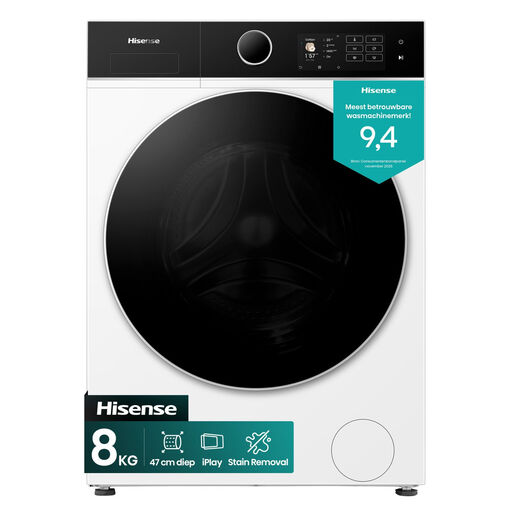
Hisense WF5I8043BWF, 8 kg
An option to compare if you share laundry and need to consider the depth of the space available.
Capacity: 8 kg. Spin speed: 1400 rpm. 18 programmes. Depth: 47 cm. The product name mentions an inverter motor.
Joybuy
 No image available
Candy GD 48B9-S, 8 kg
An option to compare if you want to consider capacity, stated noise level and energy consumption together.
Capacity: 8 kg. A energy label. 33 kWh per 100 Eco 40-60 cycles. Spin noise level: 69 dB. Spin speed: 1351 rpm. Depth: 601 mm.
Joybuy
 No image available
Comfee' CFP01EW70W-JD, 7 kg
An option to compare for shared laundry if space is limited in depth.
Capacity: 7 kg. Cotton programme. 16 wash programmes. A energy label. Depth: 400 mm.
Joybuy
 No image available
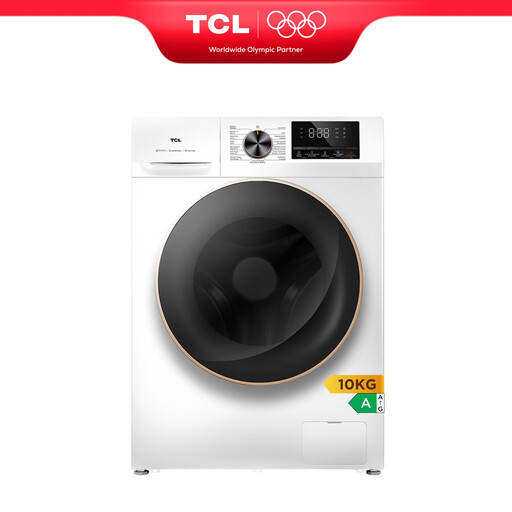
TCL FP1210WA0, 10 kg
An option to compare if your usual shared cotton load is large; check that the capacity suits your washing routine.
Capacity: 10 kg. A energy label. 15 wash programmes. Spin speed: 1200 rpm. The product name mentions a Smart DD motor.
Joybuy
Frequently asked questions
Can every cotton tablecloth be washed on Eco 40-60?
No. The Consumentenbond describes Eco 40-60 as suitable for normally soiled cotton that the care label says can be washed at 40 or 60 °C. For stubborn stains, check whether a cotton programme and suitable pre-treatment would be a better choice.
What should I check before the first wash?
Check the manual and connection point for the model you’ve chosen. Bosch specifies a stable floor, suitable water supply and drainage, an earthed socket and the removal of transit bolts before use. Once connected, check for leaks too.
How do you keep a washing machine clean when it’s shared?
Use the right amount of detergent and follow the manufacturer’s care instructions. Milieu Centraal recommends running a 60 °C wash regularly, about once a month, to help prevent residue and unpleasant smells.
Is a manufacturer’s guarantee the same as the statutory guarantee in the Netherlands?
No. According to the Rijksoverheid, there is no fixed statutory guarantee period in the Netherlands: you’re entitled to a product that works properly, and should contact the retailer if something goes wrong. A manufacturer’s guarantee is additional and may offer less cover, for example if it only covers the motor.
Do I have a cooling-off period when buying online?
For a standard online purchase as a consumer, ACM ConsuWijzer says you’ll usually have a statutory cooling-off period of up to 14 days after delivery, with some exceptions. Check the terms for delivery, installation and returns in advance too; these arrangements don’t replace your statutory rights.


