
If you wash mixed cotton loads
You want to wash socks with other suitable laundry and are looking for a drum size that suits your usual washing. The Consumers’ Association explains that the stated load capacity refers to cotton laundry.


You don’t need a larger or specialist washing machine just for a pile of cotton socks when the seasons change. Choose the drum capacity based on the cotton laundry you normally wash together. A larger drum makes sense mainly if you regularly wash bigger loads at other times too. Also check the care labels, suitable programmes, energy label and available space.
You want to wash socks with other suitable laundry and are looking for a drum size that suits your usual washing. The Consumers’ Association explains that the stated load capacity refers to cotton laundry.
You need to work around a narrow space or a tight access route and want to know whether a top-loading machine will fit. The Consumers’ Association describes top-loaders as narrower than front-loaders; remember to measure the space above the lid too.
You regularly wash larger quantities of cotton laundry and want to weigh up drum capacity against your usual needs and energy use. Milieu Centraal advises against choosing a washing machine that is bigger than you need.
First, assess the machine against your usual cotton wash. Then look at the programmes, energy use and the space where the appliance will go.
| What to consider | What should you look for? | Who should pay closer attention? |
|---|---|---|
| Suitable load capacity | Weigh a typical, sorted cotton load and compare it with the stated capacity; check the drum opening too. | If I usually wash socks with other cotton laundry, I want a drum that suits my usual load. Around 36% of consumers put suitable load capacity first. |
| Wash programme and care | Check the cotton programmes, temperature settings and any rinse options; follow the care labels on every item in the load. | When I wash socks with other textiles, I want to choose a programme that suits all the care labels. Around 29% of consumers give suitable fabric care top priority. |
| Energy use with small loads | Compare the energy label and consumption figures on the same programme basis; consider whether you usually wash socks with other suitable laundry. | If I want to reduce my regular energy and water use, I look at my usual washing habits rather than just one programme. Around 21% of consumers put energy use first. |
| Installation space | Measure the space for the machine, room for connections and the delivery route; for a top-loader, check there is enough clearance above the lid too. | If the access route or installation space is tight, I want to know in advance whether the machine will fit and can be opened. Around 14% of consumers give installation space top priority. |
A large drum won’t automatically use less energy per kilo with small loads. The Consumers’ Association notes that automatic load detection does not adjust consumption precisely for a smaller load.
Base the capacity on a typical cotton wash, and treat a temporary seasonal increase as a separate consideration. Weigh a normal, sorted load if you need to.
The fabric composition and care label help determine the right treatment; the other laundry in the drum matters too.
Check the care labels, then choose a suitable programme. Use a higher temperature only when it’s appropriate for the laundry and washing conditions.
The depth, access route, space for the door or top lid to open, and room for connections all affect whether the machine will be practical to use. The Consumers’ Association advises checking delivery arrangements in advance, as installation may incur extra costs.
Before ordering, check what delivery, connection and any removal service include; costs can vary by seller and service.
Measure the entire route and installation space. If you’re choosing a top-loader, leave enough clearance above the lid too.
A small change to a model number may refer to a different version; a similar name doesn’t confirm that the specifications are the same.
Compare the full model number and relevant specifications before treating products as equivalent.
The Serie 4 WAN2827GNL front-loader is a useful reference, with a stated capacity of 8 kg for a typical cotton wash.
The range includes an 8 kg front-loader from the 6000 ProSense line, as well as the slimline LTR8765AL top-loader, with a capacity of 6 kg.
The F4X5009THB is a front-loader with a stated capacity of 9 kg.
The WEG895 WPS PWash&TDos&Steam is a front-loader with a stated capacity of 9 kg and automatic detergent dosing.
The WW90DG6U85LEU3 is a front-loader with a stated capacity of 9 kg and automatic dosing.
The Joybuy products below have a stated capacity of 8 kg. Compare this with the amount of cotton laundry you usually wash with your socks.
 Image unavailable
The stated capacity of 8 kg gives you a useful benchmark for a typical cotton wash.
The product name lists 8 kg, 1400 rpm and energy class A, as well as ProSense.
 Image unavailable
With a capacity of 8 kg, you can compare this model with the amount of cotton laundry you usually wash together.
The product name lists 8 kg, 1400 rpm, 16 wash programmes and a steam function.
The energy label rating in the product name is A-10%.
 Image unavailable
The stated capacity of 8 kg gives you a concrete benchmark to compare with your usual cotton wash.
The product name lists 8 kg, 1351 rpm, energy class A and a steam function.
 Image unavailable
The stated capacity of 8 kg helps you decide whether this model suits the load you usually wash with your socks.
The product name lists 8 kg, 1400 rpm, EnergySpin, a ProSmart inverter motor and energy class A.
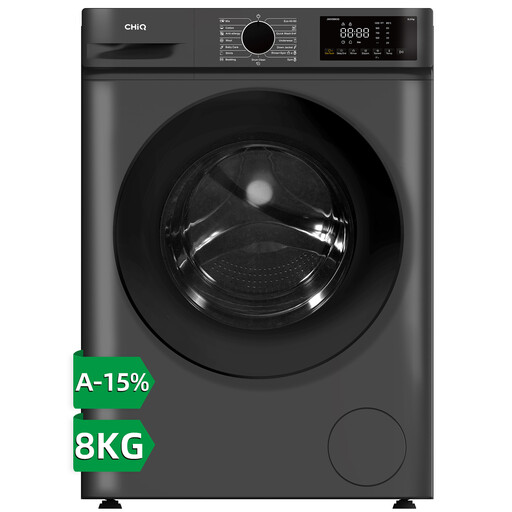 Image unavailable
The stated capacity of 8 kg is a benchmark for your usual cotton wash, not just your seasonal pile of laundry.
The product name lists a front-loader, 8 kg, energy class A-15%, a 530 mm drum, 1400 rpm, 16 programmes and steam.
Check the care label on your socks and the rest of the laundry first. For normally soiled laundry that is suitable for it, Milieu Centraal recommends the eco programme as an energy-efficient option. Don’t automatically treat a specific hygiene concern as a regular eco wash.
You can, but don’t choose a large machine just for one pile of socks. Milieu Centraal and the Consumers’ Association recommend choosing a drum that suits your usual cotton wash; load detection does not adjust consumption precisely in proportion to smaller loads.
Measure the installation space and the entire delivery route, and follow the chosen model’s instructions when connecting it. The Consumers’ Association recommends using a stable surface and removing the transit bolts before use, among other things. Dose detergent as instructed, and clean the drawer, rubber seal and filter regularly.
The energy label provides information about energy and water use; according to the Dutch government, household washing machines must carry an energy label. In the Netherlands, there is no fixed statutory guarantee period of two years: if a product is faulty, the retailer is your point of contact.