What should you look for when buying?
Start with the amount of laundry you usually accumulate. Then look at the programme for your fabrics, consumption figures based on the same label standards and the space the machine will take up.
| What to consider |
What to look for |
Who is this relevant for? |
| A suitable drum capacity |
Weigh a typical dry load and compare it with the machine’s capacity. Don’t choose a larger drum just for socks. |
If I wash socks with my usual cotton load, I want a drum that suits the amount of laundry I actually accumulate. The right capacity is the top priority for around 36% of consumers here. |
| Programmes and washing performance |
Check the cotton and eco 40-60 programmes and follow the care label; don’t make 60 °C a standard requirement. |
For normally soiled socks, I want a suitable cycle, with a different choice if the situation and care label allow it. Programmes and washing performance come first for around 29% of consumers. |
| Energy and water consumption |
Compare the energy rating, kWh per 100 cycles and litres per cycle on the same EU label basis. |
If I do laundry often, I compare the stated consumption figures rather than relying on a programme or energy rating alone. Consumption is the most important consideration for around 21% of consumers. |
| Space and water protection |
Measure the width, depth and door clearance; check which hose, base or overflow protection features each model has. |
If my laundry space is limited or a leak could have serious consequences, I want to check the dimensions and protection features in advance. Space and the risk of leaks are the main considerations for around 14% of consumers. |
Brands to compare
The examples below relate to specific models and product ranges. They are not general assessments of a brand or an indication that every model mentioned is available at all times.
AEG
The 6000 ProSense LF628600 is an example of an 8 kg model with load detection.
- AEG says that ProSense adjusts the time, water and energy consumption to suit the load on this model. The product specifications list 47 kWh per 100 eco cycles and 43 litres per eco cycle.
- These figures apply to the LF628600 and are not an independent comparison or a feature of every AEG washing machine.
Bosch
The Serie 6 WGG244ZONL is an example of a model with a 9 kg capacity and a maximum spin speed of 1400 rpm.
- Bosch lists a reload function and AquaStop for this model.
- These features are specific to this model. Check the version and availability when comparing models.
LG
The F4X1009NWB is a 9 kg model that LG describes as having ThinQ controls and an Allergy Care steam programme.
- You can compare the controls and programme name mentioned with the features you actually want to use.
- LG’s description of these features is a manufacturer statement. Don’t assume a particular result without checking the model’s programme information and conditions.
Miele
The W1 WWA120 WCS 8kg Active is an 8 kg model with CapDosing and AddLoad.
- Miele lists a spin speed of 1400 rpm and the CapDosing and AddLoad features for this model.
- Miele’s statements about fabric care and service life are manufacturer claims, not an independent comparison in this buying guide.
Washing machines at Joybuy
These Joybuy products may suit you if you wash cotton socks with other family laundry. Compare the capacity and stated programme and consumption figures with your usual load.
 Image unavailable
Samsung WW90DG6U25LE, 9 kg, 1400 rpm
The 9 kg capacity may suit you if you want to wash socks with a larger family load; consider whether you’ll make use of that capacity in your usual laundry.
The product information lists a cotton programme, Eco 40-60, AI Wash, SmartThings controls, an A energy rating, 44 kWh per 100 cycles and 50 litres per cycle.
View at Joybuy
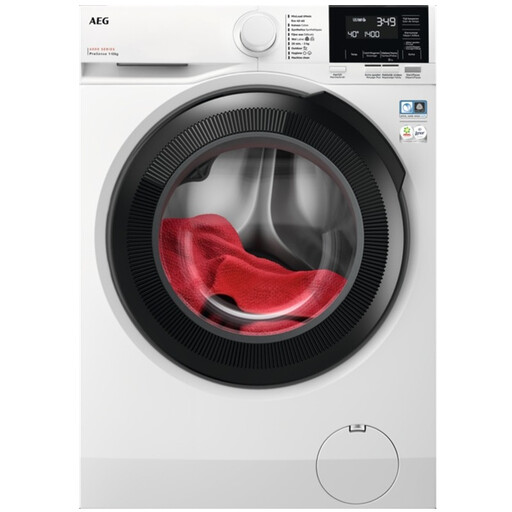 Image unavailable
AEG LR63R144, 10 kg, 1400 rpm
This model is designed for people who regularly wash larger family loads; a 10 kg capacity is most relevant if you can make use of it.
The product information lists ProSense load detection, AquaControl overflow protection, an A energy rating and 51 kWh per 100 Eco 40-60 cycles.
View at Joybuy
 Image unavailable
AEG LR73R862, 8 kg, 1600 rpm
The 8 kg capacity may suit you if you wash socks with a regular family load; compare it with the amount of laundry you usually accumulate.
The product information lists PreciseWash load detection, a MixLoad programme for everyday mixed laundry at 30 °C, an A energy rating, 42 kWh per 100 Eco 40-60 cycles and 42 litres per cycle.
View at Joybuy
 Image unavailable
AEG LR73S840, 8 kg, 1400 rpm
With an 8 kg capacity, this model may suit you if you wash socks with other suitable family laundry and the drum size matches your usual load.
The product information lists ProSense load detection and 47 kWh per 100 Eco 40-60 cycles. Check the care label before choosing a 60 °C programme.
View at Joybuy
Image unavailable
AEG LR73S862, 8 kg, 1600 rpm
The 8 kg capacity may suit socks washed with a regular family load; make sure the capacity you choose matches your usual load.
The product information lists PreciseWash load detection, MixLoad for everyday mixed laundry at 30 °C, 42 kWh per 100 Eco 40-60 cycles and 42 litres per cycle.
View at Joybuy
Frequently asked questions
Do cotton socks always need to be washed at 60 °C?
No, cotton socks don’t always need to be washed at 60 °C. Milieu Centraal recommends the eco programme for normally soiled laundry and notes that washing at 30 °C uses less energy than washing at 40 °C or 60 °C. If you have a specific hygiene need, check whether the care label allows a higher temperature.
What does eco 40-60 mean for cotton socks?
According to the European Commission, eco 40-60 is designed for normally soiled cotton that the care label says can be washed at 40 °C or 60 °C. The programme name doesn’t mean the entire cycle is guaranteed to run at a fixed temperature, so check the socks’ care labels.
What should I check before installation and during maintenance?
Measure the installation space and check the water supply, drain and installation instructions for the model you’ve chosen. The Consumentenbond recommends using the right amount of detergent and leaving the drum and detergent drawer to dry after use, among other maintenance tips. Follow the manual for specific instructions.
Am I automatically entitled to just two years’ legal guarantee in the Netherlands?
No, according to the Dutch government, there is no fixed legal guarantee period in the Netherlands. What you can expect depends, among other things, on the product and how it is normally used. If a product is faulty, the retailer is your first point of contact; a manufacturer’s guarantee or additional cover does not replace your statutory rights.
What information is shown on the EU energy label for washing machines?
According to the European Commission, the energy label for household washing machines has run from A to G since 1 March 2021. It includes information such as energy consumption per 100 cycles, water consumption per cycle and noise levels. The label helps you compare models on the same basis, but it doesn’t mean a household has to choose a machine with an A energy rating.


