
Anyone who wants to do a small wash quickly
You want to wash a small amount of lightly soiled clothing before heading out and find out what the quick programme can actually handle.


First, check the care label on your shorts, then compare the programme duration and permitted load. A quick programme may suit a small load of lightly soiled laundry; for dirtier shorts, a standard cotton programme may be more suitable if the care label allows it. Above all, choose a machine for your household’s regular laundry, taking capacity, installation space and energy consumption into account.
You want to wash a small amount of lightly soiled clothing before heading out and find out what the quick programme can actually handle.
You’re choosing a machine for your regular laundry and weighing up capacity, cleaning performance and energy consumption—not just the wash you need to do before a visit.
You check in advance whether the machine will fit through the access route and can be connected in the space you have in mind.
Start with the care label and how dirty the shorts are. Then compare the quick programmes with the size of your load and your household’s usual laundry.
| What to consider | What should you check? | Who is this most relevant to? |
|---|---|---|
| Getting a small load finished in time | Check the manual for the permitted load and duration of the quick programme. Remember to allow time for drying, too. | I want to be able to wash a small, lightly soiled load before heading out and know what the quick programme can handle. Around 36% of consumers say speed is their top priority for a small load like this. |
| Washing cotton according to the care label | Check whether the model has a cotton programme and a suitable temperature setting; follow the care label on your shorts. | If my main aim is to get my cotton shorts clean without ignoring the care instructions, I take the programme and temperature into account. Around 28% of consumers prioritise cleaning performance and care-label-friendly treatment. |
| Suitable for your household’s usual laundry | Compare the load capacity with the loads you usually wash, and check the energy consumption per 100 Eco 40-60 cycles alongside the energy label rating. | For my usual laundry, I want a capacity that suits my loads and a way to compare energy consumption. Around 27% of consumers say capacity and efficiency for regular laundry are their top priorities. |
| Fitting and connecting the machine | Measure the machine, access route and installation space; also check the connections and the model-specific installation instructions. | I want to know in advance whether the machine will fit in the chosen space and can be connected. Around 9% of consumers prioritise installation space and connections. |
The machine should also suit the laundry your household does regularly. A larger drum isn’t automatically the right choice if you often don’t fill it.
First compare your usual loads and laundry habits; then see which quick programmes fit your schedule.
Programme duration and permitted load vary from one programme to another. The name alone doesn’t tell you whether your shorts will come out clean.
Check the manual and choose a programme based on the care label, how soiled the shorts are and the permitted load.
The energy label for washing machines is based on Eco 40-60 and doesn’t predict the energy consumption of other programmes.
Compare labels on the same basis and check the information for the programmes you use often separately.
The Beko BM3WFT3841B1 is a front-loading washing machine with a cotton programme and a programme called Daily Xpress / Xpress Super Short 14 min.
According to Bosch, the Bosch WAN2827GNL is a freestanding Serie 4 front-loader with a maximum capacity of 8 kg and a spin speed of 1400 rpm.
Miele lists a 9 kg load capacity, automatic dosing and QuickPowerWash for the WEG895 WPS PWash&TDos&Steam.
These washing machines are options to compare for your household’s regular laundry. If a quick programme is specifically mentioned, check the permitted load and the manual before choosing it for your shorts.
 No image available
An option to compare if you’re looking for both a cotton programme and a quick cycle; the quick cycle is described as being for lightly soiled everyday laundry.
Load capacity: 8 kg. Spin speed: 1400 rpm. 16 programmes. The description lists Quick 15' and a cotton programme. Energy rating: A-10%.
 No image available
An option if you want to compare an 8 kg capacity and quick cycles for your usual laundry.
Load capacity: 8 kg. Spin speed: 1351 rpm. Energy rating A. The product information lists eight quick cycles from 14 minutes.
 No image available
An option to compare if you’re looking for both a cotton programme and a quick programme for lightly soiled laundry.
Load capacity: 8 kg. Spin speed: 1400 rpm. 15 programmes. The product information lists Cotton and a 14-minute Daily Xpress programme. Energy rating A.
 No image available
May be worth considering if the stated depth fits your available space; measure the installation area and access route before choosing.
Load capacity: 6 kg. Stated depth: 45 cm. Quick Wash: 15 minutes. Energy rating B.
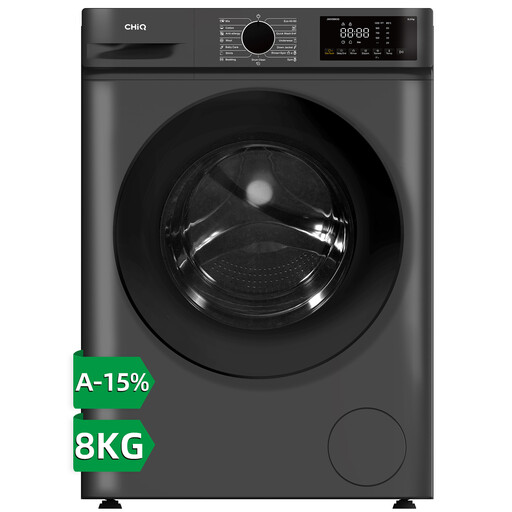 No image available
An option to compare if you’re looking for an 8 kg front-loader with a range of programmes for regular laundry.
Load capacity: 8 kg. Spin speed: 1400 rpm. 16 programmes. Energy rating A-15%.
No. Check the care label first. Eco 40-60 is designed for normally soiled laundry that can be washed at 40 or 60 °C according to its care label; it isn’t automatically the right choice if you’re short on time.
Measure the installation space and access route, check the water supply and drainage, and follow the model’s installation instructions. Consumentenbond recommends, among other things, a stable surface, an earthed socket and removing the transit bolts before use.
No. The energy label for washing machines is based on Eco 40-60 and doesn’t tell you how much energy another programme uses. Energielabel.nl explains that you need to check the energy consumption of other programmes separately.
Report the problem to the retailer. According to the Dutch government, the retailer must provide a solution if there’s a problem with a product. Whether a specific fault is covered by the legal guarantee depends on the circumstances.
For an online purchase, you often have 14 days to change your mind after delivery, according to ACM ConsuWijzer, although exceptions apply. Check which terms and conditions apply to your purchase.