
For those washing large loads of sheets
You want to wash several cotton sheets at once and choose a capacity based on the load you actually wash. Consumentenbond and Milieu Centraal advise matching the load capacity to the washing you typically do.


Choose a drum capacity that suits a weighed, typical load of sheets and other cotton items; the biggest drum is not automatically the most practical choice. Then measure the entire space and check the connections. For normally soiled cotton that the care label says can be washed at 40 °C or 60 °C, compare the eco 40-60 programme and the energy label information.
You want to wash several cotton sheets at once and choose a capacity based on the load you actually wash. Consumentenbond and Milieu Centraal advise matching the load capacity to the washing you typically do.
You need to position the machine near the tap, drain and earthed socket, and want to keep vibrations to a minimum. Consumentenbond and Bosch Nederland highlight the importance of a suitable location and correct installation.
You often wash normally soiled cotton and want to compare programmes and consumption figures on a like-for-like basis. Milieu Centraal, the European Commission and the Dutch Government provide relevant points to consider.
First, weigh a typical cotton load and measure your utility room. Then compare the programmes and label information. Finally, check that the spin noise and installation requirements are suitable for the space.
| What to consider | What should you look for? | Who considers this important? |
|---|---|---|
| Capacity for sheets | Weigh a typical cotton load and check that the drum opening is practical for large sheets. | If I want to wash sheets and other cotton items together, I want to know whether my usual load will fit comfortably in the drum. Around 29% of consumers consider suitable capacity their main concern. |
| Positioning and connections | Measure the height, width and depth, including space for the door; check the tap, drain, earthed socket and floor. | In a utility room with fixed connection points, I want to be sure that the machine can be positioned securely and accessed easily. Around 24% of consumers prioritise positioning and connections. |
| Cotton programme | Check the care labels and whether the machine has programmes to suit the fabric and level of soiling. | When I want to wash cotton according to the care label, I look for a suitable programme rather than one setting for every wash. Around 18% of consumers give the wash programme top priority. |
| Electricity and water consumption | Compare the energy label and stated consumption using the same programme basis; also match the drum to the load you usually wash. | When I wash regularly, I want to compare consumption without choosing a drum that I usually only fill part-way. This is the main concern for around 17% of consumers. |
| Spin noise and vibrations | Compare the noise figures during the spin cycle and check that the machine can stand securely and level. | If adjoining rooms are close to the utility room, I want to minimise disruption during the spin cycle. Noise and vibrations are the top concern for around 12% of consumers. |
The percentages show, for each row, how many consumers in this breakdown consider that factor their main priority; they are not survey results. For consumption comparisons, the Dutch Government’s guidance on the energy label and the European Commission’s information on eco 40-60 identify product information and the programme basis as relevant points to consider.
Load capacity is based on cotton. A larger machine is not automatically the best match if your usual loads are much smaller; load detection does not fully make up for this.
Weigh a typical load and also check that the sheets can fit through the drum opening easily.
Height, depth, door clearance, connection points and a stable floor all affect where you can position a machine in a utility room.
Measure the whole space and check in advance which connections are needed and what is included with your chosen delivery or installation service.
A matching model name alone does not always tell you which version or features a product includes.
Before buying, check the full model code and compare the key specifications listed with the version you want to order.
The Bosch Serie 6 WGG244FONL is a Dutch-market front-loading washing machine with a 9 kg load capacity and stated dimensions of 845 × 598 × 588 mm. Bosch Nederland also lists AquaStop.
According to LG, the Dutch-market F4X1009NWK has a 9 kg capacity, Inverter Direct Drive, Spa Steam and Allergy Care.
The Dutch-market Miele W1 WWA120 WCS 8kg Active has an 8 kg load capacity and a stated spin speed of 1400 rpm. Miele lists features including CapDosing and AddLoad for this model.
These washing machines are options to compare for cotton sheets and other cotton items, with a range of drum capacities.
 No image available
The stated 9 kg capacity may suit regular larger cotton loads; base your choice on the weight of the laundry you typically wash.
9 kg; 1400 rpm.
 No image available
The stated 8 kg capacity may suit a typical cotton load that fits within this load limit.
8 kg; 1400 rpm.
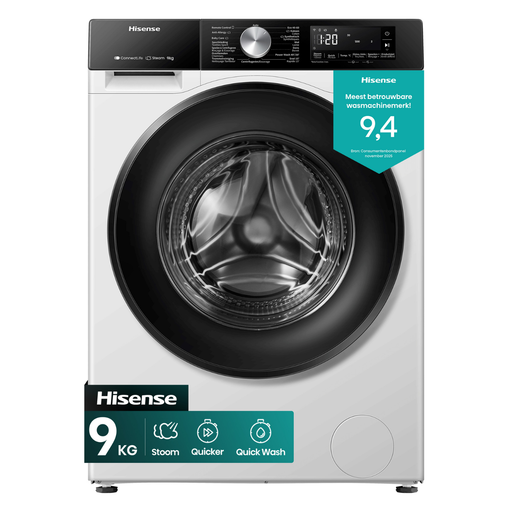 No image available
The stated 9 kg capacity may suit regular larger cotton loads; check that the drum also works for your other washes.
9 kg; 1400 rpm.
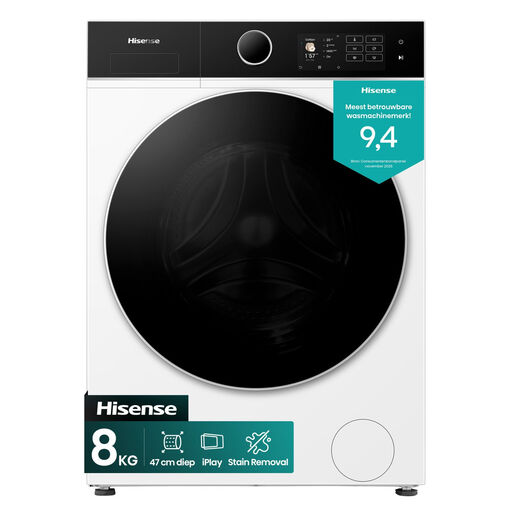 No image available
The stated 8 kg capacity may suit a typical cotton load within this load limit.
8 kg; stated depth 47 cm.
 No image available
The stated 8 kg capacity may suit a typical cotton load that fits within this load limit.
8 kg; 1351 rpm; energy label A.
No, check the care label first. According to the European Commission, eco 40-60 is intended for normally soiled cotton that the care label says can be washed at 40 °C or 60 °C; it is not a general hygiene guarantee for every situation.
Bosch Nederland recommends a stable floor, accessible water supply and drain, an earthed socket and removal of the transit bolts. Also check the installation instructions for your model.
No. ACM ConsuWijzer explains that your statutory rights depend on what you could reasonably expect from the product under normal use. If a product is faulty, the seller is responsible for providing an appropriate solution; an additional manufacturer’s or retailer’s warranty does not replace that right.
Yes. The Dutch Government states that washing machines must have an energy label, with information including energy and water consumption. This is a requirement for product information, not an obligation to buy a machine with an A energy label only.