
For homes with limited floor width
If the space available is narrow, compare the external dimensions of top-loaders and front-loaders. With a top-loader, remember to allow enough room to open the lid.


Weigh a typical sorted load of sheets and measure the space available before choosing a washing machine; the largest drum isn’t automatically best for smaller washes. A slim top-loader can be a good option if width is limited and there’s enough room to open the lid. Choose a front-loader if it fits with the necessary clearance and its capacity suits your laundry. If you’re considering a washer-dryer, compare the washing and drying capacities separately.
If the space available is narrow, compare the external dimensions of top-loaders and front-loaders. With a top-loader, remember to allow enough room to open the lid.
If you want to wash cotton sheets without choosing an unnecessarily large drum for everyday laundry, start by weighing a typical load. Consumentenbond advises matching the capacity to the laundry you usually wash in one go.
If the machine is close to a living room or bedroom, compare its spin-cycle noise level and make sure it can be installed securely. Consumentenbond points out that spinning is generally the loudest part of a cycle.
Choose this if: the machine fits with enough room for the door, hoses and installation, and its capacity suits your usual cotton laundry.
Bear in mind: front-loaders vary in depth and capacity; a larger drum isn’t automatically the right choice for smaller loads.
Choose this if: width is the main constraint and there’s enough room above the machine to open the lid.
Bear in mind: check the full external dimensions and make sure your usual load of sheets will fit in the drum.
Choose this if: you also want to tumble-dry your laundry and don’t have space for two separate appliances.
Bear in mind: drying capacity may be lower than washing capacity; also compare the programme duration and energy use of the specific model.
| What to consider | What to look for | Who should consider this? |
|---|---|---|
| Will the machine fit? | Measure the space and access route; compare the external dimensions and check the clearance needed to open the machine and the installation instructions. | If space in my flat is limited, I want to be sure the machine will fit and can be opened. Around 31% of consumers pay most attention to whether a machine fits in the available space. |
| Will it fit my sheets? | Weigh a typical sorted load and check the drum space and opening too; the stated capacity applies to cotton. | I want to load my cotton sheets without cramming them into the drum, but I don’t want an unnecessarily large machine for everyday laundry. Around 31% of consumers prioritise a suitable capacity for washing sheets. |
| Noise and vibration | Compare the noise level during the spin cycle and check that the machine can stand securely and level. Consumentenbond notes that a higher spin speed doesn’t automatically mean drier laundry. | If the machine is close to my living room or bedroom, I mainly want to know how disruptive the spin cycle might be. Around 25% of consumers pay most attention to keeping their home peaceful. |
| Energy and water use | Compare kWh per 100 eco 40-60 cycles and litres per cycle using the same label basis. Assess any drying function separately. | If I want to take running costs into account, I compare electricity and water use on the energy label. Around 13% of consumers prioritise running costs. |
Capacity refers to the weight of the laundry; a larger machine isn’t automatically better for a typical smaller load.
Weigh a usual load of sheets, then check that they fit through the opening and in the drum without being crammed in.
Its depth and height, as well as the space needed to open the lid, also determine whether the machine will work in the space.
Compare all the external dimensions with the space available and check the model’s installation instructions.
A washer-dryer may dry less laundry than it can wash. According to Consumentenbond, combined cotton wash-and-dry programmes can take a long time and use a lot of energy in typical combinations.
Compare the washing and drying capacities and the specifications of the specific machine; choose this option only if you also want to tumble-dry your laundry.
A Joybuy Netherlands product page gives different model numbers and energy classes for a Beko washing machine in its title and description. This information doesn’t clearly identify the same version.
Before buying, check the full model number and compare it with the product information for the version on offer.
For the Dutch market, AEG lists the LTR6363A as a 6 kg top-loader. According to AEG, this model measures 903 × 397 × 599 mm.
For the Dutch market, Whirlpool lists the TDLR 6261BS BE as a 6 kg top-loader measuring 40 × 60 × 90 cm.
For the Dutch market, Beko lists the B1W764BB BE as a 7 kg front-loader, 60 cm wide and 52 cm deep.
Bosch lists the Serie 4 WAN2827DNL as a front-loader for the Dutch market, with a maximum capacity of 8 kg and a spin speed of 1400 rpm.
The Joybuy products below are all front-loaders. Compare their capacity and dimensions with your usual load of sheets and the space available.
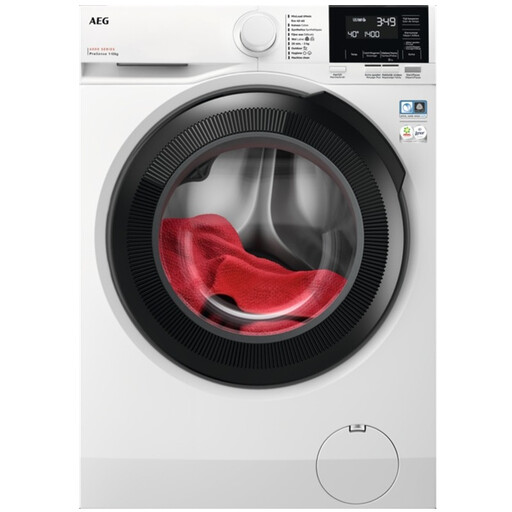 No image available
A front-loader to compare if its capacity suits your usual laundry and it fits the space available.
Capacity: 10 kg. Spin speed: 1400 rpm. Energy rating: A.
 No image available
A front-loader to compare if 8 kg suits your usual laundry and its dimensions fit the available space.
Capacity: 8 kg. Spin speed: 1600 rpm. Energy rating: A.
 No image available
A front-loader to compare if 8 kg suits your usual laundry; check the depth of the space available too.
Capacity: 8 kg. Spin speed: 1400 rpm. Energy rating: A-40%.
 No image available
A front-loader to compare if 8 kg suits your usual laundry; measure the space and check the clearance needed for installation.
Capacity: 8 kg. Spin speed: 1400 rpm. Energy rating: A.
No image available
A front-loader to compare if 8 kg suits your usual laundry; check that its external dimensions fit the available space.
Capacity: 8 kg. Spin speed: 1600 rpm. Energy rating: A-30%.
Weigh a typical sorted load and check that the sheets fit through the opening and in the drum without being crammed in. The maximum capacity applies to cotton. When estimating the capacity you need, Consumentenbond advises adding around 2 kg to the weight of a typical load.
Check the care label first. The eco 40-60 programme is designed for normally soiled cotton that the label says can be washed at 40 °C or 60 °C. The European Commission describes the programme for this type of cotton. Also check the maximum load and the manual for your chosen model.
Follow the model’s manual and check that the machine is stable and level. AEG also advises checking that the transit bolts have been removed from a new machine.
No. According to the Dutch government, there is no fixed period for the statutory guarantee in the Netherlands; what you’re entitled to expect depends on the product and the circumstances. If a product is faulty, the retailer is your point of contact. A manufacturer’s warranty is in addition to your statutory rights.
Energy labelling is mandatory for household washing machines covered by the relevant EU rules. The label includes information such as energy and water use and noise during the spin cycle; these figures don’t describe the consumption of every individual programme.