What should you look for when buying?
Start with the amount of cotton laundry you usually wash, then check which programmes, consumption figures and dimensions suit your needs.
| What matters when buying |
What to look for |
Who should pay particular attention? |
| Capacity for everyday laundry |
Weigh a typical load of sorted cotton laundry and compare it with the stated capacity. The maximum capacity applies to cotton. |
If your seasonal pile is much larger than your usual load, you’ll want to avoid regularly washing small loads. Around 33% of consumers prioritise a suitable drum capacity. |
| Washing and rinsing performance |
Check the care label, the cotton and rinse settings, and, where available, test results for the exact model. |
If you want to choose programmes to suit the level of soiling and get a good rinse, the choice between Eco 40-60 and cotton matters. Around 25% of consumers prioritise this. |
| Energy and water consumption |
Compare the figures on the energy label on a like-for-like basis, and consider the programmes you tend to use. |
If you wash regularly, factor in the consumption figures without assuming they indicate washing performance. Around 25% of consumers prioritise running costs. |
| Dimensions and connections |
Measure the space and access route; compare the model’s dimensions and installation instructions with the connections in your home. |
If space is limited, first check whether the machine can be positioned securely and connected. Around 17% of consumers prioritise fitting and installation. |
Washing machines at Joybuy
The Joybuy models below have a stated capacity of 7 or 8 kg. Check which cotton, Eco 40-60 and rinse programmes suit your care labels and laundry habits for each model.
 No image available
Midea MF110W80BA10/W-NL, 8 kg
A good fit if you’re looking for an 8 kg model and want to switch between cotton, Eco 40-60 and an extra rinse.
The product information lists an A energy rating, 42 kWh per 100 cycles, 1400 rpm and 16 wash programmes. The installation information specifies 220–240 V, a 10 A circuit and an earthed socket.
View at Joybuy
 No image available
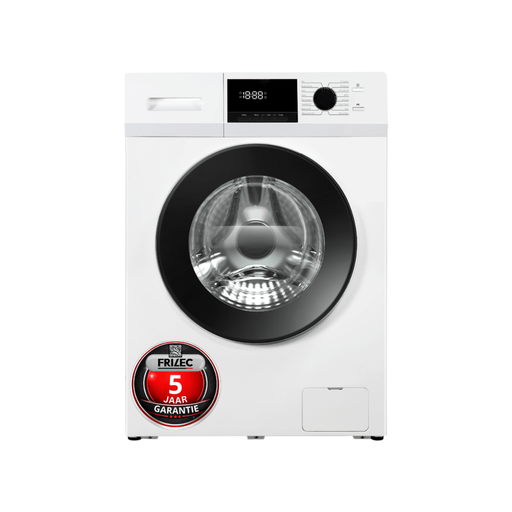
Frilec KOBLENZ8314WA-342, 8 kg
A good fit if you’re looking for a washing machine with a stated capacity of 8 kg for cotton laundry.
The product information lists an A energy rating, 42 kWh per 100 cycles, and cotton and Eco 40-60 programmes.
View at Joybuy
 No image available
Candy GD 48B9-S, 8 kg
A good fit if you’re looking for an 8 kg model with Eco 40-60 and a range of other programmes.
The product information lists an A energy rating, 33 kWh per 100 Eco 40-60 cycles, 16 programmes, 1351 rpm and a steam function.
View at Joybuy
 No image available
Comfee CFP01EW70W-JD, 7 kg
A good fit if you’re looking for a stated capacity of 7 kg and need to make the most of limited space.
The product name describes a 400 mm slim design; the product information lists cotton programmes. Check the model’s dimensions and installation instructions before assessing the space available.
View at Joybuy
 No image available
Beko BM3WFU38412CW, 8 kg
A good fit if you’re looking for an 8 kg model for cotton T-shirts and want to compare the option of an extra rinse.
The product information lists an A energy rating, 47 kWh per 100 cycles, 1400 rpm, cotton and Eco 40-60 programmes, and WaterMode with an extra rinse. The installation instructions specify an earthed socket and a flat, solid floor; remove the transit bolts before use.
View at Joybuy
Frequently asked questions
Does Eco 40-60 mean your T-shirts are washed at 40 or 60 °C?
No. The name refers to normally soiled cotton with a care label allowing washing at 40 or 60 °C. The temperature reached can vary between machines, so check the garment’s care label and choose another programme if it’s better suited to the laundry.
What should you check before using your washing machine for the first time?
Compare the space and connections with the instructions for the exact model. Bosch recommends installing its machines on a stable surface and using an earthed socket. You should also remove the transit bolts before use.
How can you stop frequent T-shirt washes making your machine smell musty?
Measure detergent according to the packaging and follow your model’s care instructions. The Dutch Consumers’ Association also recommends running a regular hot wash programme for maintenance; according to the organisation, Eco 40-60 isn’t a substitute.
Are you automatically entitled to exactly two years’ statutory cover for a washing machine in the Netherlands?
No. There’s no fixed statutory guarantee period in the Netherlands. According to the Dutch government, you’re entitled to a product that works properly; what you can reasonably expect depends, among other things, on the product and the information provided. If something goes wrong, contact the seller. A manufacturer’s guarantee is separate.
Does a washing machine need an energy label, and can you return your old machine?
Washing machines covered by the energy-labelling rules must have a label; the scale for this category runs from A to G. According to the Dutch government, when a private individual buys a new, similar appliance, the seller must take the old machine away free of charge under the one-for-one scheme. This also applies to online purchases when the specified conditions are met.


