Choose a washing machine based on the amount of sorted laundry you usually wash together; you don’t necessarily need a large drum just for a few pillowcases. Then measure the space, doorway and connections in your utility room, and compare energy use, spin noise and programmes against the care label. Washing at 60°C is a specific consideration when dealing with dust mites, and is only suitable if the fabric can withstand that temperature.
Who is this buying guide for?
For washing small mixed loads
You wash pillowcases with other suitable laundry and don’t want an unnecessarily large drum. Consider the size of your usual sorted load, not just the number of pillowcases. The Consumentenbond recommends matching capacity to the load.
For buyers with a cramped utility room
Your choice depends largely on the available floor space and clearance to open the door, the connections and possibly the noise during the spin cycle. The Consumentenbond and Energielabel.nl highlight dimensions and noise information as factors to consider.
For laundry with specific hygiene requirements
You want to know whether the pillowcases can be washed on your chosen programme, according to their care labels. Thuisarts recommends washing pillowcases at 60°C as part of measures to deal with dust mites; also check that the fabric can withstand this temperature.
What should you look for when choosing?
Start with the load you normally wash, then measure the space. Only then compare energy use, noise and programmes on models that are the right size and capacity.
A suitably sized front-loading machine
Suitable if: you usually wash pillowcases with a regular, sorted load and have room for the door to open.
Bear in mind: the maximum load capacity applies to cotton; delicate fabrics may need a smaller load.
A top-loader for narrow spaces
Suitable if: the width or door clearance needed for a front-loader limits your options, but there is room above the machine to open it.
Bear in mind: check the height, capacity and space for connections for each model too; a top-loader won’t solve every installation issue.
A larger-capacity front-loader
Suitable if: you regularly wash larger, compatible loads as well as pillowcases.
Bear in mind: extra capacity alone isn’t a reason to choose a larger drum; match it to your usual laundry.
| What to consider |
What to look for |
Who should pay particular attention? |
| Capacity |
Weigh a regular sorted load and check the permitted load for delicate programmes. The Consumentenbond explains that the stated maximum capacity applies to cotton. |
If I wash pillowcases with other laundry, I want a drum that suits my usual load. Around 36% of consumers say capacity is their main concern when buying. |
| Installation |
Measure the space, clearance for opening the door and the access route; also check the water supply, drainage and power socket. The Consumentenbond gives around 85 cm in height and 60 cm in width as typical dimensions for a standard front-loader, but measure your chosen model yourself. |
If the utility room is cramped, I want to know whether the machine can actually be installed and opened. Around 29% of consumers give installation their top priority. |
| Energy use and noise |
Compare the energy label, kWh per 100 cycles, water consumption and spin noise for models with a suitable capacity. Energielabel.nl lists this information on the washing machine label. |
If I use the machine regularly or place it near a living area, I want to consider energy use and spin noise in advance. Around 21% of consumers say energy use is their main concern when choosing. |
| Wash programmes |
Read the care label and check whether the model offers a suitable programme and the temperature you want. Thuisarts recommends 60°C for pillowcases as part of measures to deal with dust mites; this isn’t automatically suitable for every fabric. |
If my pillowcases need a specific treatment, I want to know what temperature the fabric can withstand and which programme is suitable. Around 14% of consumers put their laundry requirements first. |
Buying pitfalls
-
Choosing a large drum just because you wash pillowcases
Match the capacity to the usual combined load, not to one type of laundry. The maximum load capacity also doesn’t necessarily apply to delicate fabrics.
Weigh a normal sorted load and check the permitted load for the programmes you use.
-
Measuring only the available cupboard space
The machine also needs room to open, connect up and stand securely.
Measure the space and access route, and check the doorway and installation instructions for your chosen model before ordering.
-
Assuming a steam function is the same as washing at 60°C
A manufacturer’s description of a feature doesn’t, by itself, prove that the fabric will be washed at the right temperature on the programme you need.
Check the care label and the specific programme settings. Only follow Thuisarts’ advice to wash at 60°C for dust mites if the fabric is suitable for it.
-
Confusing an additional warranty with your statutory rights
An additional manufacturer’s or motor warranty isn’t the same as your statutory rights for the product.
The Dutch government explains that there is no fixed statutory warranty period in the Netherlands and that you can contact the seller if there is a problem with the product. Check exactly what an additional warranty covers.
Brands and models to consider
AEG
The LF628400 is an 8 kg front-loader from the 6000 ProSense series, worth comparing if load adjustment is important to you.
- AEG describes ProSense as a feature that weighs the load and adjusts the time, energy use and water consumption.
- The manufacturer’s description doesn’t prove a specific benefit for washing pillowcases; compare dimensions and programmes too.
Beko
The BM3WFT3841B1 is a freestanding 8 kg front-loader with a stated depth of 54,6 cm.
- Beko lists energy class A and spin noise of 76 dBA for this model.
- The stated depth or energy class alone won’t tell you whether the machine will fit in your utility room or be quiet enough.
Siemens
The iQ300 WM14N07CNL is an 8 kg front-loader for the Dutch market, with a maximum spin speed of 1400 rpm.
- Its stated capacity makes it easy to compare with other 8 kg machines.
- Siemens offers an additional motor warranty for this model; check the terms and distinguish it from your statutory rights for the product.
Bosch
The Serie 6 WGG244FPNL is a front-loader with a stated capacity of 9 kg.
- Bosch lists a maximum spin speed of 1400 rpm.
- The larger capacity isn’t automatically an advantage for just a few pillowcases; match it to your usual load.
Miele
The W1 WWE380 WCS PWash&Steam&8kg is an 8 kg model.
- Miele lists QuickPowerWash and SteamCare for this model.
- Without comparing these features with your fabrics and preferred programmes, they won’t tell you which machine is best for your laundry.
Washing machines at Joybuy
This selection includes a portable mini washing machine for small items and freestanding front-loaders for combined laundry loads.
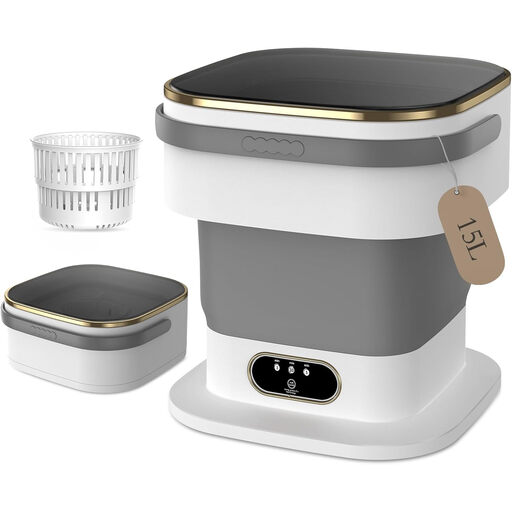 Image unavailable
15L foldable portable mini washing machine, grey and white
According to the product name, it’s designed for small items; check that the capacity suits what you want to wash.
Capacity: 15 litres. Three wash settings and a spin-drying basket.
Joybuy
 Image unavailable
Midea MF110W80BA10/W-NL 8 kg front-loader
Its stated capacity makes this model an option to compare for combined laundry loads.
Capacity: 8 kg. Spin speed: 1400 rpm. 16 wash programmes.
Joybuy
 Image unavailable
Candy GD 48B9-S 8 kg front-loader
Compare the stated capacity with the size of your usual sorted load.
Capacity: 8 kg. Spin speed: 1351 rpm. Energy class A. Steam function.
Joybuy
 Image unavailable
Beko BM3WFU38412CW 8 kg front-loader
Compare the stated capacity with your usual laundry and check the dimensions before choosing a spot in your utility room.
Capacity: 8 kg. Spin speed: 1400 rpm. Energy class A.
Joybuy
 Image unavailable
TCL FF1006WB0 6 kg front-loader, 45 cm deep
The stated depth may be useful if space is limited; measure the area and allow room to open the door.
Capacity: 6 kg. Stated depth: 45 cm. Energy class B. The product name mentions automatic weight adjustment and a 15-minute quick wash programme.
Joybuy
Frequently asked questions
Do I need a 9 kg washing machine just for pillowcases?
Not just for those few items. Weigh a typical sorted wash load and choose a capacity to match; a larger drum is mainly useful if you’ll also use it for regular, larger loads.
Do pillowcases always need to be washed at 60°C?
No, 60°C isn’t a general requirement for every pillowcase. Thuisarts recommends this temperature as part of measures to deal with dust mites; also check that your fabric’s care label allows it.
What should I check before installing a washing machine in the utility room?
Measure the space for the machine and the clearance needed to open it, and check the connections. Make sure the floor is level and stable, and follow the installation instructions for your chosen model.
Which energy label and consumption figures can I compare?
For models with a suitable capacity, compare the energy label, stated consumption per 100 cycles and water consumption. Energielabel.nl also lists spin noise; compare label values on the same basis.
Is there a fixed statutory two-year warranty period in the Netherlands?
No. The Dutch government states that there is no fixed statutory warranty period in the Netherlands; you’re entitled to a product that works properly and can contact the seller if there’s a problem. A manufacturer’s warranty or additional warranty doesn’t automatically replace this.


