
Tenant with a narrow laundry space
You want to know whether a top-loader or front-loader will fit, and whether there is enough room to open the door or lid. The Consumentenbond recommends checking the dimensions of the exact model.


Start by measuring the available width, depth and clearance for opening the machine. A top-loader may be a good solution if a front-loader is too wide or its door cannot open forwards, while a shallow front-loader may fit if depth is the main constraint. The Consumentenbond points out that ‘slim’ can refer to either width or depth, so check the dimensions of the exact model and allow room for the hoses and door. Then compare the programmes with the care label on your aprons and choose a drum capacity suited to the loads you usually wash.
You want to know whether a top-loader or front-loader will fit, and whether there is enough room to open the door or lid. The Consumentenbond recommends checking the dimensions of the exact model.
You’re looking for a programme suited to the care label and the type of soiling, without assuming that a stain-removal programme will definitely remove a particular stain. The Consumentenbond recommends following the care instructions on the textile label.
You want to choose a drum capacity that suits your aprons and the other laundry you usually wash with them. Milieu Centraal recommends choosing a machine that suits how you use it, while the European Commission explains which consumption figures appear on the energy label.
For washable aprons in a compact rented home, the key considerations are the space available, suitable fabric-care programmes and the size of your usual load. The options below mainly differ in how much space they need and how you load the laundry.
Choose this type if: width or the space in front of the machine is the main constraint, and there is enough room above it. According to AEG, the AEG LTR6363A is 397 mm wide and has a capacity of 6 kg.
Bear in mind: you need to be able to open the lid from above, so the top must be clear. The Consumentenbond notes that a top-loader cannot be installed under a worktop.
Choose this type if: there is enough width for a front-loader, but depth is limited. Beko lists the B1W764BB BE as 60 cm wide and 52 cm deep.
Bear in mind: a shallower machine will not solve the problem if the recess is too narrow. Also measure the space needed behind the machine and in front of the door.
Choose this type if: there is enough width and depth, and you can wash your aprons with other suitable items. Bosch lists the WGE02404NL as having a capacity of 7 kg and dimensions of 848 × 598 × 588 mm.
Bear in mind: a larger drum is not automatically more economical for a few aprons. Match the capacity to the loads you actually wash.
| What to consider | What to check before buying | Who should give this more weight? |
|---|---|---|
| Will the machine fit, and can you open it? | Measure the width, depth, height, access route and clearance for opening. The Consumentenbond distinguishes between width and depth; AEG lists the LTR6363A as 397 mm wide. | If I’m measuring up in a narrow rented home, I want to know whether the machine will fit and open fully; around 31% of consumers put fit first. |
| Programmes and fabric care | Follow the care label and compare the permitted treatment with the programmes on the exact model. The Consumentenbond recommends using the textile label as your guide. | When I wash aprons with different kinds of soiling, I want to choose a programme that suits the label; around 25% of consumers prioritise getting clothes clean and caring for fabrics. |
| Capacity for your load | Compare the load capacity with the aprons and other fabrics you can wash together according to their care labels. Milieu Centraal advises against choosing a machine that is larger than your needs. | If I often wash just a few aprons, I want to know whether I can responsibly combine them with other laundry; around 19% of consumers prioritise matching capacity to how often they wash. |
| Connections and risk of leaks | Check the water supply, drain, power supply, floor and water protection. Discuss any alteration that cannot easily be reversed with your landlord in advance; the Dutch government distinguishes between minor alterations and renovations. | I need the machine to fit into the existing space without requiring unwanted alterations; around 13% of consumers prioritise the connection and protection against water damage. |
| Energy use and noise | Compare the energy consumption per 100 cycles, water consumption per cycle, programme duration and spin noise on the EU energy label. The European Commission explains these label figures and the stated comparison method. | If the machine is close to my living space and runs regularly, I want to weigh up energy use and spin noise; around 12% of consumers give these factors top priority. |
A top-loader may be narrower, while a shallow front-loader can still be about 60 cm wide. Also check that the door or lid can open freely.
Measure the recess and access route, then compare the width, depth and height of the exact model, as well as the clearance for opening it and its connections.
The capacity should suit the total loads you usually wash, not just the largest figure in a product specification. Small loads may mean you need to wash more often.
Check whether you can wash aprons with other items that are suitable according to their care labels, then compare the total with the stated load capacity.
A programme name does not guarantee that a particular stain will disappear or that the apron will be disinfected. If you handle food professionally, relevant hygiene instructions may also apply.
Follow the care label and choose a treatment suited to the soiling. For professional use, consult the relevant hygiene code or your own food safety plan. The NVWA sets out the requirements for businesses that prepare, process or sell food.
The machine must not only fit the space, but also be suitable for the existing connections and floor. Water protection and installation requirements may need attention.
Before ordering, check the installation instructions, the connections in your rented home and the water protection measures in place.
The AEG LTR6363A is a top-loader for situations where width is the main consideration.
Beko lists different depths and capacities for its front-loaders, including the B1W764BB BE and BM3WFU38412CW.
The Bosch WGE02404NL is a standard front-loader for a laundry space that can accommodate its stated dimensions.
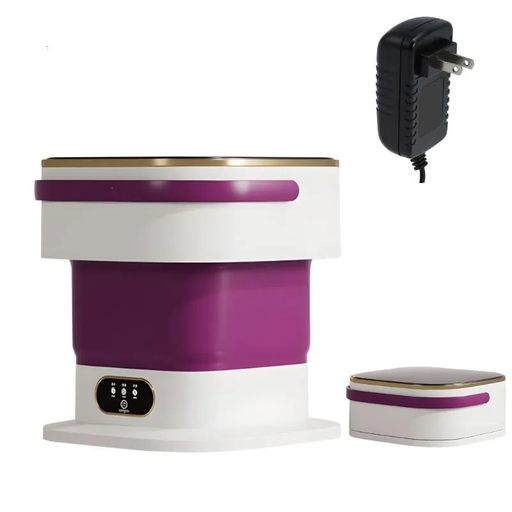
The products below are aimed at small laundry loads and compact spaces, including a foldable mini washing machine and shallow front-loaders.
 No image available
An option to consider for small loads of aprons, especially if storage space matters.
The product information lists a maximum washing load of 1,9 kg and a capacity of 15 litres.
 No image available
A front-loader to consider if space is limited in depth but there is room for a 7 kg machine.
The product title lists a depth of 400 mm. The product description mentions 16 programmes and a 15-minute programme for small, lightly soiled loads.
 No image available
A front-loader to consider if you’re short on depth and usually wash smaller combined loads.
The product title lists a depth of 45 cm and a capacity of 6 kg. It also mentions a 15-minute quick-wash programme.
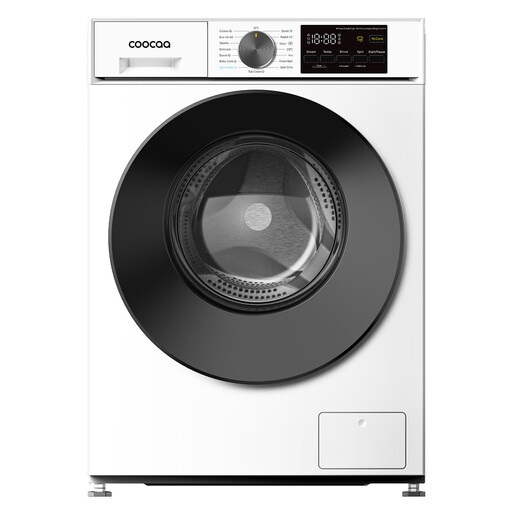 No image available
A front-loader to consider if depth is limited and you’re looking for a capacity of 7 kg.
The product information lists a depth of 440 mm, 1,200 rpm and 15 programmes.
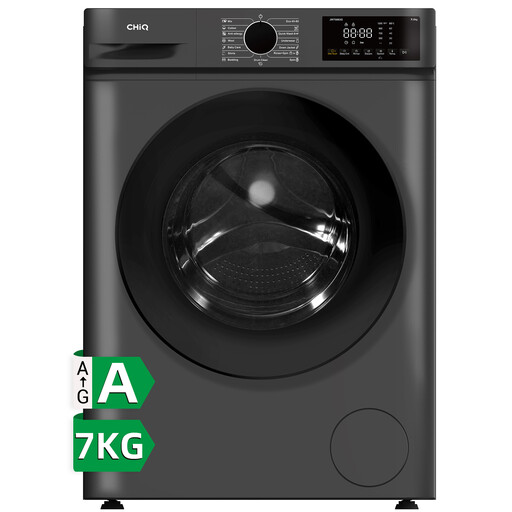 No image available
A front-loader to consider if you need a shallow machine with several programmes for different fabric types.
The product information lists a depth of 47 cm, a capacity of 7 kg, 1,200 rpm and 16 programmes.
Start with the care label: it gives the maximum temperature and recommended treatment. Also consider the type of soiling, rather than automatically choosing the highest temperature or the shortest programme. The Consumentenbond recommends following the care label.
Measure the space and access route, and check the water supply, drain, power supply, floor and installation instructions. According to the Dutch government, minor alterations that can easily be reversed may be treated differently from renovations. Discuss any major changes with your landlord in advance.
The EU energy label includes details such as energy consumption per 100 cycles, water consumption per cycle, programme duration and spin noise, using the stated comparison basis. The European Commission explains these figures. Your actual consumption will also depend on the programmes you use and how often you wash.
Not necessarily. The NVWA requires businesses that prepare, process or sell food to have an HACCP food safety plan; following a relevant hygiene code can be one way to meet this requirement. Follow the work instructions that apply to your activity.
Follow the machine’s maintenance instructions. Milieu Centraal recommends running a 60 °C wash once a month to maintain the machine and help reduce residue and odours. This does not mean that every apron can be washed at 60 °C.