Choose based on the beach-towel load you usually wash, and compare the spin result on the energy label; the maximum spin speed alone won’t tell you how much moisture remains. If you can hang the towels out to dry properly, a standalone washing machine will do the job. A washer-dryer can be useful if you only have room for one appliance. With a washer-dryer, check its drying capacity and the energy use of the complete wash-and-dry cycle. Milieu Centraal says that washing and drying separately uses less energy than using a washer-dryer.
Who is this choice relevant to?
Limited space to hang towels out to dry
You’re looking for a way to deal with wet beach towels without a large clothes airer. The key choice is whether to hang them up or use a tumble dryer. Milieu Centraal discusses both ventilation when drying clothes indoors and the choice between separate appliances and a washer-dryer.
Several beach towels per wash
You want a drum that suits the load you usually wash, without choosing a machine that’s often too large just to handle occasional peak loads. Milieu Centraal advises against buying an oversized washing machine.
Washing efficiently when space is limited
You have some room to hang washing, but want to weigh up the energy use and convenience of different drying options. Milieu Centraal covers the energy use of washer-dryers and separate appliances; the EU energy label also includes information about water consumption.
What should you look for?
Standalone washing machine and air-drying
Choose this option: if you can hang the washed towels out with enough space around them and ventilate the room.
Bear in mind: large towels still need space and time to dry; drying laundry adds moisture to the air indoors.
Washer-dryer
Choose this option: if hanging washing out is difficult and you have room for one appliance, but not for a washing machine and tumble dryer side by side.
Bear in mind: drying capacity may be lower than washing capacity. Milieu Centraal says that washing and drying separately uses less energy than washing and drying in one washer-dryer.
Separate washing machine and tumble dryer
Choose this option: if you can install both appliances safely and regularly want to tumble-dry your towels.
Bear in mind: you’ll need space and suitable connections for two appliances.
| What to consider |
What to look for when buying |
Who is this important for? |
| Residual moisture and drying space |
Compare the spin-drying efficiency class on the energy label and check which spin setting the care labels on your towels allow. Milieu Centraal advises checking the drying result on the label first, followed by the spin speed. |
If I have little room to hang large, wet towels out to dry, I want to know how much residual moisture the washing machine leaves behind. Around 36% of consumers put residual moisture and drying space at the top of their list. |
| Load capacity |
Compare the stated capacity in kg with the amount of dry towels and other laundry you usually wash together. Also check the maximum load for your chosen programme; Milieu Centraal advises against choosing an unnecessarily large machine. |
If I usually wash several beach towels at once, I want a drum that suits my regular load. Around 29% of consumers prioritise the amount of laundry per load. |
| Drying capacity and appliance space |
For a washer-dryer, check both the washing and drying capacities, the dimensions and the energy use of the complete wash-and-dry cycle. Milieu Centraal compares the energy use of washer-dryers with that of separate appliances. |
If I can only fit one appliance and have little room to hang towels out to dry, I want to know how much of my load I can wash and dry in one go. Around 21% of consumers prioritise the space available for a drying function. |
| Energy and water use |
Compare energy and water consumption on the same label basis. If you use a tumble dryer, include its cycle too; washing machine energy labels provide information about water consumption. |
If I have room to hang my towels out to dry, I want to weigh up the convenience of tumble-drying against its energy use. Around 14% of consumers put running costs at the top of their list. |
Common mistakes when choosing
-
Comparing only the highest spin speed
Maximum spin speed alone is not a measure of drying performance. EU regulations determine the spin-drying efficiency class based on the remaining moisture content.
Compare the spin-drying efficiency class on the energy label and check whether the care labels on your beach towels allow the setting you’ve chosen.
-
Confusing washing capacity with drying capacity
The two capacities can differ on a washer-dryer. For example, Bosch lists a 9 kg washing capacity and a 6 kg drying capacity for the WNG24406NL.
Check both figures in kilograms before deciding whether your usual load will fit into one wash-and-dry cycle.
-
Choosing a larger drum for an occasional peak load
A higher capacity isn’t automatically the most energy-efficient choice if you usually run the machine only partly full. Milieu Centraal advises choosing a load capacity that suits the laundry you normally wash.
Work out how many beach towels and other items you usually wash together, then compare that with the machine’s capacity and the maximum load for your chosen programme.
-
Forgetting about ventilation when drying laundry indoors
Drying laundry adds moisture to your home. Milieu Centraal warns that poor ventilation can contribute to damp and mould problems.
Think about where you can hang the towels out with enough space around them and how you’ll ventilate that area.
Brands for comparison
The models and features mentioned provide specific points of comparison; they aren’t an assessment of a brand’s entire range.
Bosch
Bosch offers both standalone front-loading washing machines and washer-dryers, making it easy to compare capacities and drying options.
- Bosch Netherlands lists a 9 kg washing capacity and a maximum spin speed of 1400 rpm for the WGG244FONL.
- For the WNG24406NL, Bosch Netherlands lists a 9 kg washing capacity and a 6 kg drying capacity; the drying load is smaller than the washing load.
Miele
The Miele W1 range includes standalone front-loading washing machines with different stated capacities and spin speeds.
- Miele Netherlands lists a capacity of 8 kg and a maximum spin speed of 1600 rpm for the WWC380 WCS PWash&Steam&8kg.
- A higher stated spin speed doesn’t, by itself, prove that your beach towels will dry faster; compare the spin-drying efficiency class too.
Samsung
Samsung offers front-loading washing machines with stated washing capacities and automatic features to consider when comparing models.
- Samsung describes the WF90F09C4SU3 as a 9 kg model with AI Wash sensors.
- Any savings or performance claims come from Samsung and apply under its own test conditions; they don’t show a specific result for beach towels with sand on them.
Beko
A Beko front-loader gives you another model to compare for capacity, spin speed and programme information.
- The Consumentenbond lists the B3WT5841WS2 SELECTIVE as having an 8 kg capacity, a 1400 rpm spin speed and energy class A.
- The listed quick programmes have different load requirements; don’t assume they’ll deliver the same washing results with a full drum of beach towels.
Joybuy products for limited drying space
This selection includes washer-dryers for anyone who wants to tumble-dry with one appliance, and standalone front-loaders for those who can hang their towels out to dry after washing.
 No image available
Candy BWR 495BL8-S
A washer-dryer to consider if you want to wash and dry with one appliance.
Stated capacity: 9 kg for washing and 5 kg for drying. The product lists a maximum spin speed of 1400 rpm and energy label A-20% / D for washing and drying.
View at Joybuy
 No image available
Haier HWD90-BP14929A-S
A washer-dryer to consider if you’re looking for one appliance for washing and tumble-drying.
Stated capacity: 9 kg for washing and 5 kg for drying. The product lists a maximum spin speed of 1400 rpm and energy label A-20% / D.
View at Joybuy
 No image available
Samsung WW90DG6U25LE
A standalone front-loader to consider if you can hang your beach towels out to dry after washing.
Stated washing capacity: 9 kg. The product lists a maximum spin speed of 1400 rpm and energy class A.
View at Joybuy
 No image available
Bosch WGB2440BFG Serie 8
A standalone front-loader to consider if you have somewhere to dry your beach towels after washing.
Stated washing capacity: 9 kg and a maximum spin speed of 1400 rpm. The product lists energy class A and a Mini Load programme.
View at Joybuy
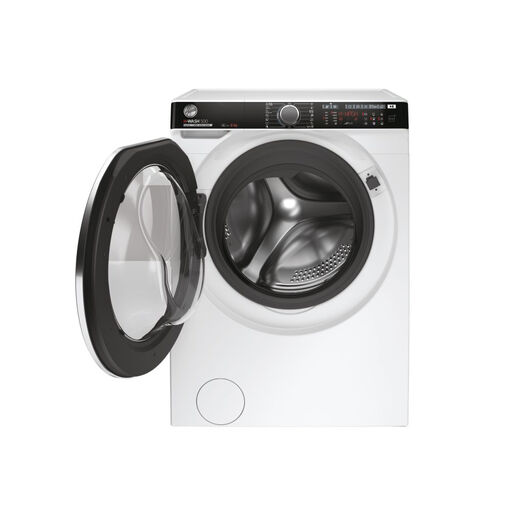 No image available
HWP 48AMBC7/1-S
A standalone front-loader to consider if you’re looking for a washing machine and can hang the towels out to dry afterwards.
Stated washing capacity: 8 kg and a maximum spin speed of 1400 rpm. The product lists energy class A and spin-drying efficiency class B.
View at Joybuy
Frequently asked questions
Is 1600 rpm always better if I want my beach towels to take up as little drying space as possible?
No. First compare the spin-drying efficiency class on the energy label and follow the care label on your beach towel. The maximum spin speed alone doesn’t give you a measured drying result for your load.
Can a washer-dryer wash and dry a full drum of beach towels in one go?
It depends on the stated washing and drying capacities. For example, Bosch lists 9 kg for washing and 6 kg for drying for the WNG24406NL. For any model, check that your load fits within the drying capacity.
What should I bear in mind when drying beach towels indoors?
Make sure the room where you hang the towels out to dry is well ventilated. Milieu Centraal points out that drying laundry adds moisture to the air indoors, and that poor ventilation can contribute to damp and mould problems.
How should I maintain a washing machine that also washes beach towels?
Follow the cleaning and maintenance instructions for your specific model, and check the care labels before choosing a programme. Bosch says that regular cleaning helps prevent dirt build-up, odours and blockages.


