
Housemates sharing a washing machine
When several people use the same machine, drying capacity and the length of a full wash-and-dry cycle matter when planning turns.


A washer-dryer can be a good fit if you have space for one appliance and housemates can work around the long combined cycle. Pay particular attention to the drying capacity for the load you want ready straight away. If you do several loads back to back, a separate washing machine and tumble dryer may be more practical, if you have room for two appliances. The Dutch Consumers' Association highlights the length of combined cycles. For workwear, always check the washing and drying instructions; for protective clothing, follow the care instructions too.
When several people use the same machine, drying capacity and the length of a full wash-and-dry cycle matter when planning turns.
Only wash clothes at home if the instructions allow it. Check the suitable washing and drying method for each item; protective clothing may have additional care instructions.
If you use the drying function regularly, compare the figures for a full wash-and-dry cycle and consider how much room you have for the appliance.
| What to consider | What to look for when buying | Who is this most important for? |
|---|---|---|
| Machine availability | Compare the time needed for a full wash-and-dry cycle and agree usage times with your housemates. | If housemates want to do their washing one after another, I want to know how long the machine will be in use. Around 29% of consumers put access to the shared machine first. |
| Caring for workwear | Check the garment label and, for protective clothing, the relevant use and care instructions. | When I wash workwear at home, I want to make sure the programme and drying method both follow the instructions. Around 24% of consumers prioritise suitable garment care. |
| Drying capacity | Compare the stated capacity in kilograms for washing and drying separately; a full wash load will not necessarily fit in one drying cycle. | If I want to dry a typical load in one go, I look at the drying capacity, not just the washing capacity. Around 23% of consumers prioritise a suitable drying load. |
| Electric drying | Compare the energy figures for the full wash-and-dry cycle on the same labelling basis. | If I use electric drying regularly, I want to be able to compare the figures for washing and drying side by side. Around 12% of consumers put drying energy use first. |
| Space and noise | Measure the space and access route, check the model's dimensions and follow the installation instructions. | In a shared home, I want to know whether the appliance will fit and can be installed in a suitable place, taking my housemates into account. Around 12% of consumers make this their first consideration. |
With models that, for example, have a 9 kg washing capacity and a 6 kg drying capacity, a full wash load cannot necessarily be dried in one go.
Plan a combined cycle around the stated drying capacity, not just the washing capacity.
An extra drying cycle could keep the machine in use for longer, making other housemates wait.
The figures for a wash programme do not tell you how much energy a full combined wash-and-dry cycle uses. The Dutch Consumers' Association describes standard washer-dryers as relatively energy-intensive when drying.
Compare full cycles on the same labelling basis and consider how often you really need to use the drying function. Air-drying is an alternative if the garment instructions and available drying space allow it.
A programme on the appliance does not replace the garment instructions or the care instructions for protective clothing.
Check the instructions before use. For protective clothing or clothing that may be contaminated with hazardous substances, ask your employer how it should be treated.
The WNG24406NL is an example of a 9/6 kg model; the WNA13400EU is a separate 8/5 kg model.
The LWR9506BN4 is a heat-pump washer-dryer for people who dry clothes electrically regularly and need to consider the space available.
The BM5DFT4841A is an example of a model with an 8 kg washing capacity and a 5 kg drying capacity.
The F4DR3096N3W is a washer-dryer with separate washing and drying capacities.
The WD90DG6B85BBU3 is a 9/6 kg model with smart washing features.
The products below include separate washing machines and tumble dryers as well as washer-dryers, so you can weigh up the difference between two appliances and one shared machine.
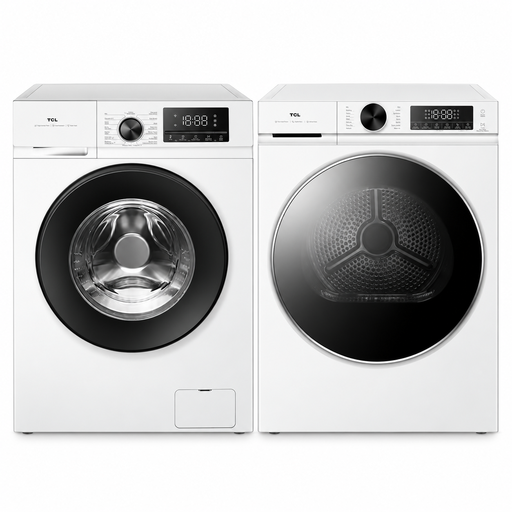 Image unavailable
According to the product description, the separate appliances can be used at the same time, which may suit housemates who want to stagger washing and drying.
Washing capacity: 8 kg. Drying capacity: 8 kg. The product name lists 1400 rpm and a steam function.
Two appliances need more space than one washer-dryer.
 Image unavailable
This washer-dryer has one washing and drying capacity; during a combined cycle, the machine cannot wash another load at the same time.
Washing capacity: 9 kg. Drying capacity: 5 kg. The product name lists 1400 rpm; the description mentions a delay start and a remaining-time display.
A full wash load will not necessarily fit in one drying cycle.
 Image unavailable
This washer-dryer combines washing and drying in one appliance; plan a combined load around the lower drying capacity.
Washing capacity: 8 kg. Drying capacity: 6 kg. The product name lists 1400 rpm, Wi-Fi and a steam function. The description mentions programmes for wool, synthetics and cotton.
A full wash load will not necessarily fit in one drying cycle.
 Image unavailable
If you want to share one appliance for washing and drying, bear in mind that other housemates may have to wait during a combined cycle.
Washing capacity: 9 kg. Drying capacity: 6 kg. The product name lists AI Control and Ecobubble.
The description mentions a Super Speed wash programme for 5 kg in 39 minutes; this is the washing time, not the time for a combined wash-and-dry cycle.
 Image unavailable
This heat-pump washer-dryer has one washing and drying capacity; check that the drying capacity suits the load you want to dry straight away.
Washing capacity: 10 kg. Drying capacity: 6 kg. The product description mentions a heat pump.
A full wash load will not necessarily fit in one drying cycle.
No. First check whether the jacket's instructions allow tumble-drying. If it is personal protective equipment, follow the relevant use and care instructions too; a programme on the machine does not determine whether the jacket can be tumble-dried.
Follow the installation instructions for the exact model. The Dutch Consumers' Association recommends, among other things, a level, sturdy surface, removing the transit bolts, securing the drain hose, levelling the appliance and using an earthed socket.
Compare the figures for the full wash-and-dry cycle on the energy label, not just those for washing. European energy labelling rules treat washing and the combined cycle separately.
Contact the retailer. According to ACM ConsuWijzer, your statutory guarantee is in addition to any manufacturer's guarantee; its duration depends on what you could reasonably expect from the product and is not automatically two years.
There is no general yes-or-no answer for all clothing and situations. Protective clothing may be personal protective equipment and must be cared for according to the relevant instructions. If it may be contaminated with hazardous substances, ask your employer how it should be treated first; this is not a general ban on washing ordinary workwear at home.