A washer-dryer is a good choice if you only have room for one appliance and the care label allows your workwear to be washed and, where appropriate, tumble-dried at home. Compare the drying capacity and figures for the full cycle with your usual loads. If you often wash and dry loads one after another, separate appliances are also worth considering. Milieu Centraal recommends a separate washing machine and tumble dryer because their combined energy consumption is lower.
Who is this choice right for?
Families with lots of washable workwear
If you regularly wash workwear with the family laundry, compare both the washing and drying capacities with the loads you actually handle. The Consumentenbond points out that the amount of laundry you want to dry needs to be within the drying capacity.
Families short on space
A washer-dryer combines washing and drying in one appliance. Measure the space available and check the dimensions and installation requirements for the specific model.
Families who often use a tumble dryer
If you use the drying function regularly, it’s worth considering the full wash-and-dry cycle and its consumption figures, as well as the programme duration.
What should you look for when buying?
Washer-dryer
A good choice if: you have space for one appliance and the load you want to dry straight away is within the capacity of the selected programme.
Bear in mind: the drying capacity may be lower than the washing capacity, so you may need to remove part of the load before drying.
Separate washing machine and heat-pump tumble dryer
A good choice if: you have room for two appliances and often wash and dry loads one after another.
Bear in mind: you’ll need space for both appliances and will have to move the laundry between them. Milieu Centraal recommends this set-up because its combined energy consumption is lower.
Heat-pump washer-dryer
A good choice if: you need one appliance, often use electric drying and can find a suitable model that fits your available space.
Bear in mind: compare the figures for the full cycle and the dimensions of the specific model. Don’t assume it will have the same features as a separate heat-pump tumble dryer.
| What to consider |
What to look for |
Who should pay extra attention? |
| Clothing care instructions |
Check the care label, any workplace instructions and whether the fabric is suitable for tumble drying. |
If I want to wash workwear at home, I don’t want to overlook the care instructions. Around 33% of consumers put appropriate clothing care first. |
| Drying capacity and time |
Compare the drying weight for the fabric in question with the duration of the full cycle. |
For regular workwear and family laundry, I want to know how much can be dried in one go and how long the machine will be in use. Around 27% of consumers prioritise handling family laundry loads. |
| Available space |
Measure the space for the appliance and check the model’s dimensions and installation requirements. |
If there’s room for only one appliance, I want to be able to combine washing and drying in it. Around 20% of consumers prioritise making the most of limited space. |
| Energy and water use when drying |
Compare energy per 100 cycles and water per cycle for the same full wash-and-dry cycle. |
If you dry laundry regularly, you’ll want to weigh the consumption of the full cycle against how often you use it. Around 20% of consumers prioritise understanding energy and water use. |
Common buying pitfalls
-
Looking only at the highest kilogram figure
The washing capacity may be higher than the drying capacity, and the permitted load can also vary depending on the type of fabric.
Compare the drying weight with the load you want to dry without having to take anything out.
If a load can’t be dried in one go, you may need extra drying cycles and more time to handle the laundry.
-
Using the wash energy rating to judge the full wash-and-dry cycle
The energy and water figures for washing alone don’t give you the same picture as the figures for washing and drying. Standard washer-dryers may also use water during drying.
Compare the EU label figures for the same full cycle, paying attention to energy per 100 cycles and water per cycle.
-
Assuming every programme is suitable for workwear
A programme name doesn’t prove that protective or potentially contaminated clothing can be safely treated at home. Arboportaal describes protective clothing as personal protective equipment when it is intended to protect against a work-related risk.
Check the clothing label and your employer’s instructions. Assess protective clothing or clothing that may be contaminated with hazardous substances separately.
-
Assuming one appliance will automatically suit a busy family
A combined cycle can keep the appliance busy for a long time. Separate appliances take up more space, but let you wash and dry independently.
Choose based on the space available, the number of loads and how often you use a tumble dryer.
You can’t start another wash in the same machine while the combined cycle is still running.
Brands worth comparing
Bosch
The Bosch WNA13400NL is a freestanding washer-dryer with an 8 kg washing capacity and a 5 kg drying capacity.
- Bosch lists a sports programme for this model.
- The drying capacity is lower than the washing capacity. A sports programme doesn’t prove that specific workwear can be safely cleaned.
AEG
According to AEG, the LWR76144 has a washing capacity of 11 kg and a drying capacity of 7 kg.
- AEG lists programmes for synthetics and outdoor clothing.
- An 11 kg washing capacity doesn’t mean you can dry 11 kg straight away. AEG gives a maximum duration of 7:30 for the full rated wash-and-dry cycle.
Hisense
The Consumentenbond lists the Hisense WD3S9043BW3 as having a capacity of 9 kg for washing cotton and 6 kg for drying cotton.
- The Consumentenbond also lists separate capacities for synthetic laundry: 4,5 kg for washing and 4,5 kg for drying.
- The capacities listed vary by fabric type, so compare them with the materials in your own laundry.
Samsung
The Consumentenbond lists the Samsung WD70TA049BE/EN as having a capacity of 7 kg for washing cotton and 4 kg for drying cotton.
- The Consumentenbond also lists capacities for synthetic laundry for this model.
- The stated capacity for synthetic laundry is 3,5 kg for washing and 2,5 kg for drying. These specifications apply to this model and not automatically to other Samsung models.
Miele
The Consumentenbond lists the Miele WTI 370 WPM as having a capacity of 8 kg for washing cotton and 5 kg for drying cotton.
- For synthetic laundry, the Consumentenbond lists a capacity of 3,5 kg for washing and 3,5 kg for drying.
- Check the capacity for the type of fabric you want to wash and dry; the cotton figures don’t necessarily apply to other fabrics.
Appliances for washing and drying at home
This selection includes both separate appliances and washer-dryers for households handling washable workwear and family laundry.
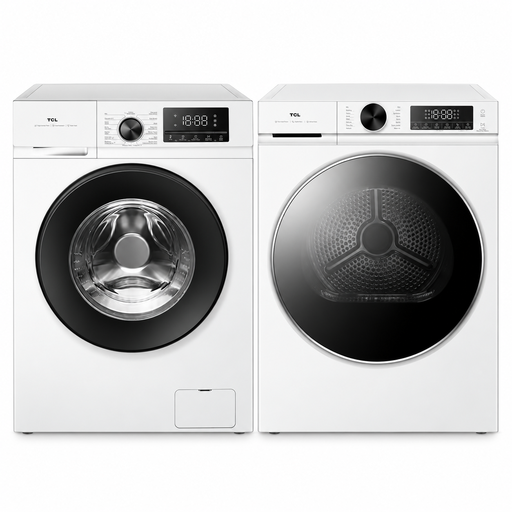 No image available
TCL washing machine and heat-pump tumble dryer, 8 kg + 8 kg
A set of two appliances that lets you wash and dry separately; make sure you have room for both.
Washing capacity: 8 kg. Drying capacity: 8 kg. Listed spin speed: 1400 tpm. Steam function.
View at Joybuy
 No image available
Candy BWR 495BL8-S, 9 kg washing and 5 kg drying capacity
A washer-dryer for anyone who wants to wash and dry in one appliance; a wash load over 5 kg is beyond the stated drying capacity.
Washing capacity: 9 kg. Drying capacity: 5 kg. Listed spin speed: 1400 RPM. The product description lists programmes for cotton and wool.
View at Joybuy
 No image available
Haier HWD90-BP14929A-S, 9 kg washing and 5 kg drying capacity
A washer-dryer for washing and drying in one place; bear in mind that the drying capacity is lower than the washing capacity.
Washing capacity: 9 kg. Drying capacity: 5 kg. Listed spin speed: 1400 rpm. The product description lists programmes for synthetics, cotton and wool.
View at Joybuy
 No image available
Midea MF205D80WB/W-NL, 8 kg washing and 6 kg drying capacity
A washer-dryer for anyone who wants to use a single appliance; compare the drying capacity with the amount you usually want to dry in one go.
Washing capacity: 8 kg. Drying capacity: 6 kg. Listed spin speed: 1400 rpm. The product description lists programmes for synthetics, wool and cotton.
View at Joybuy
 No image available
Bosch WNA13400EU, 8 kg washing and 5 kg drying capacity
A washer-dryer for washing and drying in one appliance; its stated drying capacity is lower than its washing capacity.
Washing capacity: 8 kg. Drying capacity: 5 kg. The product description lists a sports programme for microfibre, fleece and synthetic materials.
View at Joybuy
Frequently asked questions
Can all workwear be washed at home with the family laundry?
No. The word ‘washable’ on its own isn’t enough to tell you. Check the clothing label and your employer’s instructions. Arboportaal describes protective clothing as personal protective equipment when it is intended to protect against a work-related risk. If clothing may be contaminated with hazardous substances or pathogens, don’t assume a household programme will be sufficient.
Can a full wash load automatically be dried in the same cycle?
Only if the load is within the selected programme’s drying capacity and the clothes are suitable for tumble drying. For example, the Bosch WNA13400NL has an 8 kg washing capacity and a 5 kg drying capacity.
When are separate appliances an alternative to a washer-dryer?
Separate appliances are worth considering if you have room for two machines and often wash and dry loads one after another. Milieu Centraal recommends a separate washing machine and tumble dryer because their combined energy consumption is lower; you’ll need to move the laundry between the appliances.
How do I compare the energy and water use of washer-dryers?
For the same cycle, compare the EU label figures for energy per 100 cycles and water per cycle. The European Commission explains these figures on the energy label for washer-dryers. Estimate your own costs using the number of cycles you expect to run and your energy and water tariffs.
What should I check before installing an appliance?
Measure the available space and compare it with the exact model’s dimensions and installation requirements. This will help you check that the appliance fits and can be connected where you plan to put it.


