
Moving rooms with limited space
You’re looking for one appliance because it’s difficult to fit two separate machines. Measure the available space and check the connections and arrangements for your new room before you choose.


A washer-dryer can be a good fit when moving rooms if the right connections are available, one appliance works better than two, and the care label allows tumble drying. Check the washing and drying capacities separately, and don’t assume a full wash-and-dry cycle will take as little time as a wash-only cycle. If you don’t need to tumble dry, or the care label doesn’t allow it, washing and air-drying may be a better option.
You’re looking for one appliance because it’s difficult to fit two separate machines. Measure the available space and check the connections and arrangements for your new room before you choose.
You want to have clean, and possibly dry, work trousers ready around the time you move. Compare the duration of the programme you need, and bear in mind that drying capacity is lower.
Your trousers may have stretch fabric, reflective details or a protective function. Snickers Workwear recommends following the care instructions on the garment label; for protective clothing, the work instructions are also important.
A good fit when: you can fit one appliance and want to tumble dry your work trousers, if the care label allows it.
Bear in mind: drying capacity may be lower than washing capacity, and a full wash-and-dry cycle can take a long time.
A good fit when: tumble drying isn’t necessary or isn’t allowed by the care label, and you have space to dry your trousers.
Bear in mind: you’ll need space and time to let the trousers dry.
A good fit when: there’s space and suitable connections for two appliances, and you want to be able to schedule separate wash and drying cycles.
Bear in mind: this setup takes up more space, and you’ll need to move the laundry between the appliances.
| Concern | What to look for when buying | Who is this important to? |
|---|---|---|
| Will the appliance fit? | Measure the space and access route; check the external dimensions, water supply, drainage and power supply. | If I have limited space in my new room, I want to know whether the appliance can be positioned and connected safely. Around 33% of consumers say fitting the appliance is their top priority. |
| Will the trousers be ready in time? | Compare the duration of the full programme and the permitted load for that cycle. | If I need my work trousers again quickly around the time I move, I want to know how long washing and any drying will take together. Around 27% of consumers prioritise time and drying capacity. |
| Is the programme suitable for the trousers? | Follow the care label and any work instructions; don’t assume that trousers can be tumble-dried just because they’re washable. | If my trousers have stretch fabric, reflective details or a protective function, I want to follow the recommended care instructions. Around 20% of consumers make garment care their top priority. |
| How much will it use for the way I do my laundry? | Compare the same function on the EU energy label: washing only or washing and drying. | If I use the machine often, I want to consider the consumption of the cycles I’ll actually run. Around 20% of consumers prioritise energy and water use during operation. |
Drying capacity may be lower than washing capacity, so you may not be able to dry a full wash load in one go.
Compare the two kg figures for the exact model and plan an uninterrupted cycle around the drying limit.
With a larger wash load, you may need to split it or schedule an extra drying cycle.
A short programme may be intended for a small or specific load; it doesn’t necessarily tell you how long a full wash-and-dry cycle at rated capacity will take.
Check both the programme duration and the permitted load for the cycle you actually want to use.
Care instructions vary from one garment to another. For protective workwear, the required protective function may also be a factor.
Read the garment label and any work instructions before choosing a drying programme.
Washing only and washing and drying are different uses, each with its own information on the EU energy label.
Compare the figures for the same function, and consider how often you’ll actually use the tumble-drying function.
According to Bosch, the WNA13400NL is a freestanding washer-dryer with an 8 kg washing capacity and a 5 kg drying capacity.
According to AEG, the LWR9506BN4 is a heat pump washer-dryer with a 10 kg washing capacity and a 6 kg drying capacity.
Samsung lists the WD90DG6B85BK with a 9 kg washing capacity and a 6 kg drying capacity.
The Dutch Consumers’ Association overview lists the WD3S9043BW3 with a 9 kg washing capacity and a 6 kg drying capacity.
These washer-dryers are options to consider if you want one appliance around the time you move. Compare their separate washing and drying capacities with the available space and the care instructions for your work trousers.
 No image available
A washer-dryer for anyone who wants to plan washing and any drying with one appliance; tumble drying is only suitable if the care label allows it.
The stated capacity is 8 kg for washing and 5 kg for drying. The product description lists a 60-minute Wash&Dry programme; check which load size this duration applies to.
 No image available
A freestanding washer-dryer to compare if you’re looking for one appliance and the available depth is important.
The stated capacity is 8 kg for washing and 6 kg for drying; the product description lists a depth of 47 cm. Also check the other external dimensions and connections for your chosen spot.
 No image available
A washer-dryer to compare if you want one appliance and need to weigh up the washing and drying capacities separately.
The stated capacity is 10 kg for washing and 6 kg for drying. The product description links a 60-minute programme to shirts or tops; it doesn’t give a duration for a full load of work trousers.
 No image available
A freestanding model to compare if you want one appliance and are weighing up a 7 kg drying capacity against the washing capacity.
The stated capacity is 10 kg for washing and 7 kg for drying. The product description also lists a wool programme; check the care label before choosing it for work trousers.
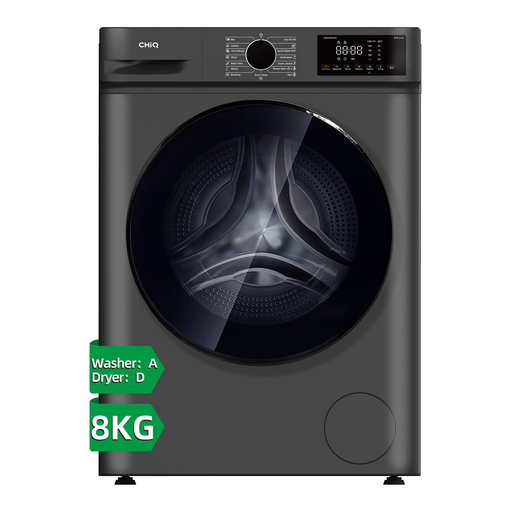 No image available
A washer-dryer to include in your comparison if the available depth in your new room is a consideration.
The stated capacity is 8 kg for washing and 5 kg for drying. The product description lists external dimensions of 600 × 520 × 847 mm; check they’ll fit the space and access route.
No. Washable doesn’t automatically mean suitable for tumble drying. Follow the care label for the specific trousers; Snickers Workwear recommends following the care instructions on the garment label.
Plan a full wash-and-dry cycle around the drying capacity, not just the washing capacity. The Dutch Consumers’ Association points out that for a combined cycle, you can’t wash more than you intend to dry afterwards without removing some of the laundry part-way through.
You can’t tell from the short programme duration alone. Check the permitted load and duration for the specific cycle; a programme described for a small or particular load doesn’t necessarily show how long a full load will take.
Compare the exact model’s external dimensions with the available space and access route, and check that there’s a water supply, drainage and a power supply. Also find out what arrangements apply to your room or shared facilities.
The EU energy label includes information such as energy consumption per 100 cycles, water consumption per cycle and programme duration. Compare wash-only figures with the same function on another model, and compare wash-and-dry figures separately using the same function.