
For small loads
You get home with a few used flannels and want a suitable programme, without running a large machine unnecessarily for just a handful of items.


A washer-dryer is particularly useful if you only have room for one appliance and want to dry your flannels after getting home without transferring them to another machine. For small loads, compare the suitable wash programme and the washing and drying capacities. If you rarely use the drying function, washing and air-drying may be more practical. The Dutch Consumers’ Association points out that washing and drying in one cycle is subject to restrictions on the drying load.
You get home with a few used flannels and want a suitable programme, without running a large machine unnecessarily for just a handful of items.
You want a suitable load to wash and dry automatically after you get home. Make sure the load is within the drying capacity.
You want the option of electric drying, but don’t have a suitable space for both a separate washing machine and a separate tumble dryer.
A good fit if: you want one appliance and want your laundry to dry after you get home without transferring it.
Bear in mind: the drying capacity may be lower than the washing capacity, so compare the full cycle too. The Dutch Consumers’ Association recommends paying extra attention to consumption when washing and drying in one cycle.
A good fit if: you only have a few flannels to wash after a weekend away and you’re not in a hurry for them to dry.
Bear in mind: you’ll need to hang the items up yourself and wait for them to dry.
A good fit if: you have room for two appliances and dry laundry regularly, not just after a weekend away.
Bear in mind: two appliances need more space and you’ll have to move the laundry between them. The Dutch environmental information centre cites lower combined energy consumption as a reason to consider separate appliances.
| What to consider | What should you check? | Who is this most relevant for? |
|---|---|---|
| A suitable programme for a small load | Check the programmes and consult the manual to see which load sizes and fabrics they’re intended for. | If I get home with just a few flannels, I want a programme that’s suitable for such a small load. Around 33% of consumers prioritise a suitable small-load wash. |
| Drying without transferring the laundry | Compare the maximum drying capacity with the washing capacity and check the duration of the full cycle. | If I don’t want to take some of the laundry out of the drum after getting home, the permitted drying load matters. Around 25% of consumers prioritise automatic washing and drying. |
| Room for one appliance | Measure the appliance and allow for the connections and space needed to open the door. | If I don’t have room for two appliances, one appliance needs to fit in the space available. Around 25% of consumers prioritise having a suitable place to install the appliance. |
| Consumption when drying regularly | Compare the label information for washing and for the complete wash-and-dry cycle. | If I often use electric drying outside weekend trips too, I want to know how this affects consumption. Around 17% of consumers prioritise the ongoing cost of use. |
For models such as the Bosch WNA13400NL and AEG LWR73864, the stated drying capacity is lower than the washing capacity. The manufacturers list capacities of 8 kg for washing and 5 kg for drying, respectively.
Compare both figures for the exact model and keep a wash-and-dry load within the applicable drying limit.
A larger wash load may mean you have to dry some items separately or transfer them to another appliance.
LG lists TurboWash 39 for the F4DR7596SYH, as well as a separate wash-and-dry function. A quick wash time alone doesn’t tell you how long washing and drying together will take.
Compare the full programme duration for the load you actually want to dry.
The full cycle may take longer than you’d expect based on the wash programme alone.
The Dutch Consumers’ Association distinguishes between washing and drying, and notes that many standard washer-dryers also use extra water during drying.
Compare the label information for the full cycle and consider how often you’ll use the drying function.
With regular use, the energy consumption of each drying cycle adds up. Some drying technologies also use water.
The Dutch WNA13400NL is a reference point for a washing capacity of 8 kg and a drying capacity of 5 kg.
The 7000 ProSteam LWR73864 is listed with a capacity of 8 kg for washing and 5 kg for continuous wash-and-dry cycles.
The F4DR7596SYH is listed with a capacity of 9 kg for washing and 6 kg for drying, and a stated depth of 565 mm.
The WTD160 WCS is listed as an 8/5 kg model for anyone comparing features for operation and maintenance too.
The I-Pro Series 3 HWD90-B14939 is listed with a capacity of 9 kg for washing and 6 kg for drying, and has a Quick 15 wash programme.
These product picks are washer-dryers for anyone who wants to combine washing and drying in one appliance.
 No image available
A combination appliance for anyone who wants to wash and dry in one machine. The stated drying capacity limits the load that can be dried without transferring items elsewhere.
Capacity: 8 kg washing and 6 kg drying.
 No image available
An option for anyone looking for a washer-dryer and weighing up its lower drying capacity against its washing capacity.
Capacity: 8 kg washing and 5 kg drying. Check that the load you want to wash and dry in one cycle is within the drying limit.
 No image available
A combination appliance for anyone comparing the washing and drying capacities of one machine with the amount of laundry they need to process in one go.
Capacity: 8 kg washing and 6 kg drying.
 No image available
Worth considering if the stated washing capacity and lower drying capacity suit the way you do your laundry.
Capacity: 9 kg washing and 6 kg drying. The title also lists 1400 RPM.
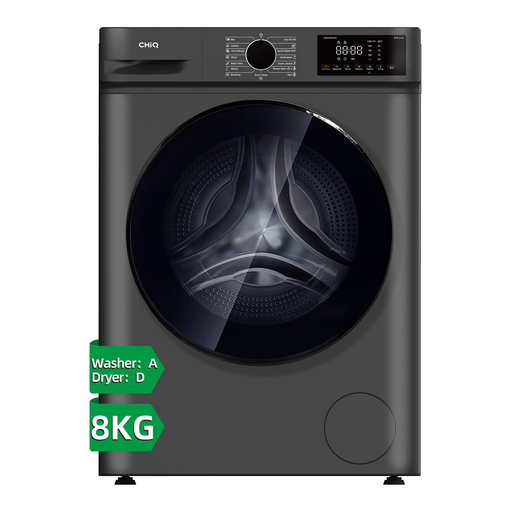 No image available
A washer-dryer to compare if having one appliance is important to you. Check the drying capacity for the load you want to wash and dry in one cycle.
The product title lists a washing capacity of 8 kg and 1400 RPM.
No, not as a general rule for normally soiled textiles. The Dutch environmental information centre says 30 °C is usually enough for everyday laundry, and recommends 60 °C in specific situations, including for tea towels or when there’s illness in the household. Always follow the care label too. If there’s a particular medical circumstance, seek appropriate advice.
Check the appliance dimensions, make sure you have a firm, level surface, and check the water supply and drain connections and that there’s an earthed socket. The Dutch Consumers’ Association recommends removing the transit bolts before use and levelling the appliance. You should also follow the manual for the model you choose.
Compare the label information for the full wash-and-dry cycle, not just the washing cycle. The European Commission explains the EU energy labels for washing machines and washer-dryers. Your actual consumption will also depend on how you use the appliance.
For a typical online consumer purchase, the Netherlands Authority for Consumers and Markets’ ConsuWijzer says you have up to 14 days from delivery to change your mind. Check the applicable exceptions and returns policy. Your statutory rights are separate from the manufacturer’s guarantee: if a product becomes faulty too soon under normal use, the seller is responsible for providing an appropriate solution.
Yes. Household washing machines and washer-dryers must have an EU energy label. The Dutch Government explains that energy labels are mandatory for many household appliances; compare the label for the exact model you’re buying.