
Someone with room for just one appliance
Wants to wash and electrically dry fabric napkins, but has no room for a second machine or a permanent drying rack. The available installation space determines which models will fit.


A washer-dryer could be a good fit if you only have room for one appliance and the napkins’ care labels allow them to be tumble-dried. Bear in mind that drying capacity is lower, and compare the full wash-and-dry cycle on the EU energy label. Milieu Centraal reports that a standard washer-dryer uses more energy than washing and drying separately. If you can hang the napkins up to dry, a washing machine with a drying rack is an alternative; a separate washing machine and tumble dryer require space for two appliances.
Wants to wash and electrically dry fabric napkins, but has no room for a second machine or a permanent drying rack. The available installation space determines which models will fit.
Washes napkins with different washing or drying symbols and wants to tackle stains without choosing a programme that could damage the fabric. GINETEX explains what the care symbols mean.
Wants to deal with laundry after several meals, so compares drying capacity and the duration and energy use of a complete cycle. The Consumentenbond lists these as factors in its washer-dryer testing.
Choose this if: you have room for just one appliance and the care label allows tumble-drying.
Bear in mind: drying capacity is lower than washing capacity on the 9/6 kg models mentioned; Milieu Centraal also reports higher energy use than washing and drying separately.
Choose this if: you have temporary space to hang the napkins up to dry, or if the care label rules out tumble-drying.
Bear in mind: wet fabric takes up space temporarily, and drying indoors requires ventilation.
Choose this if: you have room for two appliances and regularly want to dry larger loads electrically.
Bear in mind: this setup requires space for both appliances. According to Milieu Centraal, washing and drying separately uses less energy than a standard washer-dryer.
| What to consider | What to look for | Who should pay particular attention? |
|---|---|---|
| Will the appliance fit? | Compare the exact model’s dimensions with the installation space and delivery route; also check the installation instructions and connections. | If I only have one space for an appliance, I want to know in advance whether the machine can be installed and connected there. Around 36% of consumers prioritise making sure an appliance fits the available space. |
| Is it suitable for the napkins? | Check the washing and drying symbols on your own napkins. GINETEX says the number in the wash symbol indicates the maximum washing temperature; also check whether tumble-drying is allowed. | If I wash different types of table linen, I want to choose a treatment that suits the care label and the level of soiling. Around 29% of consumers prioritise keeping napkins in good condition and getting them clean. |
| How much can I dry in one go? | Compare the separate washing and drying capacities in kilograms, and check the duration of the complete cycle. | If I have napkins to wash after several meals, I want to know how many I can dry in one combined cycle. Around 21% of consumers focus particularly on processing their laundry loads. |
| How much energy and water does the cycle use? | Compare the figures on the EU energy label for washing only and for washing and drying, including energy per 100 cycles and water per cycle. | If I dry laundry frequently, I want to weigh the space saved against the consumption of a complete cycle. Around 14% of consumers prioritise running costs. |
On the 9/6 kg models mentioned, the stated drying capacity is lower than the washing capacity. This means you may not be able to dry a full wash load straight after washing without adjusting the load.
Check both capacities and keep a combined cycle within the permitted drying load.
A fabric’s suitability for a wash programme does not automatically mean it can be tumble-dried. The care label specifies which treatments are permitted.
Before choosing a programme, check both the wash and drying symbols on the napkins.
The EU energy label also includes figures for washing and drying together. The complete cycle matters if you want to dry your laundry electrically straight after washing.
Compare figures for equivalent cycles, and use electric drying when it suits your space and fabric needs.
A washer-dryer occupies one appliance space; two separate appliances need room for both. External dimensions also vary between models.
Before ordering, check the dimensions of the exact model, the delivery route and the installation instructions.
The Dutch F4DR3096N3W is worth comparing if a stated depth of 565 mm and a capacity of 9 kg for washing and 6 kg for drying are important to you.
The Serie 6 WNG24406NL is worth comparing for its 9 kg washing capacity, 6 kg drying capacity and Bosch’s AntiVlekken option.
The 7000 ProSteam UniversalDose LWR7796UD6 offers programmes such as cotton and delicates, making it worth comparing for different types of table linen.
The Dutch WD90HG6U94BEU3 is a 9/6 kg model worth comparing if automatic dosing is important to you.
These washer-dryers are included to help you compare models that wash and dry in one appliance. For each model, check the dimensions, separate washing and drying capacities, and programmes that suit your napkins’ care labels.
 No image available
An option to compare if a capacity of 8 kg for washing and 6 kg for drying suits your load.
The product information lists programmes for cotton and wool, among other fabrics, a spin speed of 1,400 rpm and a depth range of 49–54 cm. Measure your available space against the exact model.
 No image available
A model to compare if you want to explore programmes for different types of fabric.
The product information lists a washing capacity of 9 kg and a drying capacity of 6 kg, a depth of 55 cm and programmes for cotton and wool, among other fabrics.
 No image available
The stated capacity may be useful if you want to wash 10 kg and can keep the drying load within 6 kg.
The product information lists a 15-minute quick wash and a 60-minute combined wash-and-dry programme. Check the programme instructions for the load and fabric you want to treat.
 No image available
A model to compare if a stated drying capacity of 7 kg suits your needs.
The product title lists a washing capacity of 10 kg, a drying capacity of 7 kg and a width of 60 cm. The product information also lists a wool programme.
 No image available
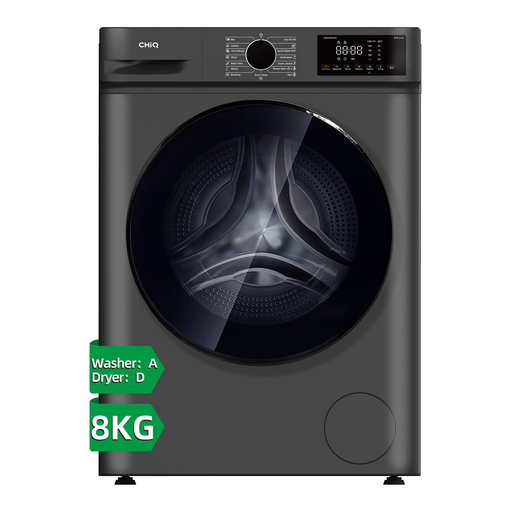
An option to consider if the stated external dimensions fit and you want programmes for different fabrics.
The product information lists a washing capacity of 8 kg and a drying capacity of 5 kg, external dimensions of 600 × 520 × 847 mm and programmes for cotton and delicates.
No. The fact that a napkin is washable does not mean it can be tumble-dried. Check the wash and drying symbols separately. According to GINETEX, the number in the wash symbol indicates the maximum washing temperature, while a circle inside a square refers to tumble-drying.
Measure the available height, width and depth, then compare them with the dimensions of the exact model. Next, consult the installation instructions for the required clearance, water drainage and electrical connection; the external dimensions alone do not guarantee that the appliance will fit. Brandweer Nederland advises plugging high-power appliances directly into a socket, not into a multi-plug adaptor or cable reel.
Not if you need to dry the entire load straight after washing: the stated drying capacity is 6 kg. Keep the load within the applicable drying limit for a combined cycle, or split the laundry into smaller loads.
Compare the EU energy label figures for washing only and for the complete wash-and-dry cycle. The European Commission lists, among other things, energy use per 100 cycles and water use per cycle.
No. According to the Dutch government, there is no fixed statutory guarantee period in the Netherlands; a product must do what you can reasonably expect of it. If a product is faulty, the retailer is your point of contact. A manufacturer’s guarantee or an extended guarantee you purchase is in addition to this.