
If you wear delicate summer dresses
You want to care for machine-washable dresses without assuming they can also go in the tumble dryer. Check the washing and drying symbols on each dress; GINETEX and C&A explain how to read care labels.


A washer-dryer makes most sense if you need one appliance and regularly want to dry dresses that are labelled as suitable for tumble drying. Machine-washable does not automatically mean tumble-dryer safe: GINETEX describes the washing temperature on the care label as a maximum, and you should check the drying symbol separately. When comparing washer-dryers, look at the washing and drying capacities and the figures for the complete cycle. In an upstairs flat, also consider where the appliance will go, vibration and water protection.
You want to care for machine-washable dresses without assuming they can also go in the tumble dryer. Check the washing and drying symbols on each dress; GINETEX and C&A explain how to read care labels.
You want to check in advance whether delivery and installation are practical, and consider vibration and the risk of water damage affecting your downstairs neighbours. The Consumentenbond covers installation and water protection; the Dutch government advises talking to your neighbours first if noise or other disturbance is an issue.
You have space for one appliance and want the option of electrically drying suitable clothes, either occasionally or often. Compare the separate washing and drying capacities, as advised by the Consumentenbond, rather than looking only at the washing load.
Start by checking the washing and drying symbols on your dresses. Then choose between air-drying, a washer-dryer or two separate appliances, based on the space you have and how often you use an electric dryer.
A good fit if: your dresses are not suitable for tumble drying, you rarely use an electric dryer or you have room for an airer.
Bear in mind: you’ll need to hang the clothes up yourself, and drying indoors requires good ventilation.
A good fit if: you have room for one appliance and want to electrically dry suitable clothes too.
Bear in mind: the drying capacity is often lower than the washing capacity. The Consumentenbond notes that standard washer-dryers can use relatively high amounts of energy when drying, and may cause more creasing. This is not a test result for every model or every dress.
A good fit if: you regularly electrically dry suitable clothes, need one appliance and have room for the model you choose.
Bear in mind: the technology does not make a dress labelled as unsuitable for tumble drying safe to put in the dryer. Compare the figures for the model’s complete cycle; don’t assume it will save energy based on the words ‘heat pump’ alone.
A good fit if: you have the space and connections for two appliances, and regularly dry laundry that is labelled as suitable for tumble drying.
Bear in mind: you’ll need more space. Milieu Centraal says a washer-dryer uses more energy than washing and drying in separate appliances.
| What to consider | What should you check? | Who should consider this? |
|---|---|---|
| Caring for dresses | Check the washing and drying symbols on each dress, then see whether the model has a suitable delicate-care programme and an option to wash only. | If you want to adapt the care to delicate fabrics, let the label determine whether an automatic drying step is suitable. Around 36% of consumers prioritise caring for dresses properly. |
| Stable installation and leak protection | Measure the route via stairs and doorways, and check the installation space, connections and water protection for the exact model. | If the machine will be upstairs, you’ll want to take vibration and the possible consequences of a leak into account. Around 29% of consumers prioritise installation and reducing the risk of leaks. |
| Space and drying capacity | Measure the available space and compare the capacity in kilograms for both washing and drying. | If you want one appliance and to dry suitable laundry without transferring it, the drying limit is especially important. Around 21% of consumers prioritise space and practical drying capacity. |
| Energy use when drying | Compare the EU label figures for washing and for the complete wash-and-dry cycle separately, using the same cycle basis. | If you regularly use an electric dryer, you’ll want to know which cycle figures match how you use it. Around 14% of consumers prioritise expected electricity and water consumption. |
Washing and drying instructions are separate. A dress may be machine-washable even though its label says not to tumble dry it.
Check both symbols on each dress before choosing an automatic wash-and-dry programme. GINETEX describes the washing temperature on the care label as a maximum.
For a combined cycle, the drying capacity limits how much laundry you can wash and dry in one go. The EU label shows separate figures for different cycles.
Compare the drying capacity in kilograms and the figures for the complete wash-and-dry cycle of the model you’re considering.
A claim about the motor alone doesn’t tell you how stable the machine will be or how vibration will travel through the floor.
Assess the installation space, make sure the machine is level and stable, and check the water protection on the exact model. Also ask what the delivery and installation service includes.
Dismantling or installation may be a separate service. This is different from the legal requirement to take back a similar old appliance.
Ask which work is included in delivery and how you should prepare your old appliance for collection. According to the Dutch government, a retailer must take back a similar old household appliance free of charge when you buy a new one.
The LWR9506BN4 is a heat pump washer-dryer with a 10 kg washing capacity and a 6 kg drying capacity.
According to Bosch, the Serie 4 WNA13400EU combines an 8 kg washing capacity with a maximum of 5 kg for washing and drying.
According to LG, the GD3R509S0 is a washer-dryer with a 9 kg washing capacity and a 6 kg drying capacity.
According to Miele, the WTI370 WPM PWash is a WT1 washer-dryer with an 8 kg washing capacity and a 5 kg drying capacity.
These washer-dryers are options for anyone looking for one appliance and wanting to electrically dry clothes that are suitable for tumble drying according to their care labels.
 Image unavailable
A good fit if you want one appliance and to dry clothes when the care label allows it; bear in mind the lower drying capacity.
9 kg washing and 5 kg drying; 1400 rpm.
The product information lists a Baby Care programme. Check that the selected programme is suitable for each dress’s care label.
 Image unavailable
An option if you want one appliance and the 6 kg drying capacity suits the loads you can tumble dry according to their care labels.
8 kg washing and 6 kg drying; 1400 rpm.
The product information lists a wool programme. Check that it is suitable for the dress’s care label.
 Image unavailable
A good fit if you want one appliance for washing and drying suitable clothes; bear in mind the lower drying capacity.
8 kg washing and 5 kg drying; product depth 59 cm.
The product information lists AutoDry and AquaStop. Check the model’s installation and connection requirements.
 Image unavailable
An option if you want one appliance and the drying capacity suits your loads of clothes that are labelled as suitable for tumble drying.
10 kg washing and 6 kg drying.
The product information lists a steam programme, among other features. Only choose a programme if the dress’s care label allows it.
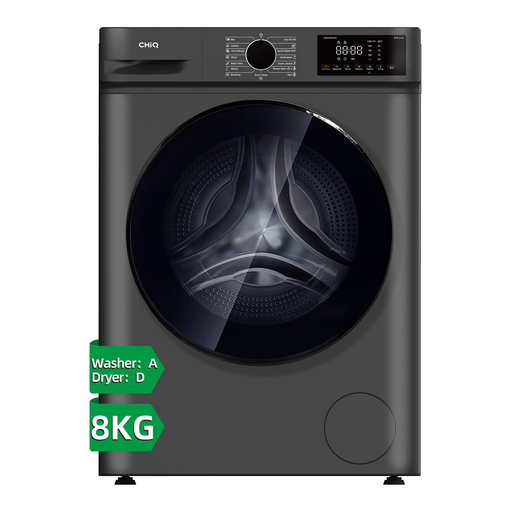 Image unavailable
A good fit if you want one appliance and are comparing models with a programme for delicate laundry; the clothing care label always takes precedence.
8 kg washing and 5 kg drying; dimensions 600 × 520 × 847 mm.
The product information lists a Delicates programme and a steam function.
Not necessarily. Check the separate drying symbol as well as the washing symbol. Don’t select a tumble-drying step if the care label says not to.
Place the machine on a firm, flat and stable surface and make sure it is level. Also check that it can be brought up the stairs and fitted in the intended space; the noise rating alone cannot predict how vibration will travel through your floor.
Make sure the room is well ventilated, with air flowing in and out. Milieu Centraal says this is important for reducing the risk of damp in your home. Follow the dress’s care label for how to dry it, such as hanging it up or laying it flat.
Don’t assume there’s one set time that applies to every flat. If neighbours are disturbed, the Dutch government advises talking to them first; also check the rules for your building.
Since 1 March 2021, household washer-dryers on the EU market have been rated on an energy label scale from A to G. The European Commission distinguishes between the washing cycle and the complete wash-and-dry cycle; compare figures for the same type of cycle.