
People who wear synthetic tracksuits
You want a programme that suits the fabric and its care label. Being machine-washable does not automatically mean a garment can go in the tumble dryer; Milieu Centraal advises following the care instructions.


Choose a washer-dryer based on the care labels on your tracksuits and how much laundry you want to dry without taking any out part-way through. The Consumers’ Association points out that drying capacity may be lower than washing capacity. If you often have large loads to dry, compare separate appliances and line drying too, as Milieu Centraal advises.
You want a programme that suits the fabric and its care label. Being machine-washable does not automatically mean a garment can go in the tumble dryer; Milieu Centraal advises following the care instructions.
You mix everyday laundry with sportswear and want to know how much can be washed and dried in each programme. The Consumers’ Association stresses that washing and drying limits can differ.
You are considering one appliance for washing and drying, but want to weigh up drying time and energy use against separate appliances. Milieu Centraal discusses this trade-off alongside line drying.
Start with the care labels and the amount of laundry you want to dry in one go. Then decide whether one appliance, a suitable programme or separate drying options best suit your needs.
Choose this if: you need one appliance and its programme is suitable for the care label. For example, the Bosch WNA13400EU lists a sportswear programme for functional, synthetic and microfibre fabrics.
Bear in mind: the permitted load for each programme and the lower drying capacity. A sportswear programme does not mean every tracksuit can be tumble-dried.
Choose this if: the care labels allow different suitable fabrics to be washed together. The LG F4DR7596SYH lists a Mix programme.
Bear in mind: a Mix programme does not change the care instructions for your clothes. This LG model does not list a separate sportswear programme.
Choose this if: you often do large loads, have room for two appliances or have clothes that the care label says must not go in the tumble dryer.
Bear in mind: two appliances take up more space and mean transferring laundry between them; line drying takes time and space.
| What to consider | What should you check? | Who is this most relevant to? |
|---|---|---|
| Fabric and programme | Follow the washing and drying care labels, and check the permitted load for the specific programme. Fasten zips before washing. | When I wash tracksuits, I want to know whether each garment can withstand the chosen treatment. Around 33% of consumers say fabric care is their main concern. |
| Washing and drying capacity | Compare both capacities and, where specified, check the limits for synthetic or mixed-fabric programmes. For example, the Consumers’ Association lists the Bosch WNG24406NL as having a 9 kg cotton washing capacity and a 6 kg cotton drying capacity, but a 4 kg synthetic washing capacity and a 2.5 kg synthetic drying capacity. | With a varying weekly load, I want to know how much laundry can go through the drying cycle without being taken out. Around 27% of consumers give suitable washing and drying capacity top priority. |
| Space and convenience | Measure the space available and check the dimensions and installation instructions for the exact model. Also check that the load is within the limit for the combined cycle. | If space is limited, one appliance may suit my setup better than two separate machines. Around 20% of consumers put limited space and convenience first. |
| Energy use when drying | Compare the information on the EU energy label for washing with that for the full wash-and-dry cycle; these are different usage scenarios. Also consider how often you actually use the tumble dryer. | If I dry laundry often, I want to factor in the energy use of that routine and consider whether line drying would work for me. Around 20% of consumers make running costs their top priority. |
Drying capacity may be lower than washing capacity. Synthetic fabrics may also have different limits from cotton, so not every load can go through the full cycle without some laundry being taken out.
Compare the limits for the exact programme and model with the amount of laundry you actually want to dry.
A larger load may mean extra drying cycles or taking some laundry out part-way through.
A programme label does not replace the washing and drying instructions on clothing labels; the wrong treatment could damage your clothes.
Sort clothes according to their care instructions and check separately whether each item can go in the tumble dryer.
Washing and the full wash-and-dry cycle are not the same type of use. Milieu Centraal says a washer-dryer uses more energy than washing and drying with separate appliances.
Compare figures for the same cycle type and weigh up the options based on how often you use the tumble dryer.
An additional warranty does not replace your statutory rights against the retailer. According to the Dutch Government, there is no fixed time limit for the statutory guarantee in the Netherlands.
Check what extra cover is offered and remember that if a product is faulty, you should contact the retailer.
An optional extended warranty may come with a separate fee.
Worth considering if you are looking for a washer-dryer with a dedicated sportswear programme. Bosch lists this programme for the WNA13400EU.
Worth considering for suitable mixed loads: the F4DR7596SYH lists a Mix programme.
The WD90HG6U94BEU3 is worth considering if you want to look at a washer-dryer with stated washing and drying capacities of 9 kg and 6 kg, as well as automatic detergent dosing.
AEG lists both condenser and heat pump washer-dryers, so drying technology can be part of your comparison.
These models combine washing and drying for households that do mixed weekly loads and sportswear. Check whether the care labels and programme capacities for each model suit your load.
 No image available
An option to consider if you are looking for a washer-dryer with a sportswear programme for suitable fabrics.
The product name lists a washing capacity of 8 kg and a drying capacity of 5 kg. Bosch lists a sportswear programme for this model for functional, synthetic and microfibre fabrics; follow the care label and programme limits.
 No image available
A washer-dryer to compare if you are looking for one appliance to wash and dry your laundry.
The product name lists a washing capacity of 9 kg and a drying capacity of 6 kg, so the drying capacity is lower than the stated washing capacity.
 No image available
An option to compare if you want to see how the washing and drying capacities of one washer-dryer measure up against your weekly load.
The product name lists a washing capacity of 10 kg and a drying capacity of 6 kg; check that your intended drying load is within this limit.
 No image available
A washer-dryer to consider if you want to compare its stated washing and drying capacities with your mixed load.
The product name lists a washing capacity of 10 kg, a drying capacity of 7 kg and a width of 60 cm. Check the installation dimensions for the exact model.
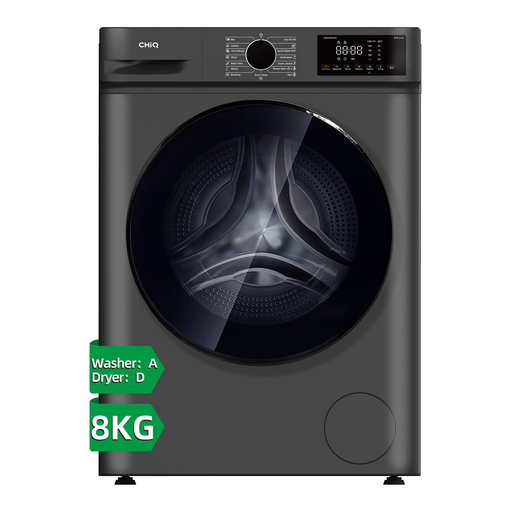 No image available
A freestanding washer-dryer to compare if you are looking for one appliance for your laundry routine.
The product name lists 8 kg and a dark grey finish. Check the specifications for the exact variant to confirm what the capacity figure means and which programmes are suitable.
No. First check the drying instructions on each garment’s care label. Being machine-washable does not automatically mean a garment is suitable for the tumble dryer; also check that the load is within the drying and programme capacity.
First check which items can be washed and dried together according to their care labels. Then compare the weight of that load with the drying capacity and any lower limits for the chosen synthetic or mixed-fabric programme.
Measure the available width, height and depth against the specifications for the exact model and its installation instructions. Fasten zips before washing and dose detergent according to how dirty the laundry is, the water hardness and the load size; also follow the appliance’s maintenance instructions.
No. According to the Dutch Government, there is no fixed time limit for the statutory guarantee in the Netherlands. What you can expect depends, among other things, on the product, its price and how it is used. If a product is faulty, contact the retailer, even if the manufacturer’s warranty has expired.
Compare both the information for washing and that for the full wash-and-dry cycle. The European Commission describes these as separate usage scenarios on the energy label for household washing machines and washer-dryers.