
Residents with synthetic tracksuits
You want to choose a wash programme that matches the care label. Machine washable doesn’t automatically mean an item can go in the tumble dryer too.


Choose a washer-dryer with a programme that suits the material and care instructions for your tracksuits, then compare the washing and drying capacities and the length of a full cycle. You should only tumble dry them if the care label allows it. If you rarely need to dry your clothes, hanging them up can reduce the need to use the drying function and free up the machine sooner. If you regularly wash and dry your clothes, drying capacity and cycle time are key considerations.
You want to choose a wash programme that matches the care label. Machine washable doesn’t automatically mean an item can go in the tumble dryer too.
You plan laundry with your housemates and want to know how long a full wash-and-dry cycle will keep the machine in use.
You may not have room for two separate appliances, so you want to work out whether a washer-dryer will fit in the space available.
First, decide whether you’ll mostly wash and hang your clothes up, or regularly run a complete wash-and-dry cycle. This will determine which capacity and programme details matter most.
Best for: A single appliance space and tracksuits that the care label says can be washed but not tumble dried.
The trade-off: You’ll need space to hang your clothes up to dry, and the drying function may go unused.
Best for: A single appliance space, clothes that can be tumble dried and housemates who can coordinate their laundry.
The trade-off: The same machine remains in use for the full cycle. The Consumers' Association recommends taking drying capacity into account: for a combined cycle, the load must fit within that capacity.
Best for: You have space for two appliances and your housemates want to plan washing and drying separately.
The trade-off: Two appliances need more space. Milieu Centraal states that a separate washing machine and tumble dryer use less energy together than a washer-dryer.
| What to consider | What should you check? | Who is this most relevant to? |
|---|---|---|
| Washing and drying tracksuits | Check the care label and whether the model has a suitable synthetic or delicate programme. Also check whether washing and drying can be set separately. | If I wash synthetic tracksuits, I want to choose a programme that suits the material and the care label. Around 31% of consumers give clothing care the highest priority. |
| Availability of the shared machine | Compare the washing and drying capacities separately, and check the length of the full cycle you plan to use. | If housemates want to do their washing one after another, I want to know how long a combined cycle will keep the machine in use. Around 25% of consumers prioritise turnaround time. |
| Fitting the space available | Measure the space for the appliance and the delivery route. Also check the exact model’s dimensions, door clearance and installation instructions. | If there’s only one suitable space, I want to know in advance whether the appliance can be installed and used there. Around 25% of consumers prioritise the space available. |
| Energy use when drying regularly | Compare the information on the EU label for the same type of cycle: washing only with washing only, or the full wash-and-dry cycle with the same cycle. | If we use the drying function often, I want to take the information for the full cycle into account, not just the information for washing. Around 19% of consumers prioritise ongoing energy use. |
For a combined cycle, the drying capacity may be lower than the washing capacity. A full wash load may not fit into one uninterrupted wash-and-dry cycle.
Check both figures and use the drying capacity as your guide if you want the load to dry without taking it out partway through.
If the load is too large for the drying capacity, you’ll need to reduce it or plan a separate drying cycle.
The care instructions also determine whether tumble drying is suitable. A general programme name doesn’t replace the care label on the garment.
Check the care label on each tracksuit before choosing a drying programme.
Drying an item against its care instructions could damage it.
Information for washing only doesn’t describe the full wash-and-dry cycle. The relevant cycle depends on how often you tumble dry your clothes.
Compare information for the same type of cycle on the EU label, and include the full wash-and-dry cycle if you dry clothes regularly.
With a washer-dryer, washing and drying use the same machine. The Consumers' Association points out that the machine remains in use until a combined cycle is complete; separate appliances, on the other hand, need more space.
Compare the space available with the expected order of your laundry loads and the length of the programmes you plan to use.
Bosch Netherlands lists a sports programme for the WNA13400EU, with capacities of 8 kg for washing and 5 kg for drying.
LG lists a washing capacity of 9 kg and a drying capacity of 6 kg for the F4DR3096N3W.
Samsung describes the WD90DG6B85BKU3 as a model with a 9 kg washing capacity and a 6 kg drying capacity, as well as app and dosing features.
This selection includes washer-dryers for a household with space for one appliance, as well as a separate washing machine and heat-pump tumble dryer set for those with room for two appliances.
 No image available
Could suit you if you’re looking for one appliance and want to compare a synthetic wash programme with your tracksuit’s care instructions.
Washing capacity: 9 kg; drying capacity: 5 kg.
The product information lists a synthetic wash programme and a spin speed of 1400 tpm.
 No image available
Could suit you if you’re looking for one appliance and want to plan housemates’ laundry around the time remaining or a delayed start.
Washing capacity: 9 kg; drying capacity: 5 kg.
The product name lists a spin speed of 1400 tpm.
 No image available
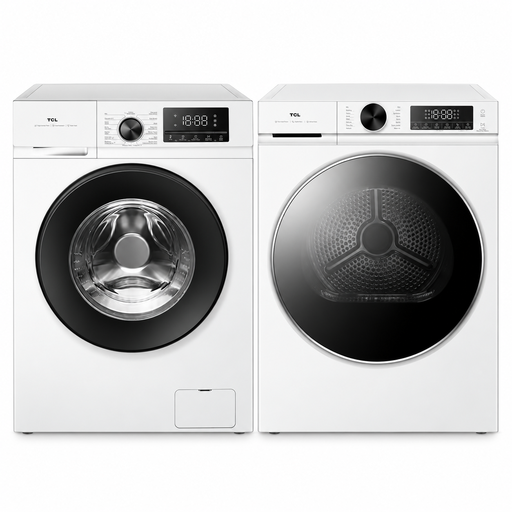
Could suit you if you have room for two appliances and your housemates want to plan washing and drying separately.
Washing capacity: 8 kg; drying capacity: 8 kg.
The description states that you can start a new wash while another load is drying. The set includes two appliances, so you’ll need space for both.
 No image available
Could suit you if you’re looking for one appliance and want to match a synthetic programme to the garment’s care instructions.
Washing capacity: 8 kg; drying capacity: 6 kg.
The product information lists a spin speed of 1400 tpm and wifi.
 No image available
Could suit you if you want to plan laundry for your housemates and occasionally tumble dry clothes too.
Washing capacity: 9 kg; drying capacity: 6 kg.
The product information lists a Super Speed programme that washes 5 kg in 39 minutes.
No. Check the care label on the specific tracksuit. Nike Netherlands advises caution when tumble drying sportswear; this general clothing advice doesn’t apply to every tracksuit.
Only if the load fits within the drying capacity of the model and programme you choose. For example, Bosch Netherlands lists 8 kg for washing only and 5 kg for washing and drying on the WNA13400EU. Check the separate figures for each model.
Measure the space for the appliance and the delivery route, and check the installation instructions for the exact model to see what connections and clearance you’ll need. Also agree who in the house will buy the appliance and contact the seller if it develops a fault.
According to the European Commission, compare figures for the same type of cycle: washing only with washing only, or the full wash-and-dry cycle with the same cycle. Also consider how often you actually tumble dry your clothes; hanging them up avoids a machine drying cycle.
Compare the exact model’s dimensions with the space available, and also check the delivery route, the clearance needed to open the door and the installation instructions. Whether it’s suitable depends on the space and connections in your home.