
Wearers of delicate summer dresses
You wash dresses with different care symbols and want to know when a gentle machine programme is suitable and when tumble drying isn’t an option.


A washer-dryer makes most sense if you want one appliance to dry clothes that are suitable for tumble drying according to their care labels. Washable summer dresses aren’t automatically suitable for machine drying: check both the washing and drying symbols, and compare drying capacity, consumption and the space available before you choose.
You wash dresses with different care symbols and want to know when a gentle machine programme is suitable and when tumble drying isn’t an option.
You want to wash and, for clothes that are suitable, dry them using one appliance in the space available in your utility room.
You’re comparing the drying function with air-drying or separate appliances, and want to distinguish figures for washing alone from those for a complete wash-and-dry cycle.
Choose this if: the care label allows machine washing but rules out tumble drying, or if you have space to hang the dresses up.
Bear in mind: air-drying takes space and time. A washer-dryer can still be useful for other laundry that’s suitable for its drying function.
Choose this if: the dress’s care label allows tumble drying and you keep the load within the drying capacity.
Bear in mind: drying capacity is usually lower than washing capacity. A combined cycle can take a long time and use extra energy and water. The Consumentenbond highlights the benefit of having one appliance, while Milieu Centraal points to the higher consumption of a washer-dryer.
Choose this if: you often tumble-dry other suitable laundry and have room for two appliances.
Bear in mind: two appliances need more space. Milieu Centraal recommends separate appliances over a conventional washer-dryer because of energy consumption; compare the figures for the appliances you’re considering.
| What to consider | What should you check? | Who is this important to? |
|---|---|---|
| Care labels and programmes | For each dress, check the maximum washing temperature, the guidance for gentle washing and the separate drying symbol. Only use a drying programme if the care label and the treatment you’ve selected allow it. | If I want to wash delicate dresses without disregarding their care labels, I’ll check both treatments first: around 36% of consumers put clothing care first. |
| Washing and drying capacity | Compare the capacity in kg for washing and drying, and check the capacity of the programme you want to use. A wash load won’t necessarily fit into a single drying load. | If I have space for just one appliance and also want to dry suitable clothes straight away, I’ll want to know how much fits into one cycle; around 29% of consumers prioritise saving space and combining functions. |
| Consumption when using the drying function | Compare the energy and water figures for washing alone with those for a complete wash-and-dry cycle, using the same labelling basis. Also consider how often you’ll actually use the drying function. | If I expect to use the drying function regularly, I’ll want to compare its consumption with air-drying or separate appliances; around 21% of consumers focus primarily on running costs. |
| Space and connections | Measure the space available and compare it with the external dimensions of the exact model. Also check the floor, water supply, drainage and connection to an earthed socket. | If I want to install a machine in a specific utility room, I’ll want to know in advance whether the space and connections are suitable; around 14% of consumers make fit their top priority. |
The washing and drying symbols refer to different treatments. A delicate or low-temperature programme doesn’t change what the care label says about tumble drying.
Check both symbols on each dress and skip the drying stage if the care label rules out tumble drying.
With a washer-dryer, the maximum drying load may be smaller than the maximum washing load.
Compare the drying capacity of the programme you plan to use with the load you want to dry.
A larger wash load may need to be split, meaning you’ll need extra drying programmes.
Figures for washing alone don’t show the consumption of a complete wash-and-dry cycle. The European Commission distinguishes between cycle-specific figures on product labels.
Compare figures for the same type of cycle and consider how often you’ll actually use the drying function.
The AEG LWR9506BN4 is a heat-pump washer-dryer with programmes you can compare if you wash a range of fabrics.
The Bosch WNA13400NL is a model to compare if you have space for one appliance and want to look at its separate washing and drying capacities.
The LG F4DR3096N3W is a 9/6kg model worth comparing if its stated washing and drying capacities suit your loads.
These models are washer-dryers for anyone who wants to combine washing and drying in one appliance. Check the care label on each dress to see whether tumble drying is allowed.
 No image available
Suitable if you want to combine washing and drying in one appliance, as long as your clothes are suitable for tumble drying.
Stated capacity: 9 kg for washing and 5 kg for drying. Keep combined loads within the drying capacity.
 No image available
An option to compare if you want to combine washing and drying in one appliance.
Stated capacity: 8 kg for washing and 6 kg for drying. Keep combined loads within the drying capacity.
 No image available
Suitable if you want to handle different types of laundry with one washer-dryer; check that the programme you choose is appropriate for the care label.
Stated capacity: 8 kg for washing and 5 kg for drying. Keep combined loads within the drying capacity.
 No image available
An option if you want to combine washing and drying in one place; choose how to treat a dress by checking its care label.
Stated capacity: 9 kg for washing and 6 kg for drying. Keep combined loads within the drying capacity.
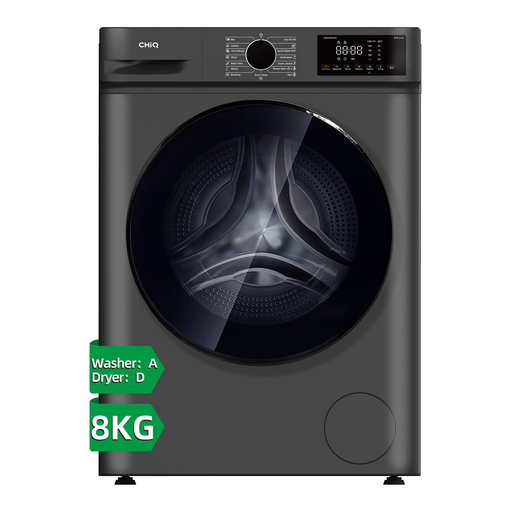 No image available
A washer-dryer to compare if you want to combine washing and drying in one appliance. Check that the programme you choose is suitable for the care label on each dress.
No. Check the drying symbol on the specific dress too. A delicate or low-temperature programme doesn’t override instructions against tumble drying.
Measure the space available and compare it with the model’s dimensions. Before use, remove the transit bolts, level the machine on a firm floor, and connect it correctly to the water supply, drain and an earthed socket. These are installation instructions, not confirmation that every utility room is suitable.
No. According to ACM ConsuWijzer, statutory warranty also applies in the Netherlands. If a product breaks down sooner than you could reasonably expect under normal use, the seller is responsible for providing an appropriate solution. There is no single fixed statutory warranty period in the Netherlands that applies to every washing machine.
Compare the figures for the complete wash-and-dry cycle, not just the class or consumption for washing. The EU label and product information sheet provide cycle-specific figures; an eco cotton cycle isn’t automatically suitable for every delicate dress.