What should you look for when choosing?
Start by asking whether tumble-drying really fits into your routine. The Consumers’ Association discusses the differences between washing and drying capacities, as well as between drying technologies. Milieu Centraal recommends drying laundry on a line wherever possible.
| What to consider |
What should you check? |
Who is this important for? |
| Space and connections |
Compare the appliance’s external dimensions with the space available and the route into the property. Also check the water supply, drainage and electrical connection. |
If I can only fit one appliance, I want to know whether it will actually fit and whether I can hang the shirts out to dry instead. Around 33% of consumers prioritise the space available. |
| Capacity for shared use |
Compare the maximum load for washing cottons with the permitted load for drying; keep the two figures separate. |
If several of us are doing laundry, I want to know whether the load we want to wash can also be dried in one go. Around 27% of consumers give shared washing and drying capacity their highest priority. |
| Energy use when drying |
Compare the figures for washing alone with those for a complete wash-and-dry cycle, based on the same usage. The energy label for washing alone doesn’t show how much energy the drying cycle uses. |
If I tumble-dry regularly, I want to compare the usage figures with the laundry routine I expect to have. Around 20% of consumers prioritise energy use. |
| Programme time and T-shirt care |
Check the duration and permitted load for the cotton and non-stop programmes. Also follow the care label on the shirts before choosing a drying programme. |
If we share the machine, I want to know when a cycle will finish and whether the shirts are suitable for the drying setting selected. Around 20% of consumers give speed and suitable T-shirt care their highest priority. |
Products on Joybuy
This selection includes washer-dryers and a set with a separate washing machine and heat pump tumble dryer, so you can compare what suits the space you have and your drying routine.
 No image available
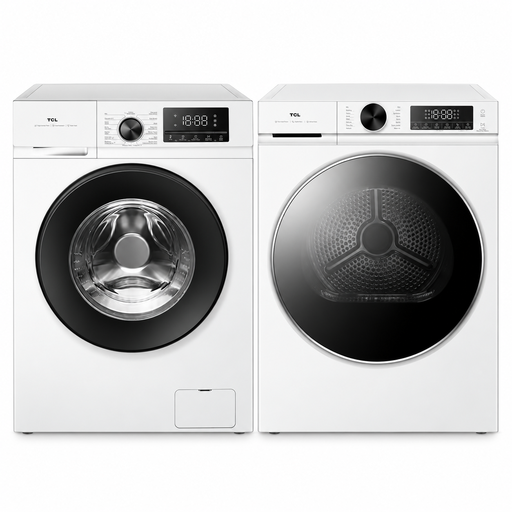
TCL washing machine and heat pump tumble dryer set, 8 kg + 8 kg, 1400 tpm
A set of two appliances to compare if you have room for a separate washing machine and tumble dryer.
Stated capacity: 8 kg for washing and 8 kg for drying. The product name mentions 1400 tpm and a steam function.
View on Joybuy
 No image available
Midea MF205D80WB/W-NL, 8 kg washing capacity and 6 kg drying capacity
A washer-dryer to compare if you have space for one appliance and also want to tumble-dry your laundry.
Stated capacity: 8 kg for washing and 6 kg for drying. The product name mentions 1400 rpm, Wi-Fi and a steam function.
View on Joybuy
 No image available
Hisense WD5I8043BWF, 8 kg washing capacity and 6 kg drying capacity
A washer-dryer to compare if you want one appliance for washing and tumble-drying.
Stated capacity: 8 kg for washing and 6 kg for drying. The product name mentions an inverter motor.
View on Joybuy
 No image available
TCL CP1210WA0, 10 kg washing capacity and 6 kg drying capacity
A washer-dryer to compare if you have space for one appliance and want to weigh up a larger washing load against the smaller drying capacity.
Stated capacity: 10 kg for washing and 6 kg for drying. The product name lists energy rating A for washing and E for washing and drying.
View on Joybuy
 No image available
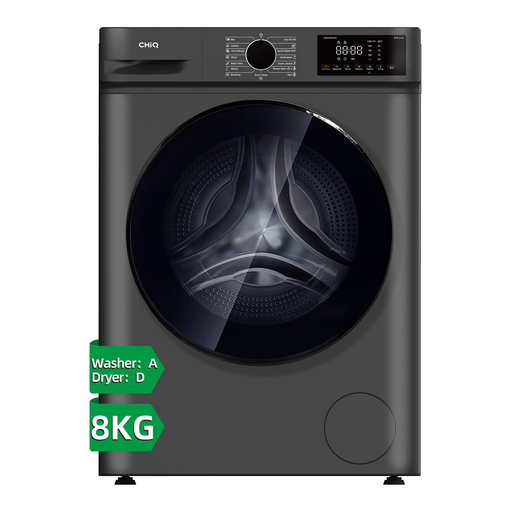
CHiQ JW85882HG, 8 kg washing capacity and 5 kg drying capacity
A washer-dryer to compare if you need one appliance to fit and want to plan the drying load separately.
Stated capacity: 8 kg for washing and 5 kg for drying. The product name mentions 1400 RPM and a steam function.
View on Joybuy
Frequently asked questions
Can we dry a full load of T-shirts completely without taking any out?
Only if the load is within the drying capacity of the model and programme you choose. Compare the kilogram figures separately; for example, the Bosch WNA13400EU has a stated capacity of 8 kg for washing and 5 kg for drying.
What should we check before installing it in our shared student house?
Measure the available space and the route into the property, and check the water supply, drainage, stable flooring and electrical connection. Follow the manual for the exact model; remove the transit bolts before the first wash and make sure the appliance is level. Bosch recommends connecting it to an earthed socket.
How should we use a washer-dryer when several people share it?
Agree who will empty the machine after each cycle, and take the selected programme duration and load into account when planning. Measure detergent according to the packaging and follow the model’s cleaning instructions. Milieu Centraal notes that an eco programme can reduce energy use for normally soiled laundry, but takes longer.
Which energy label should we compare for a washer-dryer?
Compare both the figures for washing alone and those for a complete wash-and-dry cycle. European rules for household washer-dryers treat these cycles separately; an energy label for washing alone doesn’t show the energy use of the drying cycle.
Does an old, similar appliance have to be taken away when we buy a new one?
For private purchases, the Netherlands Government says the old-for-new scheme also applies to online purchases. The retailer must accept a similar old appliance free of charge. Agree how the appliance will be handed over when your new one is delivered.


