
Students with just one laundry space
You share a small laundry area and want to know whether one appliance will fit, including the necessary connections and the route to its installation space.


A washer-dryer is particularly practical in a student house with just one space for an appliance and a regular need to dry clothes in the machine, provided its drying capacity suits your shared loads and the combined cycle fits your schedule. Consumentenbond points out that a standard washer-dryer can use relatively large amounts of energy when drying. If you can hang clothes up to dry or have room for two separate appliances, compare those options too. Always follow the care label on each pair of pyjamas.
You share a small laundry area and want to know whether one appliance will fit, including the necessary connections and the route to its installation space.
You share the machine with others and want to work out whether the drying load and programme length will leave enough time for the next wash.
You regularly compare machine drying with hanging clothes up or using two separate appliances. Milieu Centraal points out that a washer-dryer can use more energy than washing and drying separately.
A good fit when: you have space for just one appliance and want to dry clothes in the machine regularly, with loads that stay within its drying capacity.
The trade-off: the machine is tied up for the entire cycle. Consumentenbond notes that drying can use relatively large amounts of energy and that a combined cotton cycle may take a long time.
A good fit when: you need one appliance and dry clothes often. Compare the capacity of the specific model with the loads you usually do.
The trade-off: compare the energy use for the full cycle and the purchase price of the exact model. Consumentenbond reports less additional water use with heat-pump washer-dryers.
A good fit when: the care labels say your pyjamas can be machine-washed and you have room to hang them up.
The trade-off: hanging clothes up avoids a machine-drying cycle, but takes up space and time.
A good fit when: you have room for two appliances and want to dry clothes often while the next wash is running. Milieu Centraal recommends this option over a combined appliance if low energy use matters when drying regularly.
The trade-off: you need space for two appliances. Compare the specifications and costs of the specific models.
| What to consider | What should you look for? | Who is this most important for? |
|---|---|---|
| Installation space | Compare the external dimensions and access route; check the connections and installation instructions for the model. | If I only have one suitable space, I want to know whether the appliance can be installed there safely and conveniently. Around 33% of consumers say installation space is their main concern. |
| Shared laundry schedule | Compare the washing and drying capacities in kg and the full cycle time with your usual load and schedule. | If I do laundry with housemates, I want to know whether the drying load will fit and how long the machine will be in use. Around 27% of consumers put their shared laundry schedule first. |
| Energy use | On the EU energy label, compare energy per 100 cycles and water per cycle for the same type of cycle. | If I dry clothes in the machine often, I want to compare the energy use for a full wash-and-dry cycle with hanging clothes up and other appliance options. Around 20% of consumers say running costs are their main concern. |
| Pyjama care | Read the care label and check the requirements and load limit for your chosen programme. | If I want to care for my pyjamas according to their individual labels, I make sure the selected wash and dry programme is suitable. Around 20% of consumers put garment care first. |
The drying load may be smaller than the washing load, which means you might need to dry some items separately or keep the shared machine in use for longer. Consumentenbond recommends comparing both capacities.
Compare the separate kg figures with the load you want to wash and dry without having to split it.
That doesn’t show the same thing as the energy use for a full wash-and-dry cycle. The EU energy label gives information for different cycles.
For the models you’re considering, compare the same cycle and units. Include hanging clothes up or using a separate heat-pump dryer if either option suits you.
The fact that a garment is made from cotton doesn’t, by itself, determine how it should be cared for. Bosch says the WNA13400NL has a quick option for small loads; that doesn’t automatically make it suitable for every pair of pyjamas or a full load.
Follow the care label on each garment and check the requirements for the specific programme.
Beko lists the BM5DFT4841A as a freestanding washer-dryer with an 8 kg washing capacity and a 5 kg drying capacity.
Bosch lists the WNA13400NL with an 8 kg washing capacity and a 5 kg drying capacity, as well as a programme for small loads.
According to its product information, AEG offers the LWR9506BN4, a heat-pump washer-dryer with a 10 kg washing capacity and a 6 kg drying capacity.
LG lists the W4X1085NWB with an 8 kg washing capacity and a 5 kg drying capacity, as well as app features.
Joybuy product options for washing and drying: a washer-dryer listed as 10/6 kg and a compact appliance for small loads of laundry.
 No image available
The stated drying capacity is lower than the washing capacity; compare the drying load with what you want to dry after one wash.
The product description mentions a 60-minute wash-and-dry cycle for shirts or tops. That doesn’t automatically mean the cycle is suitable for a full load of cotton pyjamas.
 No image available
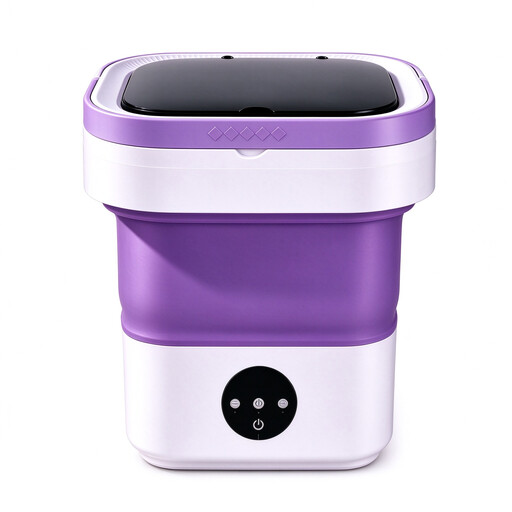
This foldable model is designed for small loads of laundry, such as underwear and socks. Consider it only if that suits what you want to wash.
The product title mentions use in a student room and while travelling. The description focuses on small loads, not a regular shared wash.
No. The fact that a garment is made from cotton doesn’t, by itself, mean it can be treated that way. Follow the care label on the specific pair of pyjamas, and don’t ignore a warning against tumble drying or a recommendation to use a gentle wash programme.
Check that the space is level, stable and sturdy, and consult the manual for the connections required by your chosen model. Consumentenbond recommends removing the transit bolts before use.
If the machine breaks down, contact the seller; a manufacturer’s warranty doesn’t replace your statutory rights. According to Rijksoverheid, the Netherlands has no fixed statutory warranty period: what you can expect from a product depends, among other things, on the product itself and normal use.
Use the information for the exact model and compare the same cycle. The European Commission says the label includes energy use per 100 cycles, water use per cycle, programme duration and noise level.