
Sports enthusiasts with muddy synthetic kit
You regularly wash sports tops, leggings or other technical fabrics alongside everyday clothes, and want to take the material and care instructions into account.


Start by choosing a model with a programme suited to your synthetic sportswear and its care label. Then compare the washing capacity with the smaller drying capacity. If you often dry full loads using electricity and have the space, compare a separate tumble dryer too: the Dutch Consumers’ Association points out that drying programmes on standard washer-dryers can take a long time and use extra water.
You regularly wash sports tops, leggings or other technical fabrics alongside everyday clothes, and want to take the material and care instructions into account.
You switch between cotton and synthetic fabrics, and want to know whether a load can also be dried in one go after washing.
You have limited space but want to dry some of your laundry using electricity, and are mindful of programme times and energy use.
Best if: you have little space for appliances and regularly wash synthetic sports fabrics. For example, Bosch lists a sports programme for the WNA14419NL.
The trade-off: a programme name doesn’t prove that mud will come out without pre-treatment; check the drying capacity too.
Best if: you have room for two appliances and regularly dry larger loads.
The trade-off: two appliances need more space; compare the capacities and specifications of the models you’re considering.
Best if: you have the space and time to dry laundry outside the machine. Milieu Centraal describes line drying as the most environmentally friendly way to dry clothes.
The trade-off: you’ll need drying space and time; clothes that can’t go in the tumble dryer will have to dry outside the machine.
| Buying concern | What should you check? | Who is it important to? |
|---|---|---|
| Washing sportswear | Check that the programme suits the fabric and care label; if necessary, wash sports kit separately from heavy cotton items. | I want to wash muddy synthetic sportswear without overlooking the care instructions. Around 36% of consumers prioritise cleaning sportswear appropriately. |
| Capacity for weekly laundry | Compare the washing and drying capacity in kg for the same model, and check the load limit for each programme. | With mixed loads, I want to know how much laundry can stay in the machine after washing. Around 29% of consumers give capacity for mixed weekly laundry top priority. |
| Washing and drying in one go | Check the drying symbols on each item, the maximum combined load and the programme time. | If I want the laundry to continue without unloading part-way through, I check which items can go in the tumble dryer. Around 21% of consumers prioritise a suitable uninterrupted cycle. |
| Space and energy use | Measure the space for the appliance and the route it will take to get there; compare energy and water figures for washing and for the complete wash-and-dry cycle. | With limited space, I also want to know what regular electric drying involves. Around 14% of consumers prioritise space and energy use. |
The two capacities can differ. Bosch lists 9 kg for washing and 5 kg for drying on the WNA14419NL; LG lists 9 kg and 6 kg for the GD3R509S0. So the maximum washing load won’t necessarily fit in a single drying cycle.
Check both capacities in the product information for the exact same model.
If the load is too large, you may need to unload some items part-way through or run an extra drying cycle.
A quick programme for a small load doesn’t tell you how long a full mixed load will take. The Dutch Consumers’ Association points out that drying programmes on washer-dryers can take a long time.
Compare the duration and maximum load for the programme you actually plan to use.
A long cycle keeps the appliance occupied for longer.
The drying symbol on the care label always takes priority, even if the machine has a sports or drying programme.
Before running a combined cycle, sort items by their drying symbols and remove anything that can’t go in the tumble dryer.
The Dutch Consumers’ Association says that drying with a standard washer-dryer uses extra energy and water. Looking only at the washing cycle won’t give you the full picture if you regularly wash and dry.
Compare the figures for the complete wash-and-dry cycle, using your own rates and usage as a guide.
The WNA14419NL is worth considering if you’re looking for a dedicated sports programme and want to compare dimensions and capacity.
The GD3R509S0 offers a 9/6-kg combination to compare with other models for mixed loads.
The WD90DG5B15BHEN is an option to compare for its programmes, capacity and space requirements.
The WN44A101NL is worth comparing for its capacity and appliance depth.
These Joybuy products are washer-dryers for anyone who wants to wash and dry in one appliance. Check the programme, capacity and drying load for each model.
 No image available
An option to compare if you wash synthetic sports fabrics and are looking for a sports programme; the programme name doesn’t prove that it removes mud specifically.
The product description lists a sports programme. The product name states an 8 kg washing capacity and 5 kg drying capacity.
 No image available
An option for mixed loads if the listed programme features suit the items you want to wash.
The product name states a 9 kg washing capacity and 6 kg drying capacity. The product description mentions AI Wash and a quick wash programme for 5 kg in 39 minutes; this isn’t an independent performance test.
 No image available
An option to compare if you want to be able to run a separate cycle for synthetics; check that the load limit and duration suit your needs.
The product description states a maximum load of 4.5 kg and a total cycle time of 5 hours and 50 minutes for the synthetics programme. The product name states a 9 kg washing capacity and 6 kg drying capacity.
 No image available
An option to compare for mixed loads if the listed programme features suit your needs.
The product name states a 10 kg washing capacity, 6 kg drying capacity and A/E energy ratings. The product description mentions adjustments based on fabric type and how soiled the load is.
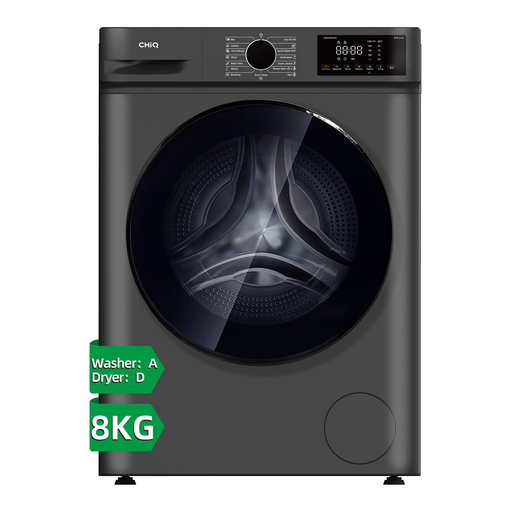 No image available
An option to compare if you wash different types of fabric; check which programme suits the care label.
The product description lists programmes for cotton and delicate fabrics, among others. The product name states an 8 kg washing capacity and 5 kg drying capacity.
First, sort items by fabric and care label. Nike Netherlands recommends keeping synthetic sportswear separate from cotton towels and clothes; a sports programme doesn’t change the care instructions for an item.
No, not necessarily. Check the drying symbol on each item, and bear in mind the machine’s separate drying capacity too.
Compare the energy and water figures for the complete wash-and-dry cycle on the same usage basis, using your own rates and number of cycles. The Dutch Consumers’ Association points out that standard washer-dryers use extra water during drying.
Measure the space for the appliance and the route it will take to get there, then compare these with the dimensions of the exact model. Check the connections in the relevant installation manual too; the stated appliance depth alone doesn’t confirm that the machine will fit in your space.
No. According to the Dutch government, statutory warranty in the Netherlands has no fixed time limit: the product must meet what you could reasonably expect. If something goes wrong, the seller is your first point of contact; a manufacturer’s or additional warranty doesn’t replace these rights.
Compare the figures for washing alone with those for the complete wash-and-dry cycle, rather than assuming one label letter applies to both uses. The European Commission states that household washing machines and washer-dryers in the EU have used a scale from A to G since 1 March 2021.