
Sportspeople with delicate synthetic clothing
You want to wash sweaty tops, leggings or sports bras without assuming they can be washed at a high temperature or tumble-dried. Nike Netherlands recommends checking the care label.


A washer-dryer is a good fit if you have limited space and want to machine-dry sports kit that its care label says is suitable for tumble drying. For synthetic sportswear, check the load limit for the specific wash-and-dry programme, not just the maximum cotton capacity; the Consumentenbond shows that these limits can vary between individual models. If you can air-dry your clothes, you can avoid a machine-drying cycle. Milieu Centraal reports that a washer-dryer uses more energy for washing and drying than separate appliances.
You want to wash sweaty tops, leggings or sports bras without assuming they can be washed at a high temperature or tumble-dried. Nike Netherlands recommends checking the care label.
You want to wash several sports outfits and need a clear distinction between the permitted wash and drying loads for synthetic fabrics. The Consumentenbond publishes model-specific capacities.
You have room for just one appliance and would sometimes like to dry your clothes without transferring them, provided the clothes and programme load allow it. The Consumentenbond recommends checking the balance between wash and drying capacity when choosing a washer-dryer.
A good fit if: you only have space for one appliance and the care label says the clothes are suitable for tumble drying.
The trade-off: the drying load may be smaller than the wash load; combined programmes take time, and according to Milieu Centraal, a washer-dryer uses more energy for washing and drying than separate appliances.
A good fit if: you have space to air-dry your clothes or the care label says not to tumble-dry them.
The trade-off: you’ll need to hang the clothes up yourself and have room for them to dry.
A good fit if: you have room for two appliances and regularly machine-dry suitable laundry.
The trade-off: this set-up takes up more space and you’ll need to transfer the laundry yourself; Milieu Centraal recommends separate appliances because of their energy use.
| What to consider | What to look for | Who is this most relevant for? |
|---|---|---|
| Fabric care | Check the care label and choose a suitable synthetic or delicate programme; only tumble-dry the clothes if the label allows it. | When I wash sweaty synthetic clothing, I want the fabric and care label to guide me; around 33% of consumers give fabric care top priority. |
| Drying load | Compare the wash and drying limits for the fabric and programme. For the Bosch WNG24406NL, the Consumentenbond lists a 4 kg synthetic wash load and a 2.5 kg synthetic drying load. | After packing a full weekend bag, I want to know whether the sportswear I can tumble-dry will fit in one load; around 27% of consumers put a suitable drying load first. |
| Space and handling | Measure the available space and check the installation details for the exact model; also consider whether air-drying is practical. | If I only have room for one appliance at home, space and avoiding the need to transfer clothes matter a lot to me; around 20% of consumers give these factors top priority. |
| Energy use and programme duration | Compare the energy label figures for washing with those for the complete wash-and-dry cycle, and check how long the programme you want to use takes. | If I need my sports kit again quickly or often use the dryer, I want to weigh up energy use and cycle time together; around 20% of consumers put this consideration first. |
Permitted loads can vary by fabric and programme. For example, the Consumentenbond lists different limits for synthetic washing and drying on the Bosch WNG24406NL.
Compare both the wash and drying limits for the programme you plan to use for your sports kit.
Figures for washing alone don’t automatically tell you how much energy a complete wash-and-dry cycle uses. The energy label for household appliances provides information about energy use.
Compare the label figures for washing and for washing plus drying separately, and consider how often you’ll actually use the dryer.
A manufacturer’s warranty or additional cover does not remove your statutory rights against the seller. ACM ConsuWijzer explains that your statutory rights depend on what you can reasonably expect from the product.
Read the terms of any additional cover separately and keep it distinct from your statutory rights with the seller.
The capacities and features listed apply to the models named; they are not a general assessment of an entire brand.
The LWR76144 is worth considering if you want to wash a larger load after a weekend away.
The WNG24406NL is a useful model to compare if you want to weigh up the cotton capacity against the limits for synthetic fabrics.
The GD3R509S0 is a model with a stated wash capacity of 9 kg and a drying capacity of 6 kg.
The WD90HG6U94BEU3 is a model with a stated capacity of 9 kg for washing and 6 kg for drying.
This selection features washer-dryers for anyone who wants to wash and, if suitable, dry sports kit in one appliance. Always check that both the care label and the chosen programme’s load limit allow tumble drying.
 No image available
A freestanding washer-dryer for anyone who wants to wash and dry in one appliance; check the synthetic programme’s load limit for your sports kit.
The product name lists a 9 kg wash capacity and a 6 kg drying capacity, with AI Control and Ecobubble.
 No image available
The stated capacity can help you choose a washer-dryer; for synthetic sportswear, also check the load limit for the specific programme.
The product name lists a 9 kg wash capacity and a 6 kg drying capacity. The description gives a maximum programme load of 4.5 kg for Synthetic Fabrics.
 No image available
Consider this washer-dryer if you’re looking for one appliance for washing and drying; choose a programme that suits the care label.
The product name lists a 10 kg wash capacity and a 6 kg drying capacity, a 60-minute wash-and-dry programme and a 15-minute quick-wash programme. The quick-wash time applies to washing, not a complete wash-and-dry cycle.
 No image available
This washer-dryer may suit you if a stated drying capacity of 7 kg is important; also check the programme limit for the fabric you’re washing.
The product name lists a 10 kg wash capacity and a 7 kg drying capacity. The stated drying capacity is not automatically the limit for every fabric programme.
 No image available
Consider this model if its stated dimensions suit your available space; choose the right load for your sports kit based on the programme and care label.
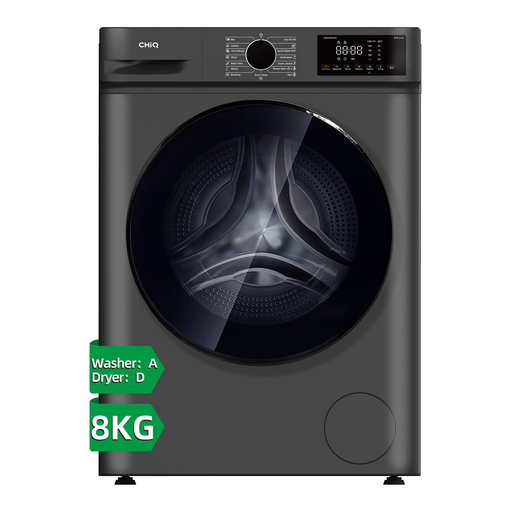
The product name lists an 8 kg wash capacity, a 5 kg drying capacity and 1400 RPM. The description gives dimensions of 600 × 520 × 847 mm and mentions a Delicates programme.
No. It depends on the care label and the programme’s load limit. Nike Netherlands recommends air-drying synthetic sportswear, or using the lowest heat setting only if the care label says it can be tumble-dried.
The permitted wash and drying capacities can differ, including by fabric type. For the Bosch WNG24406NL, the Consumentenbond lists a 4 kg synthetic wash load and a 2.5 kg synthetic drying load. So check the limit for the programme you plan to use.
Compare the dimensions and installation instructions for the exact model with your available space and connections. Then follow the model-specific manual for installation, safety and maintenance.
Compare the energy label figures for washing alone with those for the complete wash-and-dry cycle. The Dutch government describes the energy label as information about energy use; the figures for a complete cycle are relevant if you also use the dryer.
No. According to ACM ConsuWijzer, you also have statutory rights for as long as you can reasonably expect the product to last with normal use; the seller is responsible for this. The Netherlands has no fixed general two-year limit for this.