
Doing laundry in a tight space
You want one appliance for a spot where width, depth, the doorway or access to connections could be an issue. Measure the space and the route to it before comparing models.


Choose a washer-dryer that fits the measured space and available connections, then compare its washing and drying capacities separately. Use a continuous wash-and-dry programme only if the care label allows tumble drying and the load is within the drying capacity. Otherwise, you can wash your clothes and dry them another way. If you tumble-dry regularly, compare the figures for the complete wash-and-dry cycle too.
You want one appliance for a spot where width, depth, the doorway or access to connections could be an issue. Measure the space and the route to it before comparing models.
You wash clothes made from different fabrics or with different finishes, and want to follow the washing and drying instructions for each item. That may mean washing a tracksuit but not tumble-drying it.
You want to wash and dry regularly without transferring the laundry between appliances. In that case, drying capacity, the length of the complete cycle and energy and water use are important considerations.
Choose this when: there’s no room for two appliances, the care label allows tumble-drying and the load is within the drying limit.
The trade-off: drying capacity may be lower than washing capacity, and a complete cycle can take a long time.
Choose this when: you want one appliance, but can’t or don’t always want to tumble-dry your tracksuits.
The trade-off: you’ll need a suitable alternative place to dry clothes that aren’t suitable for tumble-drying.
Choose this when: there’s room for two appliances and you often tumble-dry larger loads.
The trade-off: a separate tumble dryer needs extra space, and you’ll have to transfer the laundry between appliances.
| What to consider | What should you check? | Who should pay extra attention? |
|---|---|---|
| Will it fit? | Compare the appliance’s full width, height and depth with the available space. Check the installation instructions, connections and delivery route too. | I want to know in advance whether the machine will fit in my laundry nook, allowing space for the hoses and opening the door. Around 31% of consumers say fit is their main buying concern. |
| Clothing care | Check the washing and drying instructions for each item. Make sure there’s a suitable wash programme, and choose wash-only if needed. | I want to care for the different fabrics and finishes of my tracksuits according to the care label, even if tumble-drying isn’t allowed. Around 25% of consumers prioritise clothing care. |
| Drying capacity | Compare the maximum washing and drying loads in kilograms for the same model. Check how long the complete cycle takes too. | If I want to wash and dry my laundry in one continuous cycle regularly, I need to know how much will actually fit in the drying phase. Around 25% of consumers put the practicality of the drying cycle first. |
| Running costs | Compare the energy and water figures for the same complete wash-and-dry cycle; don’t look at washing figures alone. | If I tumble-dry regularly, I want to know how much energy and water the complete cycle uses. Around 19% of consumers say running costs are their main buying concern. |
The maximum drying load may be smaller than the maximum washing load. So a full wash load won’t necessarily fit in a continuous wash-and-dry cycle.
Check the washing and drying capacities for the same model, and plan a continuous cycle around the lower drying limit.
You may need to do extra work if you have to split the load or dry some of it another way.
Whether a tracksuit can go in the tumble dryer depends on the garment and its care label. A continuous cycle will include a drying phase.
Check the drying instructions before choosing a wash-and-dry programme. If tumble-drying isn’t allowed, use the wash-only cycle.
Figures for washing alone don’t show the energy and water use of a complete wash-and-dry cycle. The European Commission explains the information shown on the EU energy label for washer-dryers.
Compare the figures for the cycle you actually plan to use, including energy per 100 cycles and water per cycle.
The product dimensions alone don’t tell you whether the machine will fit once you account for hoses, door movement and the available connections.
Measure the space and the delivery route, and check the installation instructions for the exact model.
The BM5DFT4841A is worth comparing if 8 kg washing and 5 kg drying suit your loads, and its stated depth of 57 cm will fit in your laundry nook.
According to LG, the F4DV308S1E has an 8 kg washing capacity and a 6 kg drying capacity, with a stated depth of 565 mm.
The WNG24406NL is worth comparing if 9 kg washing and 6 kg drying will suit your needs and fit in the available space.
The LWR739X64 offers a 9 kg washing capacity, a 5 kg drying capacity and separate programmes, including one for synthetics.
The WD90DG5B15BHEN is a 9/6kg option if its stated depth of 600 mm will fit and its app features suit the way you use your appliance.
This selection includes washer-dryers for anyone who wants to combine washing and, when suitable, tumble-drying in one appliance. Only tumble-dry tracksuits if the care label allows it.
 Image unavailable
An option if you want to combine washing and drying in one appliance; check whether tumble-drying is allowed for each tracksuit.
Stated capacity: 8 kg washing and 6 kg drying.
 Image unavailable
An option if you’re looking for one appliance to wash and dry your clothes; check that the drying limit suits the load you want to dry.
Stated capacity: 8 kg washing and 5 kg drying.
 Image unavailable
An option if you want to compare a washer-dryer with the stated capacity against the space you have available.
Stated capacity: 9 kg washing and 6 kg drying. Dimensions: 60 × 60 × 85 cm.
 Image unavailable
An option to compare if you’re looking for a washer-dryer for different types of clothing; always follow the care label for each item.
Stated capacity: 8 kg washing and 6 kg drying.
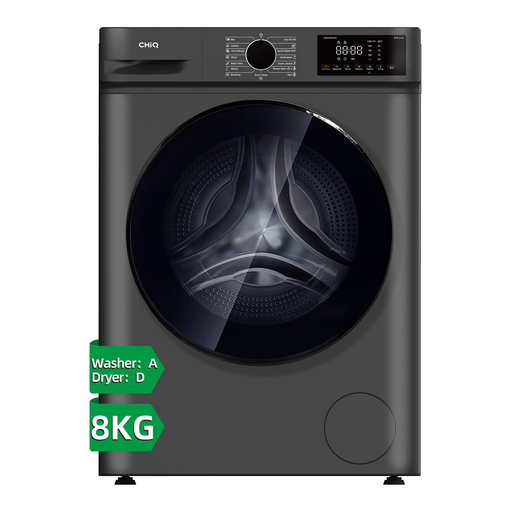 Image unavailable
An option if you’re looking for a washer-dryer for different types of laundry. Before starting a continuous cycle, check which loads are within the drying limit and whether the care label allows tumble-drying.
The product name states a capacity of 8 kg.
No. Washable doesn’t automatically mean suitable for the tumble dryer. Check the washing and drying instructions for each item. If tumble-drying isn’t allowed, choose a wash-only cycle and follow the care label for drying.
Measure the available space and the route to it, and check the installation information for the exact model. The Consumers’ Association (Consumentenbond) recommends, among other things, a flat, stable surface, removing the transit bolts, connecting the water supply and drain correctly, and using an earthed socket.
Compare the figures for washing alone separately from those for the complete wash-and-dry cycle. The EU label includes information such as energy use per 100 cycles, water use per cycle and programme duration. Your actual costs depend on how you use the appliance and your tariffs.
No. According to the Dutch government, there’s no fixed statutory warranty period in the Netherlands. You’re entitled to a product that works properly for the period you can reasonably expect it to last. If a product is faulty, contact the retailer. A manufacturer’s warranty may offer additional cover.
Household washer-dryers covered by the relevant EU rules must carry an energy label. According to the European Commission, the EU label has used a scale from A to G since 1 March 2021. Compare product information based on the same cycle.