What should you look for?
Washer-dryer
A good fit if: you have room for one appliance and regularly want to wash and dry your laundry without transferring it between machines.
Trade-off: the drying capacity may be lower than the washing capacity, and a combined cycle can take a long time.
Washing and line-drying
A good fit if: you can usually hang your laundry up and don’t need to machine-dry it regularly.
Trade-off: you’ll need a suitable place and enough time for your laundry to dry.
Separate washing machine and tumble dryer
A good fit if: you have room for two appliances and regularly machine-dry larger loads.
Trade-off: you’ll need more space and will have to transfer your laundry between the appliances.
Measure the available space, then work out how often you’ll want to machine-dry your laundry. These two considerations will help you decide whether a washer-dryer, line-drying or two separate appliances best suits your needs.
| What to consider |
What should you check? |
Who is this most relevant to? |
| Fit and connections |
Measure the exact model’s width, height and depth. Check the delivery route, clearance for the door, water supply, drainage, an earthed socket and a stable floor. The Consumentenbond recommends a flat, sturdy surface. |
I have limited space and want to make sure the appliance will fit and can be used with the door open; around 33% of consumers are most concerned about fitting and connecting the appliance. |
| Small loads and drying capacity |
Compare the washing and drying capacities for the same model. For a short programme, also check the permitted load and programme requirements in the manual. |
If I only want to wash a few flannels, I need to know whether the load is suitable for the programme and drying capacity; around 27% of consumers prioritise small loads and the actual drying capacity. |
| Washing flannels appropriately |
Follow the care label, consider how soiled the items are and check the instructions for your chosen programme. Milieu Centraal says 30 °C is generally enough for everyday laundry; some situations may call for a different temperature. |
I want to choose a suitable programme and not assume that a steam or quick programme is the same as a standard wash; around 20% of consumers say washing results are their main consideration. |
| Energy use and overall costs |
Compare the figures for washing only with those for the full wash-and-dry cycle on the EU energy label. Take into account how often you expect to use the dryer. |
If I can usually hang my laundry up, I want to know whether the convenience is worth the energy used for machine drying; around 20% of consumers prioritise running costs. |
Products at Joybuy
This selection includes freestanding washer-dryers and a portable mini washing machine with a drying function. Check the load limits, programme instructions and space required for each model. The portable mini is a different type of appliance from a full-size washer-dryer.
 No image available
Candy BWR 495BL8-S, 9 kg/5 kg
Having washing and drying functions in one freestanding appliance makes this a good option for a small laundry nook where you want to use both.
The listed capacity is up to 9 kg for washing and 5 kg for drying. For a combined load, stick to the drying limit.
View at Joybuy
 No image available
Haier HWD90-BP14929A-S, 9 kg/5 kg
This freestanding model combines washing and drying for anyone looking for one appliance who also has larger laundry loads.
The listed capacity is up to 9 kg for washing and 5 kg for drying. Follow the limit for the drying cycle.
View at Joybuy
 No image available
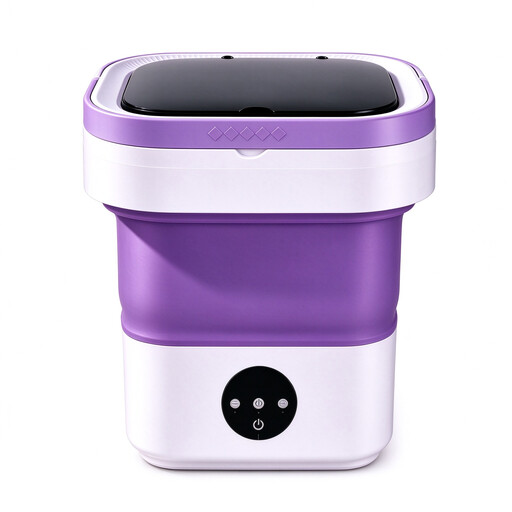
Foldable mini washing machine with drying function, 3-in-1, 12 L
The product description mentions small quantities of laundry and a capacity of 12 L. Check that this size suits your needs before choosing it as an alternative to a standard washer-dryer.
Do not dry fabrics containing flammable substances. Keep the air outlet clear, position the appliance away from flammable materials and do not leave it running unattended; the air outlet gets hot.
View at Joybuy
 No image available
Midea MF205D80WB/W-NL, 8 kg/6 kg
This model combines washing and drying in one appliance. Its stated capacity may be useful if you wash larger loads as well as flannels.
The product name lists 1400 rpm and a maximum washing capacity of 8 kg, compared with a drying capacity of 6 kg. Stick to the drying limit for a combined cycle.
View at Joybuy
 No image available
Bosch WNA13400EU, 8 kg/5 kg
Having washing and drying functions in one freestanding appliance could suit you if you want both functions and have room for one appliance.
The listed capacity is up to 8 kg for washing and 5 kg for drying. Check the permitted load for your chosen programme.
View at Joybuy
Frequently asked questions
Can I automatically dry a full washing load in the same machine?
Only if the load is within the stated drying capacity. Compare the washing and drying capacities for the same model before using a continuous cycle. For example, the Bosch WNA13400NL lists 8 kg for washing and 5 kg for drying.
Do flannels always need to be washed at 60 °C?
No. Choose the temperature based on the care label and how soiled the items are. Milieu Centraal says 30 °C is generally enough for everyday laundry and recommends a hotter wash in certain situations. A steam or refresh programme isn’t a substitute for considering these factors.
What should I check before installing an appliance in a small laundry nook?
Check the dimensions and access to the space, make sure the floor is flat and sturdy, and check the water supply, drainage and earthed socket. Remove the transit bolts before use, following the installation instructions. The Consumentenbond recommends a stable surface.
What warranty applies in the Netherlands, and what happens to my old appliance?
According to the Dutch government, you’re entitled to a product that works properly, but there is no fixed statutory two-year warranty period in the Netherlands. If something goes wrong, contact the retailer. When you buy a new appliance of the same type, the retailer must take back your old one under the Dutch take-back scheme, according to the government.
Is an energy label compulsory for washer-dryers?
Yes, energy labelling rules apply to household washer-dryers. The European Commission says the EU label has used a scale from A to G since 1 March 2021. Compare the figures for washing only with those for the full wash-and-dry cycle.


