
If you often do small loads
You regularly wash small amounts of laundry and want programmes and a drum that suit them. A high maximum capacity isn’t automatically an advantage for your usual loads.


A washer-dryer makes the most sense if you want to dry clothes electrically but only have room for one appliance. For sheets, check the drying capacity and the limit for the programme you choose, not just the washing capacity. If you usually do small loads or can hang your sheets out to dry, also compare washing without using the dryer every time and, if space allows, buying separate appliances. According to the Consumentenbond, a combined cotton wash-and-dry cycle takes almost seven hours on average, while drying in a standard washer-dryer uses relatively large amounts of energy and water.
You regularly wash small amounts of laundry and want programmes and a drum that suit them. A high maximum capacity isn’t automatically an advantage for your usual loads.
You want to be able to dry cotton sheets after washing without making the load too large. The drying capacity and the limit for the programme you choose are key.
You want the option of electric drying, but may only have room for one appliance. Measure the full space available and weigh the convenience against how often you’ll need the drying function.
A good fit if: you only have room for one appliance and the care labels say your sheets can go in the tumble dryer.
Bear in mind: the drying capacity is lower than the washing capacity, and the load must stay within the limit for the programme you choose.
A good fit if: you want to have a drying function available but can usually air-dry your sheets.
Bear in mind: you’ll need the time and space to hang your sheets up. Choose a washing capacity to suit your usual loads.
A good fit if: you have room for two appliances and often use electric drying, or want to start another wash while one load is drying.
Bear in mind: you’ll need room for both appliances. According to the Consumentenbond, a drying cycle in a standard washer-dryer uses around 2.5 times as much energy as one in a new, energy-efficient heat pump tumble dryer. The difference depends on the models and how you use them.
| What to consider | What should you check? | Who is this important for? |
|---|---|---|
| Capacity for small loads | Compare the capacity with the usual weight of your dry load and check the limit for the programme you want to use. | If I often do small loads, I want the capacity and programme to suit them. This is the top consideration for around 36% of consumers. |
| Washing and drying sheets | Check the care label on your sheets, the drying capacity, and the load limit and duration of the cotton or bedding programme. | I want to be able to dry cotton sheets after washing without splitting the load. Around 29% of consumers put this first. |
| Energy and water use with frequent use | Compare the label figures for washing alone separately from those for the full wash-and-dry cycle. | If I wash and dry often, I also want to weigh up electricity and water use. This is the main concern for around 21% of consumers. |
| Space and convenience | Measure the space available and check the installation clearance, connections and door opening. | I only have room for one appliance and want to be able to dry clothes electrically too. This is the top consideration for around 14% of consumers. |
Washing and drying capacities are different limits. A load that fits in the drum for washing may not fit within the drying limit in one go.
Compare the dry weight of your usual set of sheets with the drying capacity and the limit for the programme you want to use.
The EU energy label distinguishes between the wash cycle and the full wash-and-dry cycle. The Consumentenbond points out that drying in a standard washer-dryer uses relatively large amounts of energy and water.
Compare figures for the same type of programme, and consider how often you actually use electric drying.
A short programme and a full combined cotton wash-and-dry cycle don’t necessarily take the same load or the same amount of time. According to the Consumentenbond, a combined cotton wash-and-dry cycle takes almost seven hours on average. That isn’t a guaranteed time for a particular model or a small load.
Check the manual for the permitted load and programme duration for the exact cycle you want to use for your sheets.
The Dutch LWR73842 is an example of a washer-dryer with an 8 kg washing capacity and a 5 kg drying capacity.
According to Hisense, the Dutch WD3S9043BW3 model has a 9 kg washing capacity and a 6 kg drying capacity.
The Dutch GD3R509S0 is one model to consider, with a 9 kg washing capacity and a 6 kg drying capacity.
The Dutch iQ300 model WN44A101NL combines a 9 kg washing capacity with a 5 kg drying capacity.
The Dutch Serie 6 WNG254A7NL is listed with a 10,5 kg washing capacity and a 6 kg drying capacity.
Here you’ll find washer-dryers for washing and, if you wish, drying straight away, as well as a bundle with a separate washing machine and heat pump tumble dryer.
 No image available
An option for washing cottons and, if you wish, drying them straight afterwards. The stated drying capacity is 5 kg.
The product description lists a cotton wash programme, cotton drying and a 14-minute quick wash programme. For sheets, check the limit for the specific drying cycle.
 No image available
A washer-dryer for anyone who also wants to use the drying function for cottons. The stated drying capacity is 5 kg.
The product description lists cotton hygiene and Eco 40-60 °C. Check the care labels on your sheets and the programme limit in the manual.
 No image available
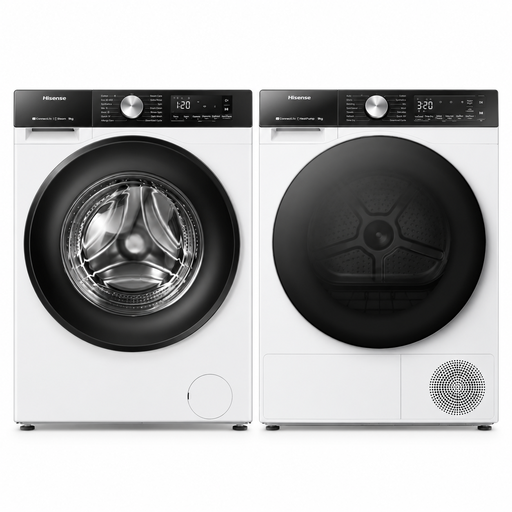
A bundle with a separate washing machine and heat pump tumble dryer, designed for anyone who has room to use both appliances side by side.
The product description lists a 9 kg capacity for both appliances and bedding programmes. Two appliances need space; stacking requires confirmed compatibility and a suitable stacking kit.
 No image available
A washer-dryer with a stated drying capacity of 6 kg. Check that your usual set of sheets fits within the programme and drying limits.
The product information lists 1400 rpm, Wi-Fi controls, a cotton programme and a quick wash programme.
 No image available
A washer-dryer for anyone who wants to be able to wash and dry cottons. The stated drying capacity is 5 kg.
The product description lists cotton programmes and sensors that respond to the amount of laundry. This isn’t a measured saving for small loads.
Only if the care labels say the sheets can go in the tumble dryer and the load is within the drying capacity and programme limit of the model you choose. For example, AEG says the LWR73842 has an 8 kg washing capacity and a 5 kg continuous wash-and-dry limit. These figures apply to that model.
Always follow the care labels and your machine’s manual first. Cotton is a standard programme type. According to the European Commission, Eco 40-60 is designed for normally soiled cotton that the care label says can be washed at 40 °C or 60 °C. Not every model has a dedicated bedding programme.
Measure the full space available and consult the installation diagram for connections and door clearance. Connect the water supply and drain according to the manual, and follow the maintenance instructions for your model. The Consumentenbond recommends using an earthed socket.
An extended warranty isn’t compulsory. According to the Dutch government, when you buy a product you’re entitled to one that works properly. There’s no fixed statutory warranty period, and the retailer is your point of contact if something goes wrong. When you buy a new, similar appliance, the retailer must take back the old one free of charge under the like-for-like scheme. Separate removal or installation services aren’t automatically included.
Electrically powered domestic washer-dryers are covered by the applicable EU ecodesign and energy-labelling rules. According to the European Commission, the current label scale runs from A to G. Compare the figures for washing alone separately from those for the full wash-and-dry cycle. This is product and sales information, not a requirement to always use the eco programme at home.