
Renter with limited space
You’re looking for one appliance that will fit in your rented home, and you check in advance that the existing connections are suitable.


A washer-dryer makes most sense if you regularly want to dry other textiles as well as wash them, and their care labels say they can go in the tumble dryer. It can also be a better fit than having two appliances. Machine-washable doesn’t automatically mean tumble-dryer-safe: VOITED recommends machine-washing its Picnic & Beach Blanket at 30 °C, but says not to tumble dry it. Measure the space and check the connections. Compare the washing and drying capacities, as well as the energy and water used by a combined cycle. The Consumers’ Association notes that standard washer-dryers use relatively large amounts of energy and water when drying.
You’re looking for one appliance that will fit in your rented home, and you check in advance that the existing connections are suitable.
You want to wash your blanket according to its care label and check separately whether tumble drying is allowed.
You also want to dry other textiles, so you compare the maximum drying load and the energy and water used over the full cycle.
A good fit if: you can connect one appliance and regularly want to dry textiles that are suitable for tumble drying.
Bear in mind: the drying capacity may be lower than the washing capacity. The Consumers’ Association describes standard washer-dryers as relatively energy-intensive when drying, and notes that they also use water during this stage.
A good fit if: you mainly want to wash, rarely need machine drying, or the blanket’s care label says not to tumble dry it.
Bear in mind: you’ll need time and enough space to hang the blanket up to dry.
A good fit if: you regularly have large loads of textiles that can go in the tumble dryer, and have the space and connections for two appliances.
Bear in mind: two appliances need more space. According to the Consumers’ Association, a new, energy-efficient heat pump tumble dryer uses less energy when drying than a standard washer-dryer.
| What to consider | What should you check? | Who should pay particular attention? |
|---|---|---|
| Washing and drying instructions | Check the permitted temperature, wash programme and drying method for your blanket. | I want to avoid damaging a washable blanket with an unsuitable drying cycle. Around 29% of consumers put proper blanket care first. |
| Positioning and connections | Measure the space and delivery route; check the available water, drainage and electrical connections. | I want to know whether one appliance will fit in my small rented home and connect to the facilities available. Around 29% of consumers give top priority to positioning and connection requirements. |
| Drying capacity | Compare the maximum washing and drying loads for the same model and check how long the full cycle takes. | I want to regularly wash and dry textiles that are suitable for tumble drying without having to take some out of the drum in between. Around 24% of consumers put automatic drying first. |
| Energy and water use, and overall costs | Compare the figures for washing only with those for washing and drying on the EU product information sheet, using the same basis. | I want to weigh up the purchase against the expected energy and water use for the way I’ll use it. Around 18% of consumers focus mainly on this cost comparison. |
The care instructions may allow machine-washing while ruling out tumble drying. For example, VOITED recommends machine-washing its Picnic & Beach Blanket at 30 °C and advises against tumble drying.
Check the washing and drying instructions separately. If tumble drying isn’t allowed, use the wash cycle only.
For the models listed, the stated drying capacity is lower than the washing capacity. So a full wash load won’t necessarily fit in the same drying cycle.
Compare the two capacities. For a continuous cycle, follow the lower load limit and the care instructions for your textiles.
You may need to remove some of the washing from the drum before drying.
Figures for washing only don’t show the energy and water used by a combined wash-and-dry cycle. The Consumers’ Association notes that standard washer-dryers use relatively large amounts of energy and water when drying.
Compare the figures for the full cycle on the product information sheet. Consider air drying if the blanket’s care label says not to tumble dry it.
The features below apply to the models and product ranges listed; mentioning a brand is not an assessment of the brand as a whole.
The Bosch WNA13400NL is a freestanding washer-dryer worth comparing if space is limited and you only need a modest drying load.
The LG F4DR3096N3W is a 9 kg/6 kg model to compare if you also have larger loads that are suitable for tumble drying.
The Samsung WD90DG5B15BHEN is a 9 kg/6 kg model to compare with other capacities and dimensions.
The Haier HWD100-BP16357U1 is a 10 kg/6 kg model to consider when weighing washing capacity against the available depth.
The Beko BM5DFT4841A is an 8 kg/5 kg model to compare with other washer-dryers that have a modest drying capacity.
These washer-dryers are worth comparing for their washing and drying capacities and the space available for a single appliance.
 No image available
A freestanding model to compare if you want washing and drying in one appliance; check that its dimensions suit your available space.
Washing capacity of 9 kg and drying capacity of 5 kg. The product description lists condenser drying, two drying programmes and dimensions of 600 × 850 × 540 mm.
 No image available
A washer-dryer to compare against your usual load, based on its stated capacity; also measure the space available.
Washing capacity of 8 kg and drying capacity of 6 kg. The product name lists 1400 rpm, Wi-Fi and a steam function.
 No image available
An 8 kg/5 kg washer-dryer to compare if you want to match the stated drying load to your textiles.
Washing capacity of 8 kg and drying capacity of 5 kg.
 No image available
A freestanding model to compare if you want one appliance for washing and drying; check the dimensions to make sure it fits your space.
Washing capacity of 8 kg and drying capacity of 6 kg. The product name lists an inverter motor.
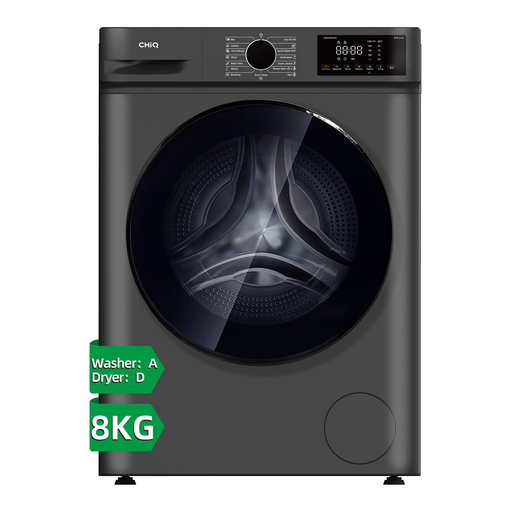 No image available
A model to compare if you’re looking for a washer-dryer and want to match the maximum drying load to your textiles.
Washing capacity of 8 kg and drying capacity of 5 kg. The product name lists 1400 rpm and a steam function.
No, it depends on the blanket’s care label. VOITED recommends machine-washing its Picnic & Beach Blanket at 30 °C and says not to tumble dry it. Always follow the instructions for your own blanket and, if necessary, use the wash cycle only.
Measure the appliance, the space where it will go and the route it needs to take to get inside. Check the existing connections too. Then consult the manual for your chosen model for connection and maintenance guidance; don’t assume every washer-dryer works the same way.
It depends on whether any changes to the property are needed. The Government of the Netherlands distinguishes between minor alterations that can be reversed without much expense and renovations that require permission. Simply installing an appliance isn’t the same as renovating the property; consider any changes needed for the connection separately.
For the exact model, compare the figures for washing with those for washing and drying. The European Commission explains that the energy label and product information sheet provide details including energy consumption. Compare like with like: use the same type of cycle and the same units.
If a problem is covered by the statutory guarantee, you should contact the retailer, not just the manufacturer. The Government of the Netherlands states that there is no fixed statutory guarantee period in the Netherlands; what you can reasonably expect from a product depends, among other things, on the product itself and how it is normally used.