A washer-dryer is a good fit for a shared house if there’s room for one appliance and you want to machine-dry your laundry regularly. When running a wash-and-dry cycle from start to finish, allow for the lower drying capacity. If your housemates need the machine again quickly, weigh up the long combined programme time against washing and hanging items to dry, or choosing two separate appliances if you have room. Consumentenbond reports that combined cotton programmes take an average of almost seven hours.
Who is this option right for?
Housemates sharing laundry facilities
You want to avoid a long wash-and-dry programme tying up the only machine. Compare programme times and drying capacity, and agree how you’ll share the machine. Consumentenbond highlights how long combined cotton programmes can take.
People washing underwear who have hygiene concerns
You want to choose a cotton wash that suits the care label, without treating a steam function or a set temperature as a general guarantee of hygiene. If you’re dealing with a specific infectious condition, follow the relevant advice from organisations such as RIVM.
Buyers short on space
You have room for one machine and sometimes want to machine-dry your laundry. Check both the space needed for installation and the model’s separate washing and drying capacities.
What should you look for when choosing?
Your choice will largely depend on the care instructions for cotton, how long the shared machine will be in use, energy and water consumption when drying, and the space available for installation.
Washing and drying in one appliance
A good fit if: you have room for one machine and don’t want to move your laundry after washing.
The trade-off: the machine is tied up while it dries; Consumentenbond reports that combined cotton programmes take an average of almost seven hours.
Washing only, then hanging your laundry to dry
A good fit if: you have a suitable place to dry your laundry and a housemate needs the machine again soon.
The trade-off: you’ll need the time and space to hang your underwear to dry.
A separate washing machine and tumble dryer
A good fit if: you have room for two appliances and housemates want to schedule washing and drying at the same time more often.
The trade-off: two appliances need more installation space than a washer-dryer.
| What to consider |
What should you check? |
Who is this important for? |
| Hygiene and cotton programme |
Check the care label, cotton programme and adjustable temperature. If you’re dealing with a specific infection, follow the relevant advice. |
When I wash cotton underwear, I want to choose a temperature that suits the fabric and the situation. Around 33% of consumers prioritise hygiene. |
| Machine availability |
Compare the duration of the programme you plan to use, the drying capacity and whether you can run a wash-only cycle. |
When housemates need the machine soon after one another, I want to know how long a combined cycle takes. Around 27% of consumers prioritise having the machine available again quickly. |
| Consumption when drying |
On the EU energy label, compare the figures for washing only and washing plus drying on the same cycle basis. |
When I machine-dry my laundry often, I want to be able to weigh up the consumption of the cycle I actually use. Around 20% of consumers prioritise running costs. |
| Installation space and connections |
Measure the space and access route, and check the model’s dimensions, water supply, drainage and installation instructions. |
When there’s only room for one appliance, I want to make sure the machine will fit and can be connected there. Around 20% of consumers prioritise having enough installation space. |
Common pitfalls
-
Assuming the washing capacity is the capacity for a continuous wash-and-dry cycle
A model may be able to wash more cotton laundry than it can dry in the same cycle. In a shared house, an additional drying cycle can keep the machine in use for longer.
Compare the washing and drying capacities of the exact model, and base a continuous cycle on the drying capacity.
An extra drying cycle can keep the machine in use for longer.
-
Comparing washing figures only
The EU energy label for washer-dryers distinguishes between washing only and washing plus drying. Looking only at the washing figures won’t tell you how much energy a cycle that includes drying will use.
The European Commission says the label includes figures such as energy consumption per 100 cycles and water consumption per cycle. Compare the figures for the same cycle you expect to use.
-
Seeing a steam function as a substitute for specific hygiene advice
A listed feature doesn’t, in itself, prove that a programme meets the advice for a specific condition.
If you’re dealing with a specific condition, follow the relevant advice and check whether the fabric can be washed as instructed on its care label. For the scabies treatment described, RIVM provides specific instructions for used fabrics.
-
Underestimating the length of a combined programme
Consumentenbond reports that combined cotton programmes take an average of almost seven hours. The exact time varies by programme and model; while the machine is drying, a housemate can’t use it.
Compare the duration of the specific programme. If the space and your household’s needs allow, consider washing only and hanging items to dry, or using two separate appliances.
A long cycle leaves less time for other people in the household to use the machine.
Brands to compare
Bosch
The Dutch Serie 4 WNA13400NL is worth comparing if you want to factor in the dimensions and separate washing and drying capacities.
- Bosch lists an 8 kg washing capacity, 5 kg drying capacity, Auto Dry and dimensions of 848 × 598 × 590 mm for the WNA13400NL.
- The stated washing capacity isn’t the amount you can dry in one continuous cycle. These specifications apply to this model and aren’t independently measured performance figures.
LG
The GD3R509S0 is worth comparing if you’re looking for a combination of 9 kg washing and 6 kg drying capacity.
- LG lists a 9 kg washing capacity, 6 kg drying capacity and AI DD for this model.
- Compare noise levels and consumption for the specific programmes you want to use. The model specifications alone don’t tell you how it compares with other machines.
Beko
The BM5DFT4841A is worth comparing if depth and spin noise are important to you.
- Beko lists an 8 kg washing capacity, 5 kg drying capacity, a depth of 57 cm and a spin noise level of 75 dBA for this model.
- Check the installation space you’ll need, and compare noise levels only where they’re based on the same measurement method. These figures don’t automatically apply to other Beko models.
AEG
The LWR76144 offers a larger capacity to compare if you often have bigger shared loads.
- AEG lists an 11 kg washing capacity, 7 kg drying capacity and a delay start function for the LWR76144.
- A larger capacity isn’t automatically helpful for small, separate loads of underwear, so consider your housemates’ laundry habits.
Products at Joybuy
This selection includes washer-dryers for anyone looking for one appliance, as well as a set of separate appliances for those who want to schedule washing and drying separately.
 No image available
Candy BWR 495BL8-S washer-dryer, 9 kg/5 kg
A washer-dryer to compare if you want to wash and dry your laundry in one appliance.
Washing capacity: 9 kg. Drying capacity: 5 kg.
For a continuous wash-and-dry cycle, the lower drying capacity applies.
View at Joybuy
 No image available
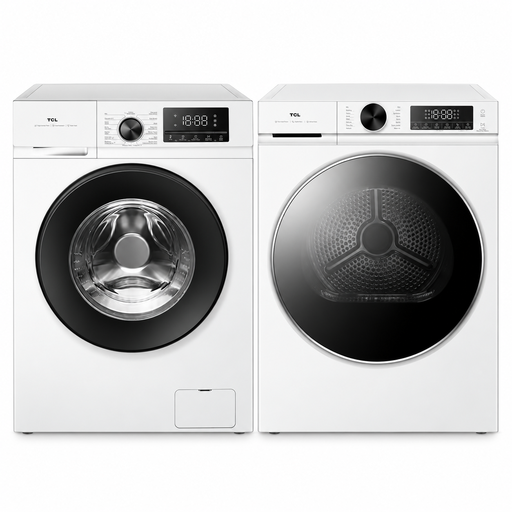
TCL washing machine and heat pump tumble dryer set, 8 kg
A set to compare if you want to schedule washing and drying using two separate appliances.
You’ll need installation space for both the washing machine and the heat pump tumble dryer.
View at Joybuy
 No image available
Midea MF205D80WB/W-NL washer-dryer, 8 kg/6 kg
A washer-dryer to compare if you want to wash and dry your laundry in one appliance.
Washing capacity: 8 kg. Drying capacity: 6 kg. The product name also mentions wifi and a steam function.
For a continuous wash-and-dry cycle, the lower drying capacity applies.
View at Joybuy
 No image available
Samsung WD90DB7B85GWU3 washer-dryer, 9 kg/6 kg
A washer-dryer to compare if you’re looking for one appliance to wash and dry your laundry.
Washing capacity: 9 kg. Drying capacity: 6 kg.
For a continuous wash-and-dry cycle, allow for the lower drying capacity.
View at Joybuy
 No image available
Hisense WD3S9043BW3 washer-dryer, 9 kg/6 kg
A washer-dryer to compare if you want to weigh up a cotton programme and separate washing and drying capacities.
Washing capacity: 9 kg. Drying capacity: 6 kg. The product name states 1400 rpm.
The cotton wash-and-dry cycle described takes 7 hours and 45 minutes; the 60-minute cycle is limited to a maximum of 1 kg. For a continuous cycle, the lower drying capacity applies.
View at Joybuy
Frequently asked questions
Does cotton underwear always need to be washed at 60 °C?
No. 60 °C isn’t a general rule for every load of underwear: check the care label and consider the circumstances. Milieu Centraal says that 60 °C can sometimes be sensible, for example when dealing with an infectious condition. For the specific scabies treatment described, RIVM advises using a full 60 °C programme for the used fabrics mentioned.
How can you reduce vibration when installing a washer-dryer?
Follow the model’s instructions and place the machine on a flat, stable surface. Consumentenbond also recommends removing the transit bolts, levelling the machine, connecting the water supply and drainage correctly, and using an earthed socket.
What do the two consumption figures on the EU energy label mean?
They help distinguish between washing only and washing plus drying. The European Commission says the label includes energy consumption per 100 cycles, water consumption per cycle, programme duration and noise levels. Compare the figures for the cycle you actually use.
Is an additional paid-for warranty compulsory in the Netherlands?
No, you don’t have to buy an additional paid-for warranty. According to the Dutch government, you’re entitled to a product that works properly, and there’s no fixed statutory warranty period in the Netherlands. The seller is your point of contact if a product is faulty; consider whether an additional warranty offers anything beyond your statutory protection.


