A washer-dryer is a good fit for a shared home if there’s only room for one appliance and machine drying is important. Plan a complete wash-and-dry cycle around the lower drying capacity and the length of the cycle, rather than the wash capacity alone. If you can air-dry your T-shirts or have room for two appliances, compare those options too: they could leave the machine free for the next load.
Which option is right for you?
Housemates with a busy laundry schedule
If several housemates use the same machine, check the length of a complete wash-and-dry cycle and the drying capacity. The Consumers’ Association and the European Commission offer guidance on comparing models’ capacities and label information.
Residents with space for just one appliance
A washer-dryer combines washing and drying in one appliance. Before deciding whether it will fit, check the dimensions and installation instructions for the exact model.
Residents who usually hang their T-shirts to dry
If you can air-dry cotton T-shirts, a washing machine without a drying function may be enough. Milieu Centraal advises washing clothes only as often as necessary and offers tips for washing efficiently.
What should you look for when buying?
Washer-dryer
Choose this option: if there’s room for one appliance and housemates also want to machine-dry their laundry.
Bear in mind: the drying capacity may be lower than the wash capacity, and the drum remains occupied for the entire cycle.
Heat pump washer-dryer
Choose this option: if you need one appliance and machine-dry laundry regularly; compare specific models and their figures for a complete cycle.
Bear in mind: features vary by model. For example, the AEG LWR9706C8 has a stated maximum depth of 660 mm, so measure the space carefully.
Washing machine with air-drying
Choose this option: if you have a suitable place to hang T-shirts and don’t need to machine-dry them.
Bear in mind: you’ll need time and space outside the machine for your laundry to dry.
Separate washing machine and tumble dryer
Choose this option: if there’s room for two appliances and housemates often want to wash and dry one load after another.
Bear in mind: two appliances need more space. Milieu Centraal recommends separate appliances over a washer-dryer because their combined energy consumption is lower.
| Concern |
What to look for when buying |
Who this matters to |
| Availability of the shared machine |
Check the length of the complete cycle and the model’s maximum drying load. |
If the next housemate wants to do their washing soon, how long the drum stays occupied matters. Around 33% of consumers say scheduling use of a shared machine is their top priority. |
| Space for just one appliance |
Measure the space and access route; compare the appliance’s dimensions and installation instructions. |
If you only have space for one appliance, you’ll want to make sure the model you choose will actually fit. Around 27% of consumers put this space requirement first. |
| Electricity and water use when drying |
Compare the EU label figures for washing only and for washing and drying, using the same basis. |
If you machine-dry often, you’ll want to know what the complete cycle uses. Around 20% of consumers say running costs are their main buying concern. |
| Washing and drying cotton T-shirts |
Check the garment care label, the available cotton programmes and the drying capacity. |
If you want to look after your T-shirts, you’ll need to know whether they can be tumble-dried and whether the load will fit. Around 20% of consumers put garment care first. |
Avoid common buying mistakes
-
Assuming the wash capacity is the drying capacity
The stated drying capacity may be lower than the wash capacity. That means a full wash load may not fit through a complete wash-and-dry cycle without interruption.
Compare the wash and drying capacities of the exact model, and plan a continuous cycle around the drying load.
You may need to dry some of the load separately, or the shared machine will be occupied for longer.
-
Comparing only the energy rating for washing
Figures for washing alone don’t show the consumption for washing and drying. The European Commission says the EU label includes information such as energy use, water use and programme duration.
Compare the label figures for the complete wash-and-dry cycle on the same basis, including kWh per 100 cycles and water per cycle.
-
Choosing a washer-dryer just to save space
With a washer-dryer, the drum can’t wash the next load while the previous one is drying.
Compare the space available with your household’s laundry routine, and also consider air-drying or two separate appliances.
Brands to consider
Bosch
The Serie 4 and Serie 6 models mentioned offer different combinations of wash and drying capacity.
- Bosch lists the WNG24406NL with a 9 kg wash capacity, 6 kg drying capacity and dimensions of 848 × 598 × 590 mm.
- Bosch says the WNA13400EU is no longer available on its own website. This doesn’t automatically tell you anything about other Bosch models or stock at other retailers.
LG
The GD3R509S0 is an example of a washer-dryer with a 9 kg wash capacity and 6 kg drying capacity.
- LG lists AI DD and a direct-drive motor for this model.
- Claims about garment protection and quiet operation come from the manufacturer; a comparative clothing test of other model numbers doesn’t prove the same results specifically for the GD3R509S0.
Beko
The BM5DFT4841A is an example of a washer-dryer with an 8 kg wash capacity and 5 kg drying capacity.
- Beko lists a depth of 57 cm for this model.
- Beko lists a spin noise level of 75 dBA. Compare the installation and noise information for the exact models; this figure alone doesn’t tell you anything about drying results or reliability.
AEG
The LWR9706C8 is a heat pump washer-dryer which, according to AEG, has a 10 kg wash capacity and 6 kg drying capacity.
- AEG lists an energy class of B for the complete wash-and-dry cycle and a cycle duration of 8 hours and 50 minutes for this model.
- The stated maximum external depth is 660 mm. Check the space available and the product specifications for how you plan to use it.
Joybuy products
These products include both separate washing machines and tumble dryers, and washer-dryers for a shared laundry schedule.
 No image available
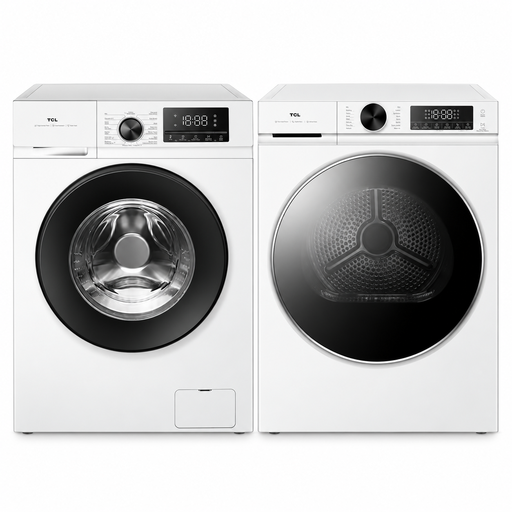
TCL washing machine and heat pump tumble dryer set, 8 kg + 8 kg
These separate appliances could suit housemates who want to wash and dry one load after another, if there’s room for both.
According to the product description, both appliances have a capacity of 8 kg. The washing machine is listed with a 1400 rpm spin speed, Steam Wash and a 15-minute programme for suitable smaller loads.
Two appliances need more space than a single washer-dryer.
View on Joybuy
 No image available
Haier HWD90-BP14929A-S, 9 kg washing and 5 kg drying
This freestanding washer-dryer combines washing and drying for households with space for just one appliance.
The stated capacity is 9 kg for washing and 5 kg for drying. The description lists cotton and Eco 40-60 programmes, as well as a delay-start function and remaining-time display.
For an uninterrupted wash-and-dry cycle, use the lower drying capacity as your guide.
View on Joybuy
 No image available
Midea MF205D80WB/W-NL, 8 kg washing and 6 kg drying
This washer-dryer could be a good fit if you have space for one appliance and want to machine-dry your laundry.
The product name lists an 8 kg wash capacity and a 6 kg drying capacity. The description mentions cotton and Eco 40-60 programmes, 14 programmes in total and Wi-Fi control.
The wash capacity is higher than the drying capacity, so plan a complete cycle around the drying load.
View on Joybuy
 No image available
Bosch WNA13400EU, 8 kg washing and 5 kg drying
This washer-dryer combines washing and drying in one appliance for a home with space for just one appliance.
The product name lists an 8 kg wash capacity and a 5 kg drying capacity. The description mentions cotton programmes, a Wash&Dry programme, a delay-start function and a remaining-time display.
For an uninterrupted wash-and-dry cycle, bear the lower drying capacity in mind.
View on Joybuy
 No image available
Samsung WD90DB7B85GWU3, 9 kg washing and 6 kg drying
This freestanding washer-dryer combines washing and drying for households with space for one appliance.
The product name lists a 9 kg wash capacity and a 6 kg drying capacity. The description mentions QuickDrive and a Super Speed wash programme for 5 kg in 39 minutes; this is a separate wash programme.
For a complete wash-and-dry cycle, use the lower drying capacity as your guide.
View on Joybuy
Frequently asked questions
Can a full cotton wash also be dried completely without interruption?
Only if the load is within the drying capacity and the instructions for the selected programme. For example, the models mentioned have a 9 kg wash capacity compared with a 6 kg drying capacity, or 8 kg compared with 5 kg.
Which programme should I choose for cotton T-shirts?
Always check the T-shirt’s care label first. The European Commission describes Eco 40-60 as a programme for normally soiled cotton that can be washed at 40 °C or 60 °C according to its textile care label; check separately whether tumble-drying is allowed.
What should I check before installing an appliance in a shared home?
Compare the available space and connections with the installation diagram for the exact model. Agree who will start a cycle and clear the machine when it finishes, so housemates can plan their laundry.
How can I cut down on unnecessary washing and drying?
Wash clothes only as often as necessary, use the right amount of detergent for the load and air-dry T-shirts that are suitable for it where possible. If you machine-dry, compare the consumption for the complete cycle.
What should I look for on the EU energy label for a washer-dryer?
Compare the label figures for the exact model’s complete wash-and-dry cycle, not just the washing figures. The European Commission lists information including energy classes, energy use per 100 cycles and water use per cycle.
Does the legal guarantee end after a two-year manufacturer’s guarantee?
No. According to ACM ConsuWijzer, your statutory rights exist alongside a manufacturer’s or retailer’s guarantee. If a product doesn’t perform as you could reasonably expect under normal use, the retailer must offer an appropriate solution free of charge; there isn’t one fixed statutory guarantee period for every washing machine.


