
Doing laundry in a small space
You want to wash and, when needed, dry pillowcases and clothes, but can only fit one appliance. Measure the available space and compare it with the drying load you want to handle in one go.


Choose a washer-dryer if having just one appliance or limited space is the deciding factor. Base your choice on the drying capacity of the exact model, not just its washing capacity. Sort pillowcases and clothes according to their individual care labels. If you dry laundry frequently, you could also consider a heat pump washer-dryer, separate appliances or line drying, weighing up space, programme duration and energy use.
You want to wash and, when needed, dry pillowcases and clothes, but can only fit one appliance. Measure the available space and compare it with the drying load you want to handle in one go.
You wash pillowcases with clothes in different colours or materials. Follow the washing and drying instructions on the fabric care labels; a programme name alone doesn’t tell you whether everything can go in together.
You want to tumble-dry much of your weekly laundry regularly and are weighing up saving space against energy use and programme duration. Also compare a heat pump washer-dryer with separate appliances.
A good fit if: having one appliance is important and your load fits within its drying capacity.
Things to consider: drying capacity may be lower than washing capacity. The Consumers' Association also highlights the energy use of conventional washer-dryers during drying.
A good fit if: you often tumble-dry laundry but only want to install one appliance.
Things to consider: the Consumers' Association reports that there are few heat pump washer-dryers available. Check the dimensions and specifications of the specific model.
A good fit if: you have room for two appliances and often deal with large or consecutive loads.
Things to consider: you’ll need space for both appliances. Milieu Centraal recommends separate appliances with energy use in mind; the best option depends on the models you choose and how you use them.
A good fit if: you have space and time to dry laundry and don’t need to tumble-dry every load.
Things to consider: hanging laundry takes time and space. Milieu Centraal describes line drying as the most environmentally friendly way to dry clothes.
| Consideration | What should you look for? | Who is this important for? |
|---|---|---|
| Drying capacity | Compare the washing and drying capacities of the same model with the load you want to dry after washing. Measure the space where it will go, too. | If I want one appliance and would ideally like to dry the laundry straight after washing, I’ll pay particular attention to the drying load. Around 36% of consumers prioritise this combination of space and capacity. |
| Combining fabrics | Read the care labels and only combine fabrics with compatible colour, washing and drying instructions; check the available programmes. | If my pillowcases and clothes have different care instructions, I want to know which items can go in together. Around 29% of consumers give suitability for mixed loads top priority. |
| Energy use and programme duration | Compare the figures on the EU energy label for washing alone and for the full cycle, including energy and water use and programme duration. | If I tumble-dry often, I want to be able to weigh up the energy use and time taken for full cycles. Around 21% of consumers prioritise these usage figures. |
| Installation and aftercare | Measure the space and delivery route; check the connections, installation instructions and terms for additional cover. | If I want the machine installed at home and may need support after buying it, I’ll check the practical arrangements in advance. Around 14% of consumers make installation and aftercare their main consideration. |
The maximum drying load may be smaller than the washing load, so a full wash may not always fit in the dryer all at once.
Compare both capacities of the exact model with your usual load, and check which fabrics can go in the tumble dryer.
If the drying load is too large, you may need to take some items out of the drum or run another drying cycle.
Figures for washing and for a complete wash-and-dry cycle describe different types of use. The Consumers' Association highlights the energy use of conventional washer-dryers during drying.
Compare the label figures for both types of use and consider which function you use most often.
Pillowcases and clothes may have different instructions for colour, washing temperature and drying.
Check the care labels on your own fabrics and separate items with incompatible instructions.
Optional extra cover is not the same as your statutory rights. According to the Dutch government, there is no fixed statutory warranty period in the Netherlands.
Ask what extra cover is actually included. If a product is faulty, the retailer is your point of contact.
The WNA13400NL is an option to consider if you want to wash 8 kg and dry up to 5 kg.
The GD3R509S0 is a model to compare if 9 kg washing capacity and 6 kg drying capacity suit your load.
The LWR9506BN4 is a heat pump washer-dryer with a stated capacity of 10 kg for washing and 6 kg for drying.
The BM5DFT4841A is a freestanding model with a washing capacity of 8 kg and a drying capacity of 5 kg.
The WD90HG6U94BEU3 is a 9 kg/6 kg model to compare with other washer-dryers of the same capacity.
This selection includes washer-dryers for a single-appliance setup and a set comprising a separate washing machine and heat pump tumble dryer. Compare their capacities and setup with your weekly laundry and the space you have available.
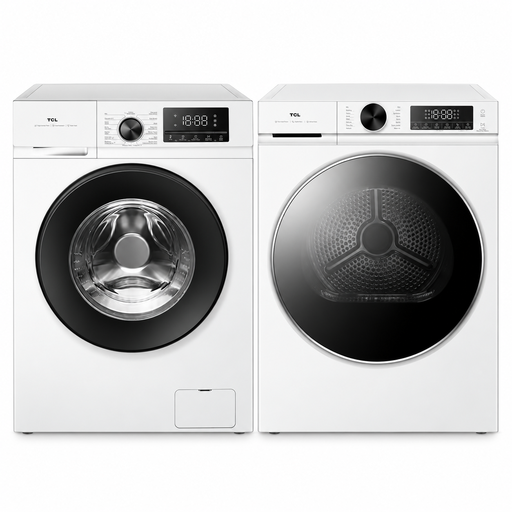 No image available
A set of separate appliances to compare if you have room for a washing machine and a heat pump tumble dryer.
Stated capacity: 8 kg for the washing machine and 8 kg for the tumble dryer. The product name lists 1400 rpm and a steam function.
 No image available
A washer-dryer to consider if you want one appliance and your load fits within its drying capacity.
The product name lists 8 kg washing capacity, 6 kg drying capacity, 1400 rpm, Wi-Fi and a steam function.
 No image available
A washer-dryer to compare if an 8 kg washing capacity suits you but you have a smaller drying load each time.
Stated capacity: 8 kg for washing and 5 kg for drying.
 No image available
A washer-dryer to compare if you want to wash loads up to the stated capacity and dry a smaller load.
Stated capacity: 9 kg for washing and 6 kg for drying. The product name lists 1400 rpm. Check the duration of the programme that suits your load.
 No image available
A washer-dryer to compare if you want to handle large loads and have enough space for the appliance.
Stated capacity: 18 kg for washing and 11 kg for drying. The product name lists AI Ecobubble and SmartThings.
No, don’t automatically use the same temperature for all pillowcases. Follow the care label on your own fabrics and sort items by colour and care instructions. Milieu Centraal recommends 60 °C mainly for certain hygiene situations, not as the standard setting for every mixed load.
Only if the load is within the drying capacity of the model and programme you’ve chosen, and the fabrics are suitable for tumble drying. So, a model with a 9 kg washing capacity and a 6 kg drying capacity can’t automatically handle 9 kg in one uninterrupted wash-and-dry cycle.
Measure the machine and the delivery route, and check that the floor is level and sturdy and that the connections are suitable. Follow the installation instructions and remove the transit bolts before use, as recommended by the Consumers' Association.
Compare both the washing cycle and the complete wash-and-dry cycle if you use both functions. The European Commission says the EU label includes information such as energy use per 100 cycles, water use per cycle and programme duration. Since 1 March 2021, the scale for these appliances has run from A to G.
No, according to the Dutch government, there is no fixed statutory warranty period in the Netherlands. You’re entitled to a product that works properly for as long as you can reasonably expect; if a product is faulty, the retailer is your point of contact. A manufacturer's warranty or additional cover may be available on top of that.