
Families with muddy walking gear
You want to get socks and other clothes clean after a week of school. Check muddy stains before drying; a dedicated programme doesn’t guarantee that a stain will disappear.


Start by working out how much laundry you want to dry in one go: the drying capacity may be lower than the washing capacity. Brush loose dirt off muddy socks and check for stains after washing, before starting the drying cycle. If you have room for a clothes airer or two separate appliances, compare those options too; the Consumers’ Association highlights the long combined programmes and relatively high drying energy use of standard washer-dryers.
You want to get socks and other clothes clean after a week of school. Check muddy stains before drying; a dedicated programme doesn’t guarantee that a stain will disappear.
You want to get several loads done on time. So, compare not just the washing capacity, but also the smaller permitted drying load and the length of the full cycle.
You’re considering one appliance because there isn’t room for two. Weigh the space saved against the energy use and drying time of the option you choose.
A good fit if: you only have room for one machine and want to wash and dry a suitable load.
Bear in mind: the drying capacity and the full programme duration; the Consumers’ Association reports relatively high drying energy use and extra water use for standard washer-dryers.
A good fit if: you need one appliance and want to take the energy use of the full wash-and-dry cycle into account.
Bear in mind: the price and external dimensions of the specific model; features of one model don’t automatically apply to all heat-pump washer-dryers.
A good fit if: you have room for two appliances or can usually air-dry your socks.
Bear in mind: a clothes airer takes up space and time, while two machines need more room. Milieu Centraal recommends a heat-pump tumble dryer if you buy a separate dryer.
First, decide whether you want to be able to check your socks between cycles. Then work out how many kilograms you want to dry at a time, and compare the installation requirements and cycle details.
| What to consider | What to check before buying | Who is this most relevant for? |
|---|---|---|
| Washing mud out of socks | Compare cleaning and rinsing performance; check whether you can inspect the stain after washing and before the drying cycle starts. | If I wash muddy socks, I want to check that the stain has gone before drying them. Around 33% of consumers prioritise cleaning muddy items. |
| Getting a week’s washing done on time | Check the maximum washing and drying capacities separately, and look at the length of the full cycle. | If I have several loads waiting, I want to know how much laundry the machine can handle in succession. Around 27% of consumers give throughput and time top priority. |
| Fitting the machine into a small space | Measure the height, width and depth, and check the model’s connection and installation requirements. | If two appliances won’t fit, I want to know whether one washer-dryer will fit in the space available. Around 20% of consumers prioritise having just one machine. |
| Energy use when tumble-drying | Compare the EU energy label figures for washing only and for the full wash-and-dry cycle; consider how often you use the dryer. | If I often use a tumble dryer, I want to take the energy use of the full cycle into account. Around 20% of consumers prioritise the running costs of drying. |
For the Hisense WD3S9043BW3, the Consumers’ Association lists a washing capacity of 9 kg compared with 6 kg for drying; for the Bosch WNA13400NL 2026, it’s 8 kg compared with 5 kg for cotton. So, if you want to wash and dry a full load in one go, use the applicable drying limit as your guide.
Compare the maximum load for the programme you want to use, and use the lowest applicable capacity for an uninterrupted cycle.
A larger wash load may mean you have to dry some items separately or run an extra drying cycle.
Persil recommends checking stains before tumble-drying and repeating the treatment if needed.
Brush off loose dirt and check your socks after washing. If the stain is still visible, follow the care label and, if necessary, wash them again rather than automatically continuing to dry them.
A stain that remains may mean extra treatment and another wash.
The EU energy label gives figures for the wash cycle and for washing and drying. The Consumers’ Association reports relatively high drying energy use for standard washer-dryers, as well as extra water use for some condenser models.
Compare label figures for the same full cycle, and consider how often you use the drying function.
In its comparison, the Consumers’ Association reported an average of nearly seven hours for the combined cotton programme. This average isn’t a guide to the running time of every individual model.
Check the length of the full programme and think about how many loads you want to get through in succession after a busy week.
According to the Consumers’ Association, the WD3S9043BW3 is a condenser washer-dryer with a capacity of 9 kg for washing cotton and 6 kg for drying cotton.
According to the Consumers’ Association, the LWR9506BN4 is a heat-pump washer-dryer with a capacity of 10 kg for washing cotton and 6 kg for drying.
According to the Consumers’ Association, the WNA13400NL 2026 is a condenser washer-dryer with a capacity of 8 kg for washing cotton and 5 kg for drying cotton.
The W4X1085NWB, available in the Netherlands, offers a washing capacity of 8 kg and a drying capacity of 5 kg.
The manufacturer lists the freestanding BM5DFT4841A as having a washing capacity of 8 kg and a drying capacity of 5 kg.
These products are washer-dryers. Compare their stated washing and drying capacities, and check the figures for the full cycle before choosing a model.
 No image available
Combining washing and drying in one appliance may suit you if you want to use a single machine; bear in mind that the drying load is smaller.
9 kg washing and 5 kg drying; 1400 rpm; inverter motor and steam function.
 No image available
A washer-dryer may suit you if you want to combine washing and drying in one appliance; its drying capacity is lower than its washing capacity.
8 kg washing and 6 kg drying; 1400 rpm; Wi-Fi control and steam function.
 No image available
Combining washing and drying may suit a household looking for one appliance; check that your chosen load is within the drying capacity.
10 kg washing and 6 kg drying; steam wash function; a 60-minute wash-and-dry programme and a 15-minute quick-wash programme.
 No image available
This washer-dryer may suit you if you’re looking for a single freestanding appliance; match the wash load to the lower drying capacity.
10 kg washing and 7 kg drying; 60 cm wide; steam care, BLDC motor, Auto Dry and Woolmark programme.
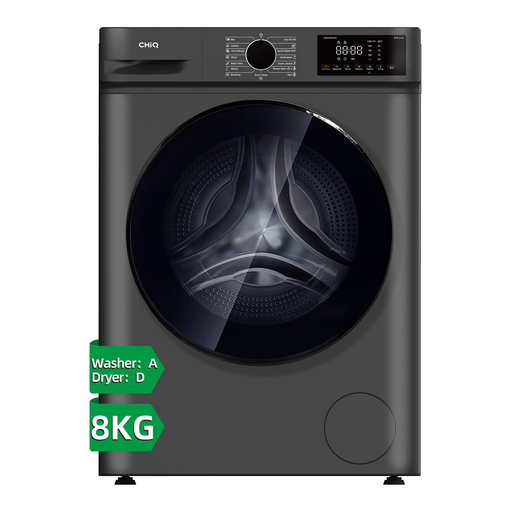 No image available
A washer-dryer may suit you if you’re looking for one appliance; check that the stated drying capacity is sufficient for your load.
8 kg washing and 5 kg drying; 1400 rpm; inverter motor, steam function and dark grey finish.
First, brush off loose dirt and check the stain after washing, before drying. Follow the care label and, if in doubt, wash the socks separately so you can check whether the mud has come out. This stain advice comes from detergent manufacturer Persil and doesn’t guarantee results for every fabric.
Check the installation requirements and the model-specific manual. The Consumers’ Association recommends a firm, level surface, removing the transit bolts, and checking the water supply, drain and earthed socket.
According to the Dutch Government, the seller must provide a product that works properly and is your point of contact if it’s faulty. A solution might include a free repair or replacement; an additional commercial guarantee doesn’t replace your statutory rights.
Yes. Under the Dutch take-back scheme, the seller must accept a similar old household appliance from a private buyer free of charge, including for online purchases, according to the Dutch Government. Arrange the practical details of handing it over at delivery in advance.
Compare the figures for washing only separately from those for the full wash-and-dry cycle. Household washer-dryers have an applicable EU energy label; the rating or energy use for the wash cycle isn’t the same as for the full cycle.