A washer-dryer could suit your move if you regularly want to machine-dry your laundry afterwards but can only fit one appliance. Plan a continuous wash-and-dry cycle for your towels based on the drying capacity and care labels, rather than the higher washing capacity. If you have time to dry your towels on a line, a separate washing machine lets you skip the drying stage. If you often machine-dry your laundry and have room for two appliances, it’s worth comparing a separate washing machine and heat pump tumble dryer. The Consumers’ Association reports that a combined cotton programme takes almost seven hours on average, so check the full programme duration and the connections at your new home too.
Who is this choice relevant for?
Moving to a room with space for one appliance
If there’s room for only one appliance after your move, a washer-dryer can combine washing and drying. The Consumers’ Association cites lack of space as a reason to consider this option; make sure you also measure the available space and check the connections.
Moving with a tight laundry schedule
If your towels need to be dry before you pack, the full cycle time and the amount that fits in one drying load both matter. The Consumers’ Association reports that a combined cotton programme takes almost seven hours on average.
Drying only when needed
If you don’t want to machine-dry every load, consider whether a washing line or airer will be practical after your move. If you do machine-dry your laundry often, you could also compare a separate washing machine and heat pump tumble dryer.
What should you look for when choosing?
First decide whether you want to machine-dry your laundry and how many appliances you can fit. Then compare drying capacity, time and energy and water consumption for the way you’ll use it.
Conventional washer-dryer
A good fit if: you have space for one appliance after your move and want to machine-dry suitable towels without transferring them to another machine.
Bear in mind: the Consumers’ Association reports that a combined cotton programme takes almost seven hours on average. According to the same source, conventional washer-dryers use relatively large amounts of energy and additional water when drying.
Heat pump washer-dryer
A good fit if: you regularly machine-dry your laundry, have space for one appliance and can accommodate the dimensions of your chosen model.
Bear in mind: dimensions vary by model; AEG lists a maximum depth of 660 mm for the LWR9506BN4.
Washing machine with an airer or washing line
A good fit if: you don’t need to machine-dry your laundry and have enough time and suitable drying space before you pack.
Bear in mind: your towels won’t be dry straight away and ready to pack, so you’ll need drying space and time to plan ahead.
Separate washing machine and heat pump tumble dryer
A good fit if: you often dry larger loads and have space for two appliances.
Bear in mind: you’ll need space and suitable connections for both appliances. Milieu Centraal says that a washer-dryer uses more energy than washing and drying separately.
| What to consider |
What to look for |
Who does this matter most to? |
| Drying load |
Compare your usual dry towel load with the drying capacity of the programme you choose; check the care labels too. |
If I want to wash and dry my towels in one continuous cycle, I’ll check the drying capacity and care labels first. Around 31% of consumers give a suitable load size top priority. |
| Space and connections |
Measure the installation space and access route; check the installation requirements, water supply, drain and electrical connection in advance. |
When moving, I first want to make sure the appliance will fit in its new location and can be connected. Around 25% of consumers put space and connections first. |
| Programme time |
Check how long the full programme takes for the load you want to wash, and allow for an extra cycle if needed. |
If my towels need to be dry before I leave, I want to know how long the full cycle takes and whether one cycle will be enough. Around 25% of consumers say getting things done on time is their main concern. |
| Energy and water consumption |
Compare the EU energy label information for washing alone and for the full wash-and-dry cycle. The European Commission lists energy and water consumption, among other details, on the label. |
If I’ll often machine-dry my laundry after moving, I’ll take the consumption of full cycles into account. Around 19% of consumers put energy and water consumption first. |
Common pitfalls
-
Confusing washing capacity with drying capacity
The maximum washing load may be larger than the drying capacity. So a towel load that fits within the washing capacity won’t necessarily fit in one continuous wash-and-dry cycle.
Compare the washing and drying capacities separately. If you want to wash and dry your towels without a break, plan the load according to the drying capacity.
-
Assuming a quick programme will dry a full load of towels
Bosch describes Wash & Dry 60' as suitable for small loads. This doesn’t mean a full load of towels will be dry in an hour.
Check the permitted load and the duration of the programme you actually want to use.
-
Looking only at the washing specifications
The full wash-and-dry cycle has its own consumption figures and programme duration. The Consumers’ Association also says that conventional washer-dryers may use additional water when drying.
Compare the information for full cycles on a like-for-like basis, and consider how often you’ll want to machine-dry your laundry after moving.
Relevant brands and models
Bosch
The WNA13400EU is an example of a freestanding washer-dryer with an 8 kg washing capacity and a 5 kg drying capacity.
- Bosch lists Auto Dry and Wash & Dry 60' for small loads.
- The 60-minute claim applies to small loads, not a full load of towels. Don’t assume the EU and NL model codes refer to the same product without confirming its identity.
Beko
The BM5DFT4841A is an example of a freestanding washer-dryer with an 8 kg washing capacity and a 5 kg drying capacity.
- Beko lists a depth of 57 cm and a spin noise level of 75 dBA for this model.
- These dimensions and noise levels apply to the BM5DFT4841A; don’t assume they’re the same for other models.
AEG
The LWR9506BN4 is an example of a washer-dryer with heat pump drying.
- AEG lists a 10 kg washing capacity, a 6 kg drying capacity and energy class B for the wash-and-dry cycle.
- AEG gives a maximum depth of 660 mm; check that the exact model will fit in the space available.
LG
The W4X1085NWB offers a point of comparison in the 8 kg washing and 5 kg drying class.
- LG lists steam and AI DD for this model.
- LG’s claims about cleaning and fabric protection are manufacturer claims; also check your towel care labels, load size and drying settings.
Washer-dryers at Joybuy
These Joybuy products combine washing and machine-drying in one appliance. Compare the drying capacity with your towel load and check the space available.
 No image available
Candy BWR 495BL8-S, 9 kg/5 kg
This washer-dryer is designed for anyone who wants to wash and machine-dry their laundry in one appliance.
The product name lists a 9 kg washing capacity and a 5 kg drying capacity.
The product name also lists 1400 rpm and energy classes A-20%/D.
View at Joybuy
 No image available
Haier HWD90-BP14929A-S, 9 kg/5 kg
This washer-dryer is a good fit if you want to plan washing and machine-drying in one appliance.
The product name lists a 9 kg washing capacity and a 5 kg drying capacity.
The product name also lists 1400 rpm, an inverter motor, steam and energy classes A-20%/D.
View at Joybuy
 No image available
Bosch WNA13400EU, 8 kg/5 kg
This washer-dryer combines washing and drying for anyone with space for just one appliance.
The product name lists an 8 kg washing capacity and a 5 kg drying capacity.
Bosch lists Wash & Dry 60' for small loads; check the load requirements for your towels.
View at Joybuy
 No image available
TCL CP1210WA0, 10 kg/6 kg
This heat pump washer-dryer is designed for anyone who wants to do both stages in one appliance.
The product name lists a 10 kg washing capacity and a 6 kg drying capacity.
The product details specify heat pump drying; use the drying capacity as your guide for a continuous cycle.
View at Joybuy
 No image available
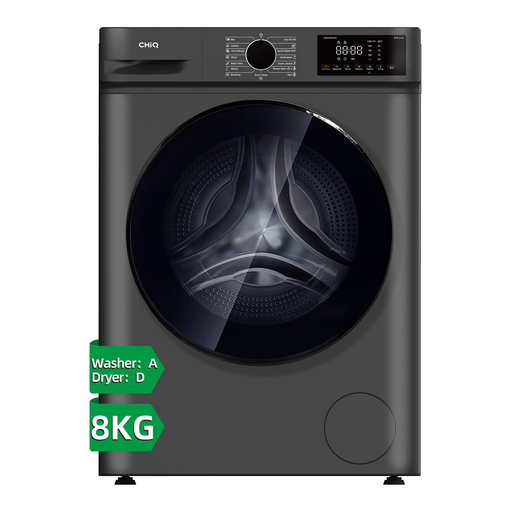
CHiQ JW85882HG, 8 kg/5 kg
This washer-dryer is a good fit if you want to wash and machine-dry your laundry in one appliance.
The product description lists an 8 kg washing capacity and a 5 kg drying capacity.
The product name lists an inverter motor, 1400 rpm and a steam function.
View at Joybuy
Frequently asked questions
Can I wash and dry a full drum of bath towels without a break?
Only if the dry load is within the drying capacity of the programme you choose and the care labels allow machine-drying. So if a machine can wash more than it can dry, it won’t necessarily handle the full washing load in one continuous cycle.
What should I arrange if the washer-dryer will be installed somewhere else after my move?
Check the installation space, water supply, drain, stable flooring and power socket. If it’s going in a shared space, agree the installation with the property manager in advance. The Consumers’ Association recommends removing the transit bolts before use and keeping them for your next move; also consult the manual for your exact model.
How do you compare the energy and water consumption of washer-dryers?
Compare the EU energy label information for washing alone and for the full wash-and-dry cycle. The European Commission lists energy consumption, water consumption and programme duration, among other details; compare models using the same cycle and units.
Which capacity matters if I want to wash and dry my towels in one cycle?
The drying capacity determines how much laundry can go through the drying stage, while the washing capacity shows the maximum amount you can wash. Compare your dry towel load with the permitted drying load for the programme you choose, and follow the fabric care labels.


