What should you look for when choosing?
For household use, the Netherlands Nutrition Centre advises washing used dishcloths at 60 °C. So first check the programme temperature, then decide whether you need the drying function.
Washer-dryer, washing and drying
A good fit if: you have limited space and want to dry towels in the same appliance straight after washing them.
Bear in mind: the drying capacity is lower than the washing capacity, and a complete cycle can take a long time. The Consumers’ Association also notes that drying uses relatively high amounts of energy and often extra water.
Washer-dryer, washing only
A good fit if: you usually have space to dry your towels, but want to keep the drying function for other laundry or occasional use.
Bear in mind: you’ll still need somewhere to dry the towels after washing them, and you won’t use the drying function for small loads.
Standard washing machine and separate drying
A good fit if: you have room to hang towels out to dry or space for two appliances.
Bear in mind: hanging towels out takes space and time, while two appliances need extra room. Milieu Centraal recommends separate appliances as an alternative if you also need a tumble dryer.
| What to consider |
What should you check? |
Who is this important for? |
| 60 °C wash programme |
Check the manual to see whether the exact model has a programme that can be set separately to 60 °C, and whether the care label allows washing at that temperature. The Consumers’ Association makes clear that the name Eco 40-60 doesn’t mean the programme washes at 60 °C. |
I want to be able to wash used kitchen towels in line with the advice, rather than relying on a quick programme name; around 33% of consumers make a suitable wash programme their top priority. |
| Small wash loads |
Compare the number of towels in each load with the permitted load for the programme you’ve chosen. The Consumers’ Association notes that washing and/or drying one full drum uses less energy than two half-full drums. |
I often wash just a few towels and want to be able to wash them without tumble-drying them every time; around 27% of consumers prioritise suitability for small loads. |
| Drying space and drying capacity |
Compare the separate washing and drying capacities, and check that the drying load stays within the stated limit. Also check the duration of a complete cycle; the EU energy label shows washing data and full-cycle data separately. |
I have limited space to dry towels and want to be able to dry them in one appliance; around 20% of consumers make a lack of drying space their top priority. |
| Energy use in practice |
On the EU energy label, compare the figures for washing only and for the complete wash-and-dry cycle on a like-for-like basis, including energy per 100 cycles and water per cycle. Focus on the complete cycle if you tumble dry frequently. |
I want to know what regular washing and occasional drying mean for energy and water use; around 20% of consumers put running costs first. |
Washer-dryers on Joybuy
This selection features washer-dryers for households that want to wash kitchen towels in one appliance and may also want to dry them there. For each model, check the manual to see whether a suitable programme can be set separately to 60 °C.
 No image available
Midea MF205D80WB/W-NL washer-dryer, 8/6 kg
For anyone who wants to combine washing and drying in one appliance. The product title lists an 8 kg washing capacity and a 6 kg drying capacity; check whether the exact model has a suitable programme at 60 °C.
View on Joybuy
 No image available
Bosch WNA13400EU washer-dryer, 8/5 kg
For anyone who wants washing and drying functions in one appliance. Bosch lists an 8 kg washing capacity and a 5 kg drying capacity; ‘Wash & Dry 60'’ means 60 minutes and doesn’t confirm a wash temperature of 60 °C.
View on Joybuy
 No image available
Hisense WD5I8043BWF washer-dryer, 8/6 kg
For anyone who wants to combine washing and drying and take both capacities into account. The product title lists an 8 kg washing capacity and a 6 kg drying capacity; also check the available programmes and adjustable wash temperature.
View on Joybuy
 No image available
Samsung WD18DB8995BZ/T2 washer-dryer, 18/11 kg
For anyone looking for one appliance with separate washing and drying capacities. The product title lists an 18 kg washing capacity and an 11 kg drying capacity; check the load limit and temperature of the programme you want to use for kitchen towels.
View on Joybuy
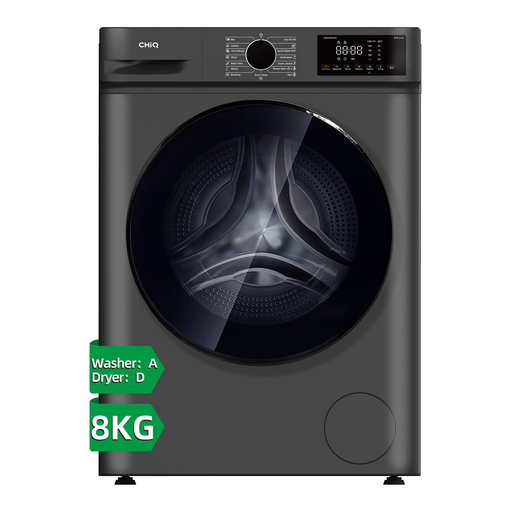 No image available
CHiQ JW85882HG washer-dryer, dark grey
For anyone who wants to combine washing and drying in one appliance. The product title lists 8 kg; check the product specifications to see what this capacity refers to, what the drying capacity is and whether the appliance has a suitable programme at 60 °C.
View on Joybuy
Frequently asked questions
Is Eco 40-60 suitable for used dishcloths?
Not if you’re following the advice to wash them at 60 °C. The Consumers’ Association measured different temperatures during Eco 40-60; check the care label and choose a programme whose temperature you can set separately.
Should I choose the quick wash-and-dry programme for a small load?
Not based on programme duration alone. On Bosch appliances, ‘Wash & Dry 60'’ means 60 minutes; for the cycle you choose, also check the wash temperature and permitted load.
What should I check during installation and maintenance?
Follow the instructions for the exact appliance. The Consumers’ Association recommends, among other things, placing it on a stable, level surface, removing the transit bolts and connecting the water supply and drain correctly; use an earthed socket.
Does a two-year manufacturer’s warranty cover all my rights if there’s a fault?
No. According to the Dutch government, the retailer is your first point of contact if something goes wrong. Depending on the fault and your rights, a solution could include a free repair or replacement.
Can a Dutch retailer charge me to take back my old, similar appliance?
For a private purchase, the retailer must take back an old, similar appliance free of charge, including for an online purchase, according to the Dutch government. This doesn’t mean that separate installation or dismantling services are automatically free.


