
The weekend washer on a deadline
Wants duvet covers dry before Monday without having to transfer them between appliances. Pay particular attention to the drying capacity and the duration of the complete cycle.


Choose a washer-dryer for a continuous wash-and-dry cycle if the care label says your duvet cover can go in the tumble dryer and the whole load fits within the selected programme’s drying capacity. The Consumers’ Association advises against washing more than the machine can dry in a combined cycle. If you have a lot of bedding and room for two appliances, washing and drying separately may be more practical. In either case, compare the full programme duration and, if you dry regularly, the figures for the complete wash-and-dry cycle.
Wants duvet covers dry before Monday without having to transfer them between appliances. Pay particular attention to the drying capacity and the duration of the complete cycle.
Washes several duvet covers, or sheets as well, and wants to know whether the whole load will fit into one drying cycle or needs to be split.
Has room for just one appliance and weighs up the space-saving benefit against drying time, energy and water use, and the possibility of creasing.
First, check that your dry bedding load is within the limit for the drying programme you want to use. Then compare the full cycle and the space available for the appliance.
| Concern | What to look for | Who is this most important to? |
|---|---|---|
| Getting the load dry on time | Check the duration of the complete wash-and-dry cycle for a suitable load; a short programme may be intended for a smaller amount of laundry. | If I need the covers dry before the working week, the end time of the full cycle matters. Around 36% of consumers prioritise the duration of the complete cycle. |
| Drying capacity for bedding | Compare the permitted drying weight with your own dry load; the maximum washing capacity doesn’t tell you how much can be dried in a continuous cycle. | When washing several covers or sheets, I want to know whether everything will fit into one drying cycle. Around 29% of consumers prioritise drying capacity. |
| One appliance and fewer steps | Measure the available space and check the clearance needed for connections. Also decide whether you could hang some of the load to dry or schedule an extra drying cycle. | If I only have room for one appliance, a washer-dryer can save space, as long as I can dry some of the load separately if needed. Around 21% of consumers prioritise space and fewer steps. |
| Energy and water use when drying regularly | Compare the energy use for the complete wash-and-dry cycle and the water use per cycle on the same label basis. | If I dry laundry often, I want to weigh up the use involved in both washing and drying, rather than looking at the wash cycle alone. Around 14% of consumers focus mainly on running costs. |
The European Commission says the EU energy label includes information such as energy use per 100 cycles, water use and programme duration. Compare figures for complete cycles like for like, rather than comparing a wash cycle with a wash-and-dry cycle.
The Bosch WNA13401NL is listed as having an 8 kg washing capacity, but its capacity for continuous washing and drying is 5 kg. A full wash load can therefore be larger than the amount that can be dried in one go.
Check the weight of your usual dry bedding load against the limit for the programme you want to use.
If the load exceeds the drying limit, you may need to schedule an extra drying cycle or hang some of it up.
Bosch describes Wash & Dry 60' on the WNA13401NL as suitable for small loads. AEG lists a nominal full-cycle duration of 7 hours and 45 minutes for the LWR7796UD6. These times don’t necessarily apply to every load or machine.
Plan around the full cycle for the amount and fabric you want to wash and dry.
A longer cycle could mean your bedding is ready later than planned before the working week.
The EU energy label distinguishes between figures for washing alone and those for the complete wash-and-dry cycle. Looking only at the wash figures therefore won’t give you the full picture if you use the tumble dryer.
Compare the complete-cycle figures for specific models on the same label basis.
If you dry laundry regularly, total energy and water use may differ from what you’d expect based on the wash cycle alone.
According to Bosch Netherlands, the WNA13401NL is an 8 kg washing and 5 kg continuous drying model with Auto Dry.
The models mentioned range from the LWR7796UD6, with a 9 kg washing capacity and 6 kg continuous drying capacity, to the LWR9516BN4, which has a heat pump and, according to the Consumers’ Association, can wash 10 kg and dry 6 kg of cotton.
According to LG Netherlands, the F4DR3096N3W is listed as having a 9 kg washing capacity and a 6 kg drying capacity.
According to Miele, the WTD160 WCS is a washer-dryer with an 8 kg washing capacity and a 5 kg drying capacity.
This selection includes separate washing machines and tumble dryers, as well as washer-dryers, to suit different loads and installation spaces.
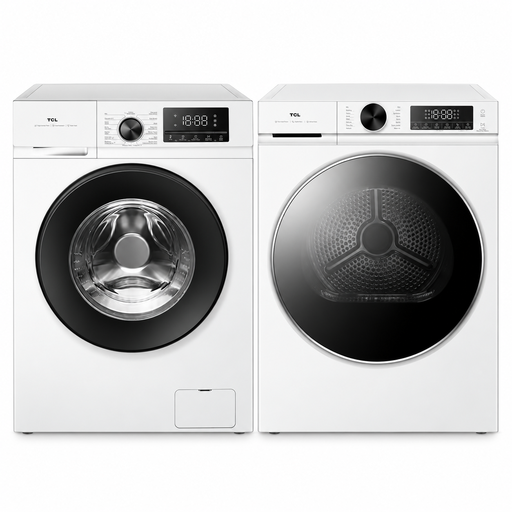 No image available
Ideal if you have room for two appliances and want to plan washing and drying separately.
Washing machine: 8 kg; heat pump tumble dryer: 8 kg; 1400 tpm; steam function.
 No image available
Worth considering if your dry load fits within the stated drying capacity.
8 kg washing capacity and 6 kg drying capacity; stated depth: 47 cm.
 No image available
An option to compare if your load fits within the drying limit and you want to set a delayed start.
9 kg washing capacity and 6 kg drying capacity; 1400 rpm; Wi-Fi control via ConnectLife and delayed start.
 No image available
Worth comparing if the dry load you have in mind fits within the stated drying capacity.
10 kg washing capacity and 6 kg drying capacity; energy label classes A/E.
 No image available
An option to compare if your dry bedding load fits within the stated drying limit.
10 kg washing capacity and 7 kg drying capacity; Steam Care, Auto Dry and a Woolmark wool programme.
Not without checking the programme limits. Bosch describes Wash & Dry 60' on the WNA13401NL as suitable for small loads. Check the duration of the complete programme that’s suitable for your load.
Check the washing and drying symbols on the specific cover, then choose a suitable programme. GINETEX explains that the symbols provide information such as the maximum washing temperature and permitted drying treatment. Don’t assume that one setting is right for every fabric.
Make sure it’s on a firm, level surface, remove the transit bolts, connect the water inlet and drain correctly, level the appliance and use an earthed socket. The Consumers’ Association also recommends following the chosen model’s manual for installation and maintenance.
Compare the figures for the complete wash-and-dry cycle, not just the class or energy use for washing. According to the European Commission, the EU label includes information such as energy use per 100 cycles, water use and programme duration.
No. According to the Dutch Government, the Netherlands has no fixed statutory guarantee period: you’re entitled to a product that works as it should, and if there’s a fault, the seller must provide a solution. A manufacturer’s guarantee is an extra benefit and doesn’t replace this right.