
If you wash large duvet covers
You want to wash a duvet cover, perhaps with other bedding, and may want to dry it straight away. So check not only the washing capacity but also the lower drying capacity.


Only choose a washer-dryer if the load you want to dry is within its separate drying capacity, and compare the duration and energy and water use of the full cycle. The Dutch Consumers’ Association and the European Commission advise comparing washing data separately from data for the full wash-and-dry cycle. If you have room for two appliances or can hang the duvet cover up to dry, these are also options to consider. Milieu Centraal points out that energy use is still a factor to weigh up when drying clothes in a machine.
You want to wash a duvet cover, perhaps with other bedding, and may want to dry it straight away. So check not only the washing capacity but also the lower drying capacity.
You share the space or the time available to use the appliances with others. The duration of a full cycle, noise, vibrations and arrangements for using the space all matter.
You dry clothes often and want to weigh up energy use against the space available. To do this, compare the figures for the full wash-and-dry cycle, not just those for washing.
Choose this option: if there is room for only one appliance and your intended load is within both the washing and drying capacities.
Bear in mind: the maximum washing load is not necessarily the amount you can dry straight away.
Choose this option: if you often dry clothes in a machine and the dimensions and cycle time of the specific model suit your needs.
Bear in mind: heat-pump technology does not automatically mean a short full cycle; the stated eco wash-and-dry cycle of the AEG LWR9506BN4 takes 8 hours and 50 minutes.
Choose this option: if the shared space can accommodate two appliances and you often use a tumble dryer.
Bear in mind: you will need more space; according to the Dutch Consumers’ Association, a washer-dryer’s combined cotton programme takes longer on average than washing and drying in separate appliances.
Choose this option: if the care label and an available drying space allow it.
Bear in mind: you will need time outside the machine and an approved place to dry the duvet cover; you will not need to dry it in a machine.
Start with the load you want to wash and the drying capacity, then consider the time needed, energy and water use, and the space available.
| What to consider | What should you check? | Who should pay particular attention? |
|---|---|---|
| Washing and drying capacities | Check both capacities, the care label and the load size for the programme you choose. | I want to wash and dry my duvet cover in one continuous cycle; around 33% of consumers prioritise having suitable washing and drying capacities. |
| Cycle time and noise | Compare the duration of the full cycle and the noise rating; agree usage times with the other users. | If I share the utility room, I want to know how long the machine will be in use and how much noise it makes; around 27% of consumers prioritise shared usage times and disruption. |
| Electricity and water use | Compare the figures for washing only with those for the full wash-and-dry cycle on the same basis. | I use a tumble dryer often and want to weigh up electricity and water use against how often I use it; around 20% of consumers prioritise energy and water consumption. |
| Space and arrangements | Measure the space and access route; check the connections and any arrangements for installation and use. | I need to know whether the appliance and connections will fit and whether installation has been agreed; around 20% of consumers prioritise space and arrangements. |
A machine may be able to wash more than it can dry in the same cycle. The Dutch Consumers’ Association advises comparing the load you want to wash with the amount you want to dry.
Check the washing and drying capacities for the exact model, and follow the care label and the programme’s load limit.
If the drying load is too large, you may need to dry or hang up some of it later.
The EU energy label gives figures for washing and for the full wash-and-dry cycle. The Dutch Consumers’ Association points out that standard washer-dryers may also use water while drying.
Compare the figures for the full cycle on the same basis and weigh them against how often you dry clothes in a machine.
Hoses, the access route, vibrations and arrangements for a shared installation can also affect how practical the setup is.
Measure the space and access route, and check the connections and usage arrangements before choosing an appliance. A flat, stable surface helps reduce vibrations and noise, according to the Dutch Consumers’ Association.
The duration of a programme for a small load does not necessarily tell you how long a full wash-and-dry cycle will take. The Dutch Consumers’ Association describes combined programmes as long-running.
Check the capacity and duration of the programme that suits your duvet cover, and factor in how busy the shared machine is likely to be.
The LWR9506BN4 is a heat-pump washer-dryer for people who often dry clothes and have enough space.
The WNG254A7NL has a higher stated washing capacity than drying capacity.
The F4DR3096N3W is a 9 kg/6 kg model to compare with the load you actually want to dry.
The BM5DFT4841A is an 8 kg/5 kg alternative for a smaller intended load.
The WTI370 WPM PWash 8/5 kg is an 8 kg/5 kg washer-dryer to compare if you do not need a larger load washed and dried in one go.
These options include both separate appliances and washer-dryers. In a shared utility room, compare the space required with the washing and drying capacities.
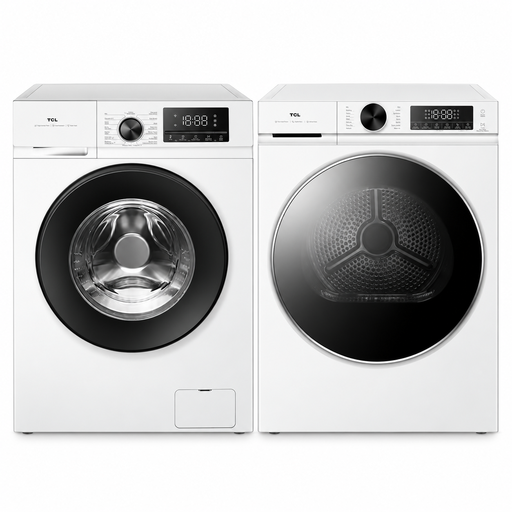 Image unavailable
This set includes a washing machine and a separate heat-pump tumble dryer; according to the product information, you can wash a load while an earlier one is drying.
The stated capacity is 8 kg for each appliance. The set needs more space than a single washer-dryer.
 Image unavailable
This washer-dryer is designed for a load that stays within the separate washing and drying limits.
The stated capacity is 9 kg for washing and 5 kg for drying; compare the load you want to dry with the lower limit.
 Image unavailable
This washer-dryer may suit a load that is within the stated washing and drying capacities.
The title lists an 8 kg washing capacity, a 6 kg drying capacity, Wi-Fi and a steam function. The drying capacity is lower than the washing capacity.
 Image unavailable
This washer-dryer is an option if the load you want to wash and dry straight away is within the separate capacities.
The stated capacity is 9 kg for washing and 6 kg for drying. The drying limit is therefore lower than the washing limit.
 Image unavailable
This washer-dryer has a higher stated capacity, but check that the appliance itself will fit in the shared space.
The stated capacity is 18 kg for washing and 11 kg for drying. Its stated dimensions are 686 × 875 × 1110 mm; the drying limit is still lower than the washing limit.
Only if the load and the programme you choose are also within the separate drying capacity. Check the duvet cover’s drying instructions too; the washing weight alone is not enough.
Check that the floor is level, solid and stable, and that a water supply, drain and earthed socket are available. Remove the transit bolts and level the appliance according to the instructions. If the space is shared, agree on installation and use with the manager or other users.
First follow the duvet cover’s washing and drying care labels, then choose a suitable programme. Not every model has a bedding programme, so check the programmes available on the exact model.
Check with your landlord or the manager first, and consult the arrangements and house rules for the shared space. Also ask who is responsible for the connections, use and maintenance.
Since 1 March 2021, the relevant EU rules have used a scale from A to G. Compare the figures for washing and the full wash-and-dry cycle, including energy, water, programme duration and noise, rather than looking only at the washing rating.