
Cyclists with technical clothing
You wash tops, shorts or layers whose care labels specify the temperature and suitable programme. AGU recommends checking the care label before washing and following its instructions.


Choose a washer-dryer with a wash programme that suits the care labels on your cycling kit, then compare its washing and drying capacities with the size of your usual weekly wash. A sports or outdoor programme does not make clothes marked ‘do not tumble dry’ suitable for the dryer: take them out of the machine after washing and leave them to air-dry.
You wash tops, shorts or layers whose care labels specify the temperature and suitable programme. AGU recommends checking the care label before washing and following its instructions.
You want to wash cycling kit alongside your everyday laundry and work out how much of a load you can actually wash and dry in one go. Consumentenbond recommends looking at washing and drying capacities separately.
You’re considering one washer-dryer instead of two separate machines. Consumentenbond lists a lack of space as one reason to consider a washer-dryer. Be sure to measure the space available and think about how often you’ll use the drying function.
Start with the care instructions for your cycling kit. Then compare the capacities and consumption figures for the functions you’ll actually use.
| What to consider | What to look for | Who is this important for? |
|---|---|---|
| Wash programme and fabric care | Check that the wash programmes on the exact model are suitable for the care labels on your clothes. Also check whether you can wash without having to dry the load straight afterwards. | I want to wash my cycling kit according to its care label and decide for myself whether it can be tumble-dried. Fabric care is the top priority for around 33% of consumers. |
| Washing and drying capacity | Compare the washing and drying capacities in kilograms for the same model, as well as the maximum load for your chosen programme. | I want to wash my usual weekly load without assuming the whole load can go straight into the dryer. Around 27% of consumers prioritise the capacity for their weekly wash. |
| Consumption for each function | Compare energy, water and programme duration for the same type of use: washing only or the full wash-and-dry cycle. | I want to know which cycle suits my everyday use and compare the consumption figures for it. This is the main buying priority for around 20% of consumers. |
| Space and appliance choice | Measure the space available and allow for access to the door and connections. Work out how much everyday laundry you actually want to machine-dry. | I need to choose between one washer-dryer and making space for two separate appliances. Saving space is the top priority for around 20% of consumers. |
Washing instructions and drying instructions are not the same. A sports or outdoor programme does not override a ‘do not tumble dry’ instruction on the care label.
Sort clothes according to their care labels, and take any cycling kit marked ‘do not tumble dry’ out of the drum after washing. AGU recommends following the care label instructions for cycling kit.
The maximum washing capacity may be higher than the capacity for washing and drying. That means a full wash load might not fit in a single drying load.
Compare both capacities for the exact model and check the load limit for the programme you want to use.
Some of the laundry may need an extra drying cycle or have to be air-dried.
Energy and water figures for washing alone do not automatically reflect the consumption for washing and drying combined.
Compare the label figures for the way you’ll use the machine most often. The European Commission includes energy consumption per 100 cycles and water consumption per cycle on the energy label.
Delivery, installation and taking away an old appliance may involve separate arrangements. The Dutch government describes the ‘old for new’ scheme as taking back an old, similar appliance when you buy a new one.
Before ordering, check exactly what’s included in delivery, installation, any dismantling and collection of your old appliance.
AEG offers washer-dryers with features including an outdoor programme, such as the LWR7586CUB and LWR9506BN4 models.
Bosch publishes models with different capacities; the WNG254A7NL is one example designed for larger wash loads.
The specifications for the GD3V509S1 list separate capacities and energy label figures for different types of use.
The WTI370 WPM PWash is a washer-dryer with an 8 kg washing capacity and a 5 kg drying capacity.
Separate capacities are listed for the WD90DB7B85GWU3 washer-dryer.
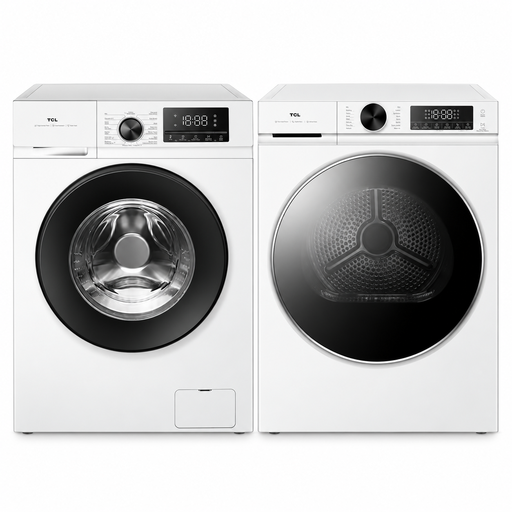
This selection includes washer-dryers and a set with a separate washing machine and heat-pump tumble dryer. Compare the capacities, and always follow the care label on your cycling kit.
 No image available
A set with two appliances, so you can plan washing and drying separately; make sure you have space for both.
The product name lists 8 kg + 8 kg and a steam function.
 No image available
A washer-dryer for anyone who wants to wash their usual weekly load in one appliance and occasionally machine-dry it. The drying load is smaller than the washing load.
The product name lists a washing capacity of 9 kg and a drying capacity of 5 kg.
 No image available
A washer-dryer for mixed weekly loads; if you plan to dry clothes straight after washing, bear in mind the smaller drying capacity.
The product name lists a steam function and an 8 kg washing capacity compared with a 6 kg drying capacity.
 No image available
Bosch lists a sports programme for this model; before use, check that the programme is suitable for the care label on the specific garment.
The product name lists a washing capacity of 8 kg and a drying capacity of 5 kg. Bosch says this model is no longer available in its own online shop; check availability with the retailer.
 No image available
A washer-dryer for mixed weekly loads; check that the load is suitable for what you want to dry on each programme.
The product name lists a washing capacity of 8 kg and a drying capacity of 6 kg.
No. Follow the care label on each item. AGU recommends washing cycling kit at a maximum of 30 °C and air-drying it; this brand advice does not replace the care label on other garments.
Follow the care instructions from your machine’s manufacturer. For its washer-dryers, Electrolux recommends, among other things, running an empty cleaning programme or an empty cotton programme at 60 °C. Don’t wash cycling kit above the temperature allowed by its own care label.
Compare the label figures for the same type of use: washing only or the full wash-and-dry cycle. The European Commission lists, among other things, energy consumption per 100 cycles and water consumption per cycle. Your actual costs will also depend on how you use the machine and your tariffs.
If the machine is faulty, contact the retailer to arrange a solution under your statutory rights to goods that meet the required standards. For distance sales, you usually have a 14-day cooling-off period; check whether it applies to your situation before placing your order.
According to the Dutch government, when you buy a new, similar appliance, the retailer must take back your old one. Arrange with the retailer in advance how you’ll hand over the appliance.