
Housemates with different types of cushion covers
You want to care for washable covers properly without assuming they can go in the tumble dryer too. Check the care label on each cover.


A washer-dryer is only suitable for automatically drying cushion covers if their care labels allow tumble drying; being machine-washable doesn’t automatically mean they can go in the tumble dryer. In a shared home, you’ll also need to consider the drying capacity and how long the machine will be in use. If the covers need to air-dry or housemates often do their washing one after another, separate appliances may be more practical if you have the space.
You want to care for washable covers properly without assuming they can go in the tumble dryer too. Check the care label on each cover.
You want to avoid a long combined cycle keeping the machine out of use for the next person unnecessarily.
You’re weighing up the space-saving benefit of one appliance against the drying capacity and use of separate appliances.
A good fit if: the cover’s own care label allows tumble drying, you want to fit just one appliance and the load is within the drying capacity.
The trade-off: you don’t need to transfer the washing, but a combined cycle keeps the shared machine in use for longer.
A good fit if: the covers are machine-washable but not suitable for tumble drying, or you prefer to air-dry them.
The trade-off: the drying function won’t add anything for these covers; make sure you have enough space and time to dry them.
A good fit if: you have the space and connections for two appliances, and housemates often do their washing one after another.
The trade-off: two appliances need more space. Milieu Centraal notes that an efficient heat-pump tumble dryer uses less energy for drying than a standard washer-dryer.
| What to consider | What should you check? | Who should give this more weight? |
|---|---|---|
| Care instructions for the cover | Check both the washing and drying symbols on each cover and follow its specific instructions. | I want to wash the cover without choosing a drying cycle that its care label rules out. Around 36% of consumers consider the care instructions their top priority. |
| Machine availability | Check the length of the full cycle and agree with your housemates when longer programmes can run. | If I share the machine with others, I don’t want them to wait unnecessarily long for their turn. Around 29% of consumers prioritise shared laundry time. |
| Drying capacity and space | Compare the washing and drying capacities separately, and measure the space for the appliance and the route needed for its connections. | I want to know that the appliance will fit and can dry the load I have in mind. Around 21% of consumers give capacity and installation space their top priority. |
| Energy use with frequent use | Compare the figures for washing only with those for the full wash-and-dry cycle, using the same label basis. | If we dry clothes often, I want to compare the energy use of the cycles we actually use. Around 14% of consumers prioritise energy use. |
A cover may be suitable for machine washing but not for tumble drying. For example, IKEA says the KRYDDBUSKE cushion cover can be washed at a maximum of 40 °C but must not be tumble-dried.
Before starting, check the washing and drying symbols on each cover. Don’t choose an automatic drying cycle if the care label rules it out.
Drying a cover against its care instructions could damage it.
A washer-dryer may be able to wash more kilograms than it can dry. For example, the Bosch WNA13401NL is rated for 8 kg of washing and a maximum of 5 kg of drying.
Compare both capacities and base an uninterrupted wash-and-dry cycle on the lower drying limit.
If the washed load can’t be dried in one go, you’ll need to handle it again or run a second drying cycle.
Energy figures for washing alone don’t tell you the same thing as those for a full wash-and-dry cycle. When comparing drying, Milieu Centraal distinguishes between a standard washer-dryer and an efficient heat-pump tumble dryer.
Compare the full cycle on the same label basis and consider how often your housemates actually use the dryer.
The WNA13401NL is an example to consider if you want to weigh up the washing and drying programmes separately.
The F4DR3096N3W is worth considering if a stated drying capacity of 6 kg is relevant to you.
The WD90HG6U94BEU3 is a model to compare if its 9 kg washing and 6 kg drying capacities suit the load you have in mind.
The freestanding BM5DFT4841A is a model to compare if the space available for installation is important to you.
The LWR76144 is worth considering if you need a higher stated washing and drying capacity.
This selection includes washer-dryers for anyone who wants one appliance, plus a set with a separate washing machine and heat-pump tumble dryer for households with space for two appliances.
 No image available
Worth comparing if you want to match the washing and drying capacities separately to your load.
Washing capacity of 9 kg and drying capacity of 5 kg. The product description lists 16 washing programmes, 2 drying programmes and a delay start of up to 24 hours.
 No image available
Worth comparing if separately stated washing and drying capacities are important when planning a shared laundry load.
Washing capacity of 9 kg and drying capacity of 5 kg. The product description lists 16 washing programmes, 2 drying programmes and a delay start of up to 24 hours.
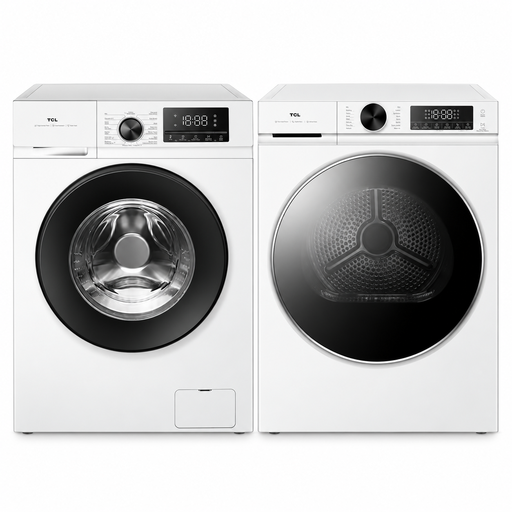 No image available
Worth comparing if you have space for two appliances and want to plan washing and drying separately.
The set includes a washing machine and a heat-pump tumble dryer, each with a stated capacity of 8 kg. The product description says that washing and drying can take place at the same time.
 No image available
Worth comparing if a stated drying capacity of 6 kg suits the load you want to dry.
Washing capacity of 8 kg and drying capacity of 6 kg. The title mentions Wi-Fi control; the product description lists a wool programme and a delay start.
 No image available
Worth comparing if you’re taking the lower drying capacity into account when choosing a washer-dryer.
Washing capacity of 8 kg and drying capacity of 5 kg. The product description lists AutoDry and separate programmes for different fabrics; always check the cover’s own care label before tumble-drying it.
Not just because it’s machine-washable. Check the drying symbol and instructions on the care label. For example, the IKEA KRYDDBUSKE cushion cover can be machine-washed but must not be tumble-dried.
Measure the space and check the water, drainage and electrical connections against the manual for your chosen model. Also agree with your housemates who will use the appliance. LG’s installation instructions, for example, cover water and drainage connections and levelling the appliance.
If you dry clothes regularly, compare the figures for the full wash-and-dry cycle, not just those for washing. The EU energy label includes figures such as energy use per 100 cycles and water use per cycle; your actual costs depend on how you use the appliance and your energy tariff.
Report the problem to the retailer. According to ACM ConsuWijzer, your statutory guarantee is separate from any manufacturer’s guarantee. If a product breaks down too soon during normal use, the retailer must offer a solution under the applicable terms. There isn’t simply a fixed statutory guarantee of two years for every washing machine.
Household washer-dryers are covered by European energy labelling rules. The Dutch government states that an energy label is compulsory for household appliances; since 1 March 2021, this product group has used the EU scale from A to G. This is product information, not a permit that residents need to apply for before using an appliance.