
Families with covers that need careful drying
Want to wash removable covers without assuming they can also go in the tumble dryer? Follow the care label on each cover and choose a suitable wash programme.


First, check the care label on each cushion cover: being machine-washable doesn’t automatically mean it can go in the tumble dryer. If tumble drying isn’t allowed, focus on the wash programme, washing capacity and available space. If the label does allow tumble drying, also consider the drying capacity and the figures for the full wash-and-dry cycle.
Want to wash removable covers without assuming they can also go in the tumble dryer? Follow the care label on each cover and choose a suitable wash programme.
If you also do regular family laundry, assess the washing and drying capacities separately.
A single appliance may suit you if you want to wash and dry suitable fabrics in one place. Check its dimensions and the connections it requires.
Start with the cover’s care label, then decide whether you can actually use the drying function for those covers. A separate washing machine and tumble dryer need more space; with a washer-dryer, check the washing and drying capacities separately.
Choose this option: if the care label allows washing but rules out tumble drying, or if you’ll only use the dryer for other family laundry.
Bear in mind: the drying function won’t dry these covers, so leave them to air-dry.
Choose this option: only if the specific cover’s care label allows tumble drying, the temperature and programme are suitable, and the load is within the drying limit.
Bear in mind: drying capacity may be lower than washing capacity, so you may need to remove some items after washing.
Choose this option: if you often wash large loads and have space and suitable connections for two appliances.
Bear in mind: two appliances take up more space, and you’ll need to move laundry from the washing machine to the tumble dryer. The cover’s care label still applies.
| What to consider | What to look for | Who is it most relevant to? |
|---|---|---|
| Washing and drying instructions | Check what the care label allows for each cover and whether the machine has a suitable dedicated wash programme. | Want to wash your covers without risking an unauthorised tumble-dry cycle? Around 36% of consumers put treating covers correctly first. |
| Capacity for family laundry | Compare washing and drying capacities, and check the limit for the programme you plan to use. The Consumentenbond advises assessing these capacities separately. | Want to wash a family-sized load in one go? Around 29% of consumers prioritise capacity for the load they intend to wash. |
| Space and connections | Measure the available space and check the dimensions and installation instructions for the exact model. | Only have room for one appliance? Around 21% of consumers prefer a solution that fits into the space for a single appliance. |
| Cycle consumption | Compare energy and water figures for the same cycle, and check the stated programme duration. | Want to take the consumption of your usual wash or wash-and-dry cycle into account? Around 14% of consumers prioritise consumption and running costs. |
Cushion covers can have different drying instructions. A drying programme doesn’t make a cover suitable for tumble drying if its care label says not to.
Check each cover’s care label individually and skip the drying phase if tumble drying isn’t allowed.
A drying cycle that goes against the care label can damage the cover.
The maximum washing load doesn’t tell you how much fabric the machine can dry straight afterwards. With a larger wash load, you may need to remove some items or run a separate drying cycle.
Compare both capacities and check the limit for the programme you plan to use.
The figures for washing only and for washing and drying relate to different ways of using the machine. So, looking only at the washing figures won’t help if you often use the full cycle.
Compare the EU label figures for the cycle you actually plan to use.
The WNG24406NL is worth considering if you want to compare a model with a 9 kg washing capacity and a 6 kg drying capacity.
The LWR9706C8 is a heat-pump washer-dryer with a stated capacity of 10 kg for washing and 6 kg for drying.
The F4DR3096N3W has a stated capacity of 9 kg for washing and 6 kg for drying.
The WTD160 WCS is a model with a stated capacity of 8 kg for washing and 5 kg for drying.
The WD3S9043BW3 is listed with a washing capacity of 9 kg and a drying capacity of 6 kg.
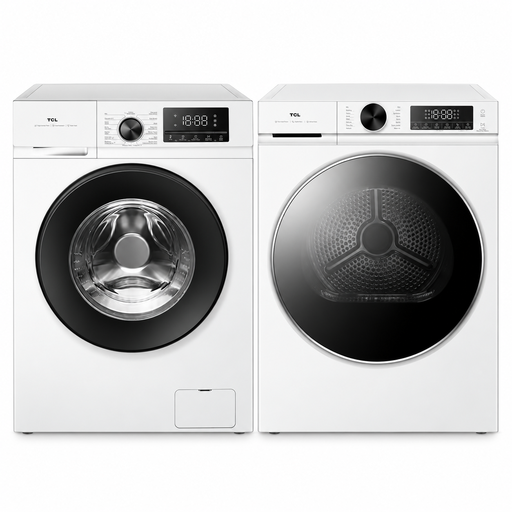
This selection includes washer-dryers and one set with a separate washing machine and heat-pump tumble dryer. A two-appliance set is only suitable if you have enough space and the right connections.
 No image available
A two-appliance set for washing and drying separately, if you have the space and suitable connections.
The product name lists 8 kg for each appliance, 1400 rpm and a steam function. Only tumble-dry cushion covers if their care label allows it.
 No image available
A washer-dryer for anyone who wants to wash cushion covers and use the drying function only when the care label allows it.
The product name lists a 9 kg washing capacity, a 5 kg drying capacity and 1400 rpm. If the wash load exceeds the drying limit, you may need to remove some items.
 No image available
A combined appliance for anyone who wants to wash in one place and tumble-dry fabrics, if their care label allows it.
The product name lists 8 kg for washing, 6 kg for drying and 1400 rpm. The drying capacity is lower than the washing capacity, so check the load before the drying cycle.
 No image available
A washer-dryer to consider if you have space for just one appliance and want to wash covers only, following their care labels.
The product name lists an 8 kg washing capacity and a 5 kg drying capacity. You may need to remove some items from a larger wash load; only tumble-dry covers if their care label allows it.
 No image available
A washer-dryer for anyone who wants to wash cushion covers and use the full drying cycle only for fabrics whose care labels allow it.
The product name lists 9 kg for washing and 6 kg for drying. You may need to remove some items from a larger wash load; also check the limit for the programme you choose.
Not automatically. Check the cover’s care label separately for washing and drying: some covers must not be tumble-dried, while others can only be tumble-dried under certain conditions, such as at a low temperature.
Follow the instructions for your chosen model. The Consumentenbond recommends, among other things, placing the appliance on a flat, sturdy surface, removing the transit bolts, checking the water supply and drainage, levelling the machine and using an earthed socket.
Compare the EU label figures for the same cycle, including energy consumption per 100 cycles and water consumption per cycle. A cost estimate in euros will also depend on your own tariffs and how often you use the machine.
Washer-dryers are covered by EU energy labelling rules, which include information about consumption. ACM ConsuWijzer also explains that your statutory guarantee from the seller is separate from a commercial manufacturer’s guarantee; there is no single fixed statutory guarantee period for every washer-dryer.
For online sales, the Netherlands Authority for Consumers and Markets says you generally have a statutory cooling-off period of up to 14 days after delivery. Check which exceptions apply and read the seller’s information.