
Careful cushion-cover washer
You want to wash removable covers without choosing a drying programme that is unsuitable for their care labels. Bosch Netherlands advises checking the washing and drying symbols separately.


A washer-dryer is a practical choice if you only have space for one appliance but need to tumble-dry clothes. First, check that the care labels on your cushion covers allow both washing and tumble drying. Then compare the washing and drying capacities, as well as the consumption for a full cycle. If the covers are not suitable for tumble drying, the drying function offers no benefit for that load.
You want to wash removable covers without choosing a drying programme that is unsuitable for their care labels. Bosch Netherlands advises checking the washing and drying symbols separately.
You’re looking for one appliance that can wash and, if needed, dry your laundry, but you’ll first need to check that it will fit and can be connected to the available utilities. The Dutch Consumers’ Association points out that a washer-dryer takes up less space than a separate washing machine and tumble dryer.
You plan laundry with your housemates and want to know how much washing can fit into one complete wash-and-dry cycle. The Dutch Consumers’ Association discusses both the capacity and the duration of combined programmes.
A good fit if: you want to tumble-dry clothes and only have room for one appliance at home.
Bear in mind: the drying capacity is lower than the washing capacity. The Dutch Consumers’ Association also notes that combined programmes can take a long time.
A good fit if: the covers are not suitable for tumble drying or you have somewhere suitable to hang them.
Bear in mind: you’ll need space to dry them, and the covers won’t be ready to use straight after washing.
A good fit if: you have room for two appliances and your housemates regularly tumble-dry laundry that the care labels say is suitable for it.
Bear in mind: two appliances take up more space. Milieu Centraal recommends separate appliances over a washer-dryer because of energy consumption. Also compare the specifications of the models you’re considering.
| Point to consider | What should you look for? | Who is this important for? |
|---|---|---|
| Care of covers | Check the washing and drying symbols separately; only choose a programme that suits the care label. | If I want to care for my covers according to their labels, I don’t want to assume that being machine washable also means they can be tumble-dried. Consumers who prioritise care make up around 33% of consumers in this choice context. |
| Space and installation | Measure the space and access route; check the model’s dimensions, connections and installation instructions. | With limited space, I want to know whether one appliance will fit where it needs to go and can be connected to the available utilities. For consumers who prioritise space, this applies to around 27% of consumers in this choice context. |
| Capacity and planning | Compare the washing and drying capacities in kilograms and check how long the full cycle takes. | If I share the machine with housemates, I want to estimate how much laundry can go through the cycle in one go and how long the machine will be in use. Consumers who prioritise capacity and waiting time make up around 20% of consumers in this choice context. |
| Energy and water use when drying | Compare the same cycle on the EU energy label and check both energy and water consumption. | If I plan to tumble-dry clothes regularly, I want to take the consumption of the full wash-and-dry cycle into account, not just washing. For consumers who prioritise running costs, this applies to around 20% of consumers in this choice context. |
Washing and drying have separate instructions on the care label. A permitted washing programme does not automatically mean that tumble drying is suitable.
Check the washing and drying symbols on each cover before choosing a complete cycle. Bosch Netherlands explains what these symbols mean.
With a washer-dryer, the drying capacity may be lower than the washing capacity. This means a full wash load might not fit into the drying cycle all at once.
Compare both capacities and plan a complete cycle based on the drying capacity.
If the load is larger than the drying capacity, you may need an extra drying cycle or have to wait longer.
The EU energy label provides information about different cycles. The figure for washing alone does not show the consumption for a full wash-and-dry cycle.
Compare the figures for the same cycle on the EU energy label. Milieu Centraal points out that a washer-dryer uses more energy when drying than separate washing and drying appliances.
Using the full cycle may mean higher energy and water consumption; this depends on the model and how you use it.
Even a single combined appliance needs to fit and be suitable for connection. A tight space or missing connection could make installation difficult.
Measure the space and access route, and check the installation instructions and available connections. Find out in advance what is included with delivery and installation.
According to Bosch Netherlands, the Series 4 WNA13400NL is a model with an 8 kg washing capacity and a 5 kg drying capacity.
According to LG, the GD3R509S0, available in the Netherlands, has a 9 kg washing capacity and a 6 kg drying capacity.
According to Samsung, the WD90HG6U94BEU3, available in the Netherlands, has a 9 kg washing capacity and a 6 kg drying capacity.
According to AEG, the LWR73842, available in the Netherlands, has an 8 kg washing capacity and a 5 kg capacity for a full wash-and-dry cycle.
This selection includes washer-dryers and one set with a separate washing machine and heat pump tumble dryer. Always check the care label and the chosen model’s programme instructions before washing cushion covers.
 No image available
The stated capacity is 9 kg for washing and 5 kg for drying; the drying capacity determines how much you can wash and dry in one complete cycle.
Check that the washing and drying programmes are suitable for the cover’s care label.
 No image available
With a washing capacity of 9 kg and a drying capacity of 5 kg, a full wash load may exceed the smaller drying capacity.
Before use, check that the programmes match the washing and drying symbols on the cover.
 No image available
This model lists an 8 kg washing capacity and a 6 kg drying capacity, so the drying load may need to be smaller than the wash load.
Check the model instructions and the cover’s care label before choosing a washing or drying programme.
 No image available
The stated capacity is 8 kg for washing and 5 kg for drying; bear this drying capacity in mind for a complete cycle.
Check the instruction manual to see which programmes are suitable for the cover’s washing care label.
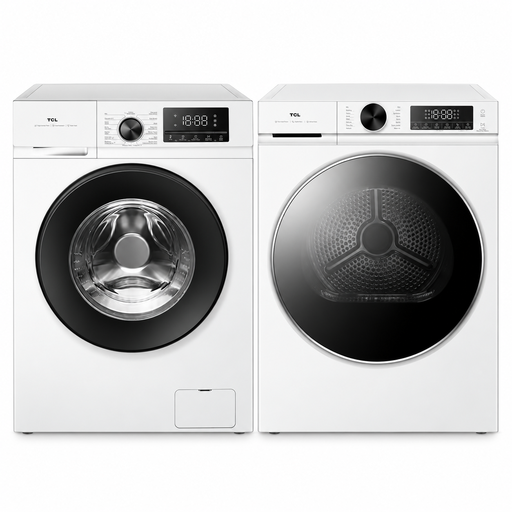 No image available
This set includes two separate appliances and lists a capacity of 8 kg + 8 kg; bear in mind the space required for both appliances.
Washing and drying separately may suit a household that wants to use both appliances at the same time; check whether the covers’ care labels allow tumble drying.
Not necessarily. Check the washing and drying symbols separately: a crossed-out tumble-drying symbol means the cover must not go in the tumble dryer. Choose a washing programme that follows the care label.
Follow the model’s instructions and check that the machine is stable and level, and connected to the correct water, drainage and electricity supplies. Remove the transit bolts before use.
Look at the figures for a full wash-and-dry cycle as well as those for washing alone. The European Commission explains that the EU energy label includes information such as energy consumption per 100 cycles; compare the same cycle across different models.
Under the statutory guarantee, the seller must provide a solution. According to the Dutch government, a manufacturer’s or extended guarantee does not replace your statutory rights; check what additional cover an extra protection plan offers.
In the Netherlands, the old-for-new scheme applies to private purchases of a new, similar appliance. The Dutch government states that the shop must not charge for taking it away; this also applies to online purchases.