
Holiday-let owners with delicate curtains
If you want to clean washable curtains without going against a tumble-drying ban or temperature limit, start by checking the care instructions for the fabrics in your property.


Start by checking the washing and drying symbols on the label of your own curtains: being machine washable does not automatically mean they can go in a tumble dryer. If tumble drying is permitted, compare the drying capacity and programme duration with the actual load and the time between guest changeovers. If tumble drying is not permitted, you can wash the curtains and hang them up to dry. Two separate appliances are mainly worth considering if you have the space and need to process several loads that are suitable for tumble drying.
If you want to clean washable curtains without going against a tumble-drying ban or temperature limit, start by checking the care instructions for the fabrics in your property.
If you need to plan laundry around guests arriving and leaving, it helps to choose a drying capacity and programme duration that suit the actual curtain load.
If you only have room for one appliance, a washer-dryer may be worth considering. Bear in mind its smaller drying load and the time needed to dry your laundry.
A good fit when: your curtain label permits tumble drying and the load is within the drying capacity.
The trade-off: drying capacity may be lower than washing capacity, and a full cycle can take a long time.
A good fit when: the curtains can go in the washing machine but not the tumble dryer, or when they can be left to air-dry after washing.
The trade-off: you’ll need to allow for the drying space and time available.
A good fit when: you have room for two appliances and want to process several loads between guest changeovers that are labelled as suitable for tumble drying.
The trade-off: two appliances need more space, and a separate tumble dryer is still not suitable for curtains labelled as not suitable for tumble drying.
| What to consider | What to look for | Who should pay particular attention? |
|---|---|---|
| Fabric care | Check the washing and drying symbols on each curtain and follow the permitted temperature and care instructions. | Want to wash the curtains in your property without going against their care instructions? Around 36% of consumers prioritise preserving their fabrics. |
| Drying load and time | Compare the drying capacity with the actual load, and check how long the full programme takes for that load size. | If the curtains need to be ready between guest changeovers, both the drying capacity and cycle time matter. Around 29% of consumers prioritise changeover time. |
| Space for installation | Measure the space, access route and room needed for connections, then compare these with the dimensions of the exact model. | If you only have room for one appliance, the combined washing and drying functions need to fit in that space. Around 21% of consumers prioritise saving space. |
| Running costs | On the EU energy label, compare the figures for washing alone with those for a full wash-and-dry cycle. | If you expect to tumble-dry suitable loads often, also consider the ongoing energy and water consumption. Around 14% of consumers prioritise running costs. |
A washer-dryer can save you from having to transfer laundry between appliances, but according to Consumentenbond, the amount you wash also needs to match what you want to dry in one go. The European Commission’s EU energy label gives separate figures for things such as energy consumption per 100 cycles and water consumption per cycle, so make sure you compare like with like.
A curtain may be suitable for machine washing but not for tumble drying. For example, the IKEA SILVERLÖNN curtain’s care instructions say to wash it at a maximum of 30 °C and not to tumble-dry it. These instructions apply to that product, not to all curtains.
Check both the washing and drying symbols on each curtain before making tumble-drying capability a reason to buy.
A washer-dryer may have a lower drying capacity than washing capacity. So a load you can wash in one go may not fit into a single drying cycle.
Compare the weight of your planned curtain load with both the washing and drying limits of the exact model.
If the load exceeds the drying capacity, you may need extra drying time or an additional drying cycle.
Programme duration depends on the cycle and load size. On the Hisense WD3S9043BW3, for example, the 60-minute programme is for loads of up to 1 kg; the stated Eco 40-60 wash-and-dry cycle takes 7 hours and 59 minutes for a load of up to 6 kg.
Before factoring a programme into your changeover schedule, check how long it takes for the load you actually want to wash and dry.
The Bosch WNA13400NL is a washer-dryer with a separate washing function.
The Beko BM5DFT4841A is a freestanding option with separate washing and drying capacities.
According to Hisense, the WD3S9043BW3 has a washing capacity of 9 kg and a drying capacity of 6 kg.
According to AEG, the AEG LWR9506BN4 combines a heat pump with a washing capacity of 10 kg and a drying capacity of 6 kg.
According to LG, the LG HPWD116A is a washer-dryer with a washing capacity of 11 kg and a drying capacity of 6 kg.
This selection features washer-dryers for curtains that are labelled as suitable for machine washing. Only use the drying function if the curtain label permits tumble drying and the load is within the model’s drying capacity.
 No image available
This washer-dryer may be suitable if your curtain label permits machine washing; the drying load is limited to a maximum of 5 kg.
The product name states 1400 rpm.
 No image available
This washer-dryer combines washing and drying in the space for one appliance, provided the curtain label allows both and the load is within the drying capacity.
 No image available
This washer-dryer may be an option if you’re looking for one appliance and the curtain care label permits machine drying.
The product name states a width of 60 cm.
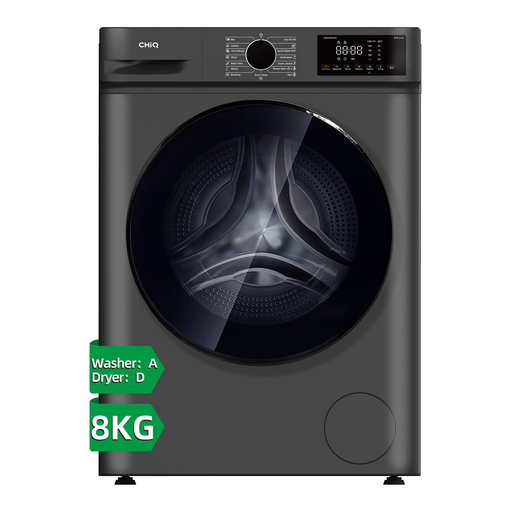 No image available
This washer-dryer offers a washing function for curtains labelled as suitable for machine washing. Check separately whether the label also permits tumble drying.
The product name states a washing capacity of 8 kg.
 No image available
This washer-dryer may be suitable if the curtain label permits tumble drying and the load stays within its 6 kg drying capacity.
The stated Eco 40-60 wash-and-dry cycle takes 7 hours and 59 minutes for a maximum load of 6 kg; the 60-minute programme is for loads of up to 1 kg.
No. Check the washing and drying symbols on the label of your own curtains. For example, the IKEA SILVERLÖNN curtain’s care instructions say to wash it at a maximum of 30 °C and not to tumble-dry it. This is specific to that product, not a rule for all curtains.
Not without checking the load requirements. Look at the duration of the relevant cycle for the weight you actually want to wash and dry. For example, the 60-minute programme on the Hisense WD3S9043BW3 is for loads of up to 1 kg.
Compare the washing-cycle figures with those for the full wash-and-dry cycle on the EU energy label. Only calculate consumption using a suitable number of cycles and your own energy and water tariffs.
Measure the installation space and access route, then compare them with the dimensions of the exact model. Also follow that model’s installation and maintenance instructions; general guidance is no substitute for them.
When a consumer makes a purchase, they are entitled to a product that meets the required standards; the Netherlands does not have a fixed statutory guarantee period. According to ACM ConsuWijzer, consumer protection does not automatically apply if you use the agreement mainly or exclusively for business purposes. So consider who is making the purchase and how the machine will be used, and check the relevant terms of sale and guarantee.