Who is this guide for?

Washing stained tablecloths

You want to tackle food or drink stains after a weekend away without choosing a temperature or drying method that conflicts with the care label. Bosch recommends treating stains appropriately; a machine setting doesn’t replace that judgement.

Washing several tablecloths

You want to wash more than one tablecloth, so you’re comparing the washing capacity with the lower capacity for a complete wash-and-dry cycle. AEG and Bosch list separate maximum loads for washing and for continuous washing and drying.

Washing when space is limited

You’re considering an all-in-one machine because two appliances won’t fit comfortably. Measure the available space and check the model’s full dimensions and installation requirements.

What should you look for when choosing?

One washer-dryer

A good fit if: you want to use one appliance or have little room for separate machines.

Bear in mind: drying capacity may be lower than washing capacity; Milieu Centraal says separate appliances use less energy than a washer-dryer.

Separate washing and drying

A good fit if: you have room for separate appliances and regularly use an electric dryer, or prefer to dry your tablecloth on the line.

Bear in mind: two appliances need more space; line drying takes time and requires a suitable spot.

What to consider What to look for Who is this important for?
Stains and fabric care Check whether the model has a cotton programme or a relevant stain option. Follow the care label and treat stains appropriately for their type. After a weekend away, I want to tackle stains without treating the cotton incorrectly; around 36% of consumers prioritise treating stains appropriately.
Full drying load Compare the weight of your load with both the washing capacity and the capacity for a complete wash-and-dry cycle. If I want to dry the whole load in one go, the maximum drying capacity needs to be sufficient; around 29% of consumers prioritise the capacity for a complete cycle.
Space for installation Measure the available space and check the model’s full dimensions and installation instructions. If two appliances won’t fit, I want to know whether one machine will fit in the space available; around 21% of consumers prioritise installation space.
Energy use with frequent use Compare energy-label information for the same type of use, and look at washing and the complete wash-and-dry cycle separately. If I regularly wash and use an electric dryer, I want to compare energy use for the whole cycle; around 14% of consumers prioritise energy use.

Common purchasing mistakes

  • Mistaking washing capacity for drying capacity

    With a washer-dryer, the maximum load for washing may be higher than the maximum for a complete wash-and-dry cycle. That means your full wash load won’t always fit in the same drying cycle.

    Compare both capacities with the load you want to wash, and check whether the tablecloth is suitable for tumble drying.

    A load that exceeds the drying maximum may need extra drying cycles.

  • Comparing only the washing energy rating

    Energy-label information for the wash cycle alone doesn’t tell you how much energy the complete wash-and-dry cycle uses. The European Commission provides separate information for washing and the full cycle.

    Compare models on the same cycle basis, and consider line drying or separate appliances as part of your decision.

  • Expecting a stain option to remove every stain

    Bosch lists AntiStain as a feature of the WNG24406NL, but the right treatment also depends on the stain and the care label.

    Check the tablecloth’s care instructions and treat stains appropriately; don’t assume a machine feature guarantees a clean result.

Brands compared

AEG

The AEG LWR76144 has a washing capacity of 11 kg and a maximum capacity of 7 kg for a complete wash-and-dry cycle.

  • AEG lists SpecialCare Wash-to-Dry and a condenser drying system as features of this model.
  • The full wash load won’t automatically fit within the lower drying capacity; the specifications don’t indicate how the machine will perform with every tablecloth.

Bosch

The Bosch WNG24406NL has a capacity of 9 kg for washing only and a maximum of 6 kg for a complete wash-and-dry cycle.

  • Bosch lists AntiStain, Auto Dry and Iron Assist as features of this model.
  • These features don’t guarantee that every stain will disappear or that every tablecloth will come out crease-free; check the care instructions and the care label.

Beko

The Beko BM5DFT4841A has a maximum washing capacity of 8 kg and a drying capacity of 5 kg.

  • Beko lists this model as 60 cm wide and 57 cm deep.
  • The stated dimensions alone don’t confirm that the appliance will fit in your space; check the installation requirements too.

LG

The LG F4DR7596SYH has a washing capacity of 9 kg, a drying capacity of 6 kg and a cotton programme.

  • LG lists automatic dosing and steam as features of this model.
  • LG also notes that it doesn’t have a Crease Care option. The stated D/A energy ratings refer to washing and washing plus drying respectively.

Miele

The Miele WTI370 WPM PWash has a washing capacity of 8 kg and a drying capacity of 5 kg.

  • Miele lists QuickPower and SteamCare as features of this model.
  • Miele’s claims about shorter programmes or less ironing don’t guarantee the same results for a particular cotton tablecloth.

Joybuy products

Joybuy washer-dryers to compare when choosing a model.

Hisense WD3S9043BW3 washer-dryer, 9 kg washing capacity and 6 kg drying capacity

Hisense WD3S9043BW3, 9 kg/6 kg

An option if you’re looking for one appliance and need a cotton programme; check that the stated capacity suits your load.

The product information lists a cotton programme, a washing capacity of 9 kg and a drying capacity of 6 kg.

View at Joybuy
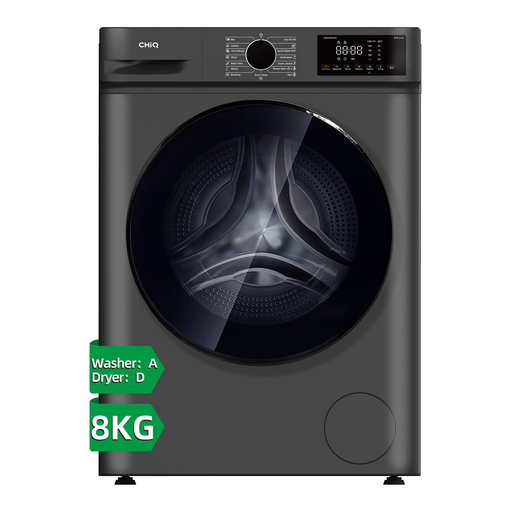
CHiQ JW85882HG washer-dryer, dark grey, 8 kg washing capacity and 5 kg drying capacity

CHiQ JW85882HG, Dark Grey, 8 kg/5 kg

Compare this model with your usual load if you’re looking for one appliance and its lower drying capacity may be sufficient.

The product information lists a cotton programme, a washing capacity of 8 kg and a drying capacity of 5 kg.

View at Joybuy

TCL CP1210WA0 washer-dryer, 10 kg washing capacity and 6 kg drying capacity

TCL CP1210WA0, 10 kg/6 kg

An option if you want to compare a larger wash load with the amount the machine can dry in a complete cycle.

The product title lists a washing capacity of 10 kg and a drying capacity of 6 kg. The product information mentions Steam Wash.

View at Joybuy

Samsung WD90DB7B85GWU3 washer-dryer, 9 kg washing capacity and 6 kg drying capacity

Samsung WD90DB7B85GWU3, 9 kg/6 kg

Compare the capacity with your own laundry and check that the programme you choose is suitable for the tablecloth.

The product title lists a washing capacity of 9 kg and a drying capacity of 6 kg. The product information mentions AI Wash and Auto Dispense.

View at Joybuy

Comfee CFP03ED100W-HR washer-dryer, 10 kg washing capacity and 7 kg drying capacity

Comfee CFP03ED100W-HR, 10 kg/7 kg

Compare this washer-dryer with your usual load if you want to dry more laundry in one complete cycle.

The product title lists a washing capacity of 10 kg and a drying capacity of 7 kg. The product information mentions Auto Dry, Steam Care and a wool programme.

View at Joybuy

Frequently asked questions

Which programme should you use for a stained cotton tablecloth?

First check the care label and treat visible stains appropriately for their type. EU programme rules include eco 40-60 for normally soiled cotton that the care label says can be washed at 40 or 60 °C; not every tablecloth can withstand this treatment.

Can a washer-dryer automatically dry a full wash load?

Only if the load is within the drying capacity and the fabric is suitable for tumble drying according to the care label. For example, the Bosch WNG24406NL has a capacity of 9 kg for washing only and a maximum of 6 kg for a complete wash-and-dry cycle.

What should you check when installing it?

Choose a stable, level spot and follow the model’s installation instructions. Remove the transit bolts before use and connect the water supply and drain as instructed in the manual; also check the guidance on the power socket.

How do you maintain a washer-dryer?

Follow the detergent dosing advice and the manufacturer’s cleaning instructions. Consumentenbond recommends regular cleaning and maintenance as part of using an appliance correctly; use the manual for your chosen model as your guide.

What costs and rights apply when buying online in the Netherlands?

Compare the purchase price and any installation costs, and assess energy use based on your own washing and drying habits. For a typical online purchase, you generally have a statutory 14-day cooling-off period after delivery; if a product is faulty, the seller is legally required to put things right.

Does a new washer-dryer need an EU energy label?

Household washer-dryers covered by EU rules are subject to energy-labelling requirements. Compare the information for the wash cycle separately from that for the complete wash-and-dry cycle, and check the details for the exact model.
