Brands as a guide to capacity
The models listed illustrate differences in washing and drying capacity; mentioning a brand is not a claim about availability or a recommendation for washing socks.
Bosch
According to Bosch, the WNC254A0NL has a washing capacity of 10,5 kg and a drying capacity of 6 kg.
- Bosch lists automatic drying detection.
- A load over 6 kg can’t be dried in one uninterrupted cycle within that drying capacity.
AEG
According to AEG, the LWR7586CUB combines an 8 kg washing capacity with a 5 kg drying capacity.
- AEG lists a wash-and-dry function suitable for cotton; the stated external dimensions are 847 × 597 × 599 mm.
- For a complete uninterrupted cycle, the stated drying capacity remains 5 kg.
LG
According to LG, the F4DR9537S2W has a washing capacity of 13 kg and a drying capacity of 7 kg.
- The larger washing capacity may be useful if you’re processing bigger loads as well as socks.
- Capacity alone isn’t a reason to choose this model for a small load of socks; its drying capacity is 7 kg.
Samsung
According to Samsung, the WD90HG6U94BEU3 combines 9 kg of washing capacity with 6 kg of drying capacity.
- Samsung lists AI Wash as a product feature.
- Samsung’s claims about lower water or detergent consumption apply under the manufacturer’s own test conditions and don’t represent measured results for this holiday let.
Hisense
The Consumentenbond lists the WD3S9043BW3 with a washing capacity of 9 kg and a drying capacity of 6 kg.
- A Joybuy product page lists a duration of 7 hours and 59 minutes for the specific eco 40–60 wash-and-dry cycle.
- That stated duration applies to the specified cycle and doesn’t automatically apply to other programmes or load sizes.
Products for this situation
This selection includes a compact portable washing and drying solution, washer-dryers and a set of separate appliances. Focus on the space available, drying capacity and the time needed for a complete cycle.
 No image available
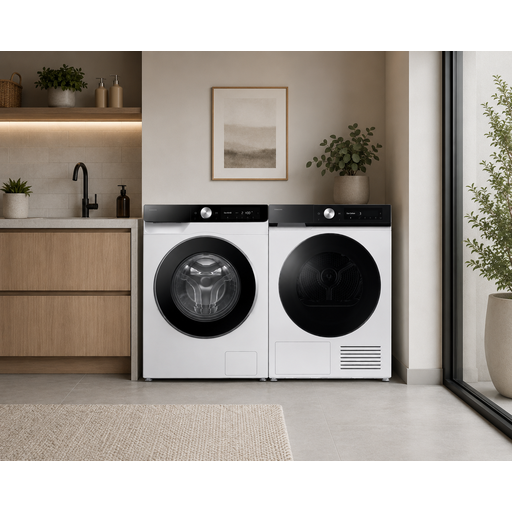
Samsung WW90DG6U25LK + DV90DB7845GEU3, set of 2 appliances
A set of separate appliances for anyone with enough space who wants to schedule washing and drying separately; you’ll need to transfer the laundry between the appliances.
According to the product description, both the washing machine and heat pump tumble dryer have a capacity of 9 kg.
View at Joybuy
 No image available
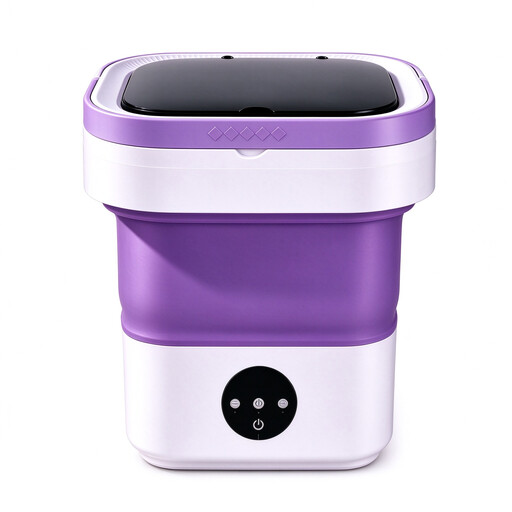
Foldable mini washing machine and dryer, 3-in-1, 12 L
The description lists socks as a suitable small item of laundry; the portable, foldable design may be useful when compact storage is important.
The stated capacity is 12 L. Don’t cover the air outlet during use: it gets hot, and the appliance must be kept away from flammable materials.
View at Joybuy
 No image available
Midea MF205D80WB/W-NL, 8 kg washing and 6 kg drying capacity
A washer-dryer for anyone looking for a single appliance; its stated drying capacity is lower than its washing capacity.
The product name lists 8 kg for washing, 6 kg for drying and 1400 rpm. The description mentions a cotton programme and Wi-Fi controls.
View at Joybuy
 No image available
Bosch WNA13400EU, 8 kg washing and 5 kg drying capacity
A washer-dryer for anyone who wants to use one appliance and can keep the load of socks within the stated drying capacity.
The product name lists 8 kg for washing and 5 kg for drying. The description gives dimensions of 84,8 × 59,8 × 59 cm and mentions AutoDry.
View at Joybuy
 No image available
Samsung WD90DB7B85GWU3, 9 kg washing and 6 kg drying capacity
A freestanding washer-dryer for anyone who wants to combine washing and drying in one appliance; bear in mind its lower drying capacity.
The product name lists 9 kg for washing and 6 kg for drying, along with AI Control, Ecobubble and a white finish.
View at Joybuy
Frequently asked questions
Can you always wash all cotton socks at 60 °C?
No, don’t treat this as a general rule. Check the socks’ care labels: Milieu Centraal recommends lower temperatures for normally soiled laundry and says 60 °C may be sensible in specific hygiene situations. The EU eco 40–60 programme is intended for suitable cotton items; it doesn’t mean that every garment is washed at exactly 60 °C.
What should you consider when installing an appliance in a holiday let?
Measure the space and follow the instructions for the exact model. The Consumentenbond recommends, among other things, a flat, solid floor, removing the transit bolts, connecting the water supply and drainage correctly, and using an earthed socket.
How do you maintain an appliance that often runs small loads?
Follow the model’s maintenance instructions and use an amount of detergent suited to the load and how soiled it is. Milieu Centraal recommends running a washing machine at 60 °C periodically to remove soap and dirt residue; only wash items that can withstand that temperature.
Is the legal guarantee always two years, including for appliances bought for a rental property?
No. According to the Dutch government, the Netherlands has no fixed statutory guarantee period for consumer products; if a consumer product is faulty, the retailer is the point of contact. This consumer guidance doesn’t determine which rights apply when an appliance is bought for business use in a holiday let, so check the relevant contract and warranty terms.
Does an old appliance have to be taken away free of charge?
The Dutch government describes a free old-for-new scheme for comparable appliances owned by private individuals, including for online purchases. The scheme doesn’t apply to appliances owned by businesses, so don’t assume that removal will be free when buying for a business let.


