What should you look for when washing cotton sheets in student accommodation?
Washer-dryer
A good fit if: you have room for one appliance and want to wash and dry a suitable load without transferring it.
Bear in mind: the drying capacity may be lower than the washing capacity, and the appliance will be occupied for the whole cycle. The Consumers' Association explains this trade-off between capacity and cycle time.
Separate washing machine and heat pump tumble dryer
A good fit if: you have room for two appliances and want more flexibility when planning your washing and drying.
Bear in mind: you’ll need space for both appliances. Milieu Centraal and the Consumers' Association explain that a heat pump tumble dryer uses less electricity than a standard washer-dryer.
Washing machine and air-drying
A good fit if: you have a suitable space to dry your sheets and don’t need to tumble-dry them.
Bear in mind: you’ll need room and time for air-drying. Milieu Centraal describes air-drying as an alternative to electric drying.
When comparing washer-dryers for cotton sheets, first check the capacity for a complete wash-and-dry cycle. Then consider how long the shared machine will be in use, its consumption and the space available for installation.
| What to consider |
What should you check? |
Who is this important for? |
| Washing and drying sheets in one go |
Compare the weight of your usual dry load with both the cotton washing capacity and the capacity for a complete wash-and-dry cycle. Also check the programme instructions. |
I want to wash my sheets and then dry them without taking them out, so the drying limit is the deciding factor for me; around 33% of consumers mainly look for a suitable capacity for their sheets. |
| Availability of the shared machine |
Check the duration of the full cycle for the relevant load and compare it with washing and drying separately. |
If several housemates need the laundry space, I want to know how long the machine will be in use; around 27% of consumers mainly consider the time taken. |
| Consumption when drying regularly |
Compare energy and water consumption for the same cycle and units. Also consider how often the sheets will actually be tumble-dried. |
I want to weigh up the running costs against air-drying or using a separate tumble dryer; around 20% of consumers mainly consider the cost of regular tumble-drying. |
| Installation space and connection |
Measure the available space and access, check the external dimensions, and follow the installation and maintenance instructions. Connect a high-power appliance directly to a socket, as advised by the Fire Service. |
If there’s only one suitable space, I want to know in advance whether the appliance will fit and can be connected safely; around 20% of consumers mainly consider installation. |
Products at Joybuy
This selection includes washer-dryers for cotton laundry and a separate washing machine with a heat pump tumble dryer. Compare the capacity and space required with your own needs.
 Image unavailable
Haier HWD90-BP14929A-S washer-dryer, 9 kg washing and 5 kg drying capacity
A combination appliance for anyone who wants to wash and dry in one machine, as long as the load fits within the drying capacity.
Capacity: 9 kg washing and 5 kg drying.
View at Joybuy
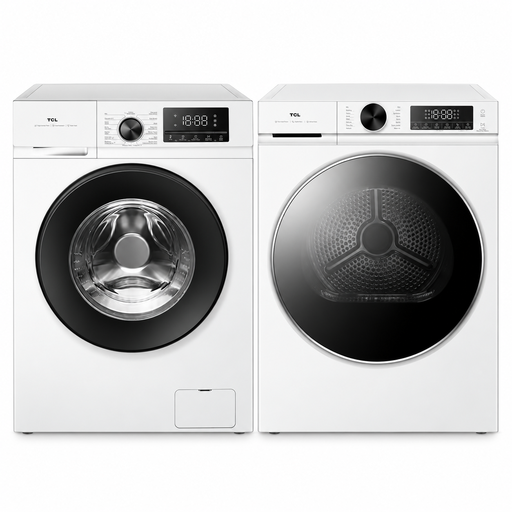 Image unavailable
TCL washing machine and heat pump tumble dryer set, 8 kg + 8 kg
A set of two appliances for anyone who wants to plan washing and drying as separate steps and has room for both.
Capacity according to the product name: 8 kg for the washing machine and 8 kg for the heat pump tumble dryer.
View at Joybuy
 Image unavailable
Midea MF205D80WB/W-NL washer-dryer, 8 kg washing and 6 kg drying capacity
A combination appliance for anyone looking for one machine and able to match their usual load to its drying capacity.
Capacity: 8 kg washing and 6 kg drying.
View at Joybuy
 Image unavailable
Samsung WD90DB7B85GWU3 washer-dryer, 9 kg washing and 6 kg drying capacity
A combination appliance for anyone who wants to wash and dry sheets in one machine, provided the wash load fits within the drying capacity.
Capacity: 9 kg washing and 6 kg drying.
View at Joybuy
 Image unavailable
Hisense WD5I8043BWF washer-dryer, 8 kg washing and 6 kg drying capacity
A combination appliance for anyone who wants one machine for washing and drying and can match the load to the drying capacity.
Capacity: 8 kg washing and 6 kg drying.
View at Joybuy
Frequently asked questions
Can I wash and dry 9 kg of sheets in a machine with a 9 kg washing capacity?
No. The washing capacity isn’t automatically the same as the capacity for a complete wash-and-dry cycle. For the Hisense WD3S9043BW3, the Consumers' Association lists a 9 kg cotton washing capacity and a 6 kg cotton drying capacity.
Which programme should I use for normally soiled cotton sheets?
First check the care label and the appliance manual. The European Commission describes eco 40-60 as a programme for normally soiled cotton that can be washed at 40 °C or 60 °C according to the care label. Follow the instructions for load size and drying too.
What should I bear in mind when connecting and maintaining the appliance?
Follow the manual for your chosen appliance and the manufacturer’s maintenance instructions. The Fire Service advises connecting high-power appliances directly to a socket rather than using a multi-socket adaptor or cable reel. This is safety advice, not a product-specific legal connection requirement.
In the Netherlands, do I still have rights after two years if my machine breaks down too soon?
Possibly. According to ACM ConsuWijzer, there isn’t a fixed statutory guarantee period for every appliance. What you could reasonably expect from the product and whether you used it normally are relevant; if a product is faulty, the seller is responsible for providing an appropriate remedy free of charge.
What does the EU energy label tell me about a washer-dryer?
The label provides information about factors including energy and water consumption, programme duration and noise, and distinguishes between washing and the full wash-and-dry cycle. When comparing models, use the same cycle and units; a class for washing alone doesn’t necessarily tell you the same thing about washing and drying, according to the European Commission.


