
Washing a full weekly load
You wash cotton tablecloths with other suitable items and want to know whether the whole load can be dried in one go too. The Consumers' Association recommends checking washing and drying capacity separately.


When choosing a washer-dryer, focus on the amount of laundry you want to wash and dry in one go: drying capacity is not the same as washing capacity. Also check the fabric care labels, programmes, energy and water use for the complete cycle, and the space available. If you regularly dry large loads and have room for two appliances, compare a separate washing machine and heat pump tumble dryer too.
You wash cotton tablecloths with other suitable items and want to know whether the whole load can be dried in one go too. The Consumers' Association recommends checking washing and drying capacity separately.
You want to wash a tablecloth with other items only if their washing and drying instructions are compatible. The European Commission and Bosch Netherlands explain why the programme and fabric care label matter.
You want to dry your laundry electrically but may only have room for one appliance. In that case, check the figures for the complete cycle and the installation dimensions, as well as weighing up a washer-dryer against two separate appliances.
First, compare the capacity with the load you actually want to wash and dry in one go. Then check that the fabrics can be washed together on a suitable programme, and look at energy and water use for the full cycle.
| What to consider | What should you check? | Who is this important for? |
|---|---|---|
| Washing and drying capacity | Compare the stated washing and drying capacities with the load you want to wash and dry consecutively. | If I want to wash tablecloths with my weekly laundry without unloading part-way through, the load must also fit within the drying capacity. Around 33% of consumers prioritise having enough capacity for a continuous wash-and-dry cycle. |
| Handling different fabrics | Read the care labels and check that the model has suitable cotton, mixed-load and other programmes you need. | When washing tablecloths with other fabrics, I want to avoid assuming that one programme is suitable for everything. Around 27% of consumers prioritise treating mixed loads correctly. |
| Energy and water use for the complete cycle | Compare energy and water figures for the same cycle; if you dry regularly, include other types of appliance in your comparison too. | If I dry laundry often, I want to take the energy and water used for both washing and drying into account, rather than looking at washing alone. Around 20% of consumers focus on energy and water use when drying regularly. |
| Space and cycle time | Measure the installation space and access route, and check how long the complete cycle takes for the stated load. | If I only have room for one appliance, I need to consider how long the drum will be occupied. Around 20% of consumers prioritise available space and a practical weekly schedule. |
The maximum washing load and maximum drying load are different figures. This means a washing load may be too large to dry in one go straight afterwards.
Check the drying capacity of the exact model and make sure your load is suitable for the programme you intend to use.
If the drying load is too large, you may need to run an extra drying cycle or remove some items part-way through.
EU label information distinguishes between washing and the complete wash-and-dry cycle. The Consumers' Association also points out that standard condenser washer-dryers use water during drying.
Compare figures for the complete cycle on a like-for-like basis, and take into account how often you actually use the dryer.
Bosch lists a 60-minute wash-and-dry programme for small loads on the WNA13400NL. This does not tell you how long a full weekly load will take.
Check the permitted load and programme duration for the cycle you want to use for your tablecloths and other laundry.
According to the Dutch government, a retailer cannot charge for taking back an old, similar appliance from a private customer under the like-for-like take-back scheme. This is separate from services such as disconnecting or installing an appliance.
Before placing your order, ask which delivery, disconnection, collection and installation services are included.
The F4DR7596SYH is worth considering if you want to compare separate cotton and mixed-load programmes.
The WNA13400NL is worth comparing if a smaller continuous load works for your schedule.
The LWR9706C8 is a heat pump washer-dryer worth comparing if you dry laundry regularly.
The HWD90-B14939 is worth considering when comparing washer-dryers with a 9 kg washing capacity and a 6 kg drying capacity.
The WD90DG6B85BKU3 is worth comparing if installation dimensions are a factor.
These models are here to help you compare washer-dryers for cotton and mixed weekly loads. Check each model's programmes and its separate washing and drying capacities.
 No image available
An option to consider if you want to wash and dry cotton and other fabrics with compatible care labels in one appliance.
The product information lists cotton, wool and synthetic programmes. The stated capacity is 8 kg for washing and 6 kg for drying; make sure any continuous-cycle load fits within the drying capacity.
 No image available
An option if you want to wash cotton and other fabrics with suitable washing and drying instructions in one appliance.
The product information lists separate programmes for cotton, synthetics and wool. The stated capacity is 9 kg for washing and 6 kg for drying; check the drying load before planning a continuous cycle. The title lists 1400 rpm.
 No image available
A model to compare if you're looking for a larger washing capacity and want to consider a heat pump drying function.
The stated capacity is 10 kg for washing and 6 kg for drying. The product description mentions a heat pump drying function; bear the lower drying capacity in mind when planning a continuous cycle.
 No image available
An option to consider if you need a larger drying capacity than the 5 or 6 kg offered by some models.
The stated capacity is 10 kg for washing and 7 kg for drying. The product description lists a wool programme; follow the relevant fabric care labels for wool and other fabrics.
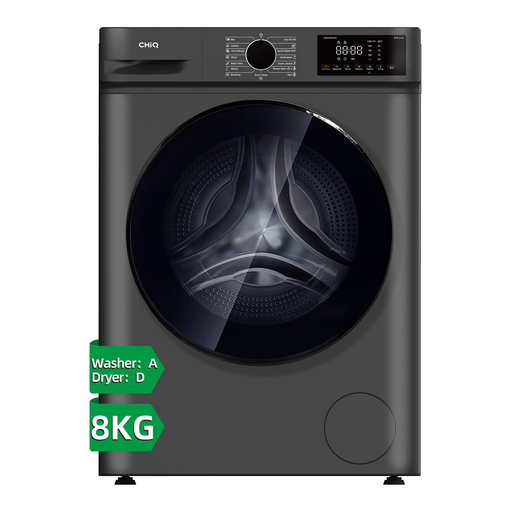 No image available
A model to consider if the load you want to wash and dry in one go fits within the stated capacity.
The product information lists a cotton programme. The stated capacity is 8 kg for washing and 5 kg for drying; the title lists 1400 rpm.
Not simply because the tablecloth is made of cotton. Compare the care labels on all items for washing temperature, programme and tumble drying. The European Commission describes eco 40-60 as suitable for normally soiled cotton that can be washed at 40 °C or 60 °C according to its label; wash items with different care instructions separately.
Measure the installation space and access route, and follow the installation instructions for your chosen model. The Consumers' Association recommends, among other things, a stable, level surface, removing the transit bolts, correctly connecting the water supply and drain, and using an earthed socket. Follow the model-specific instructions for cleaning and maintenance.
No, not automatically. According to the Dutch government, there is no fixed statutory warranty period in the Netherlands; what you can reasonably expect in terms of a product's lifespan depends on factors including the product and the sales information. If a product is faulty, contact the retailer. A manufacturer's warranty does not replace your statutory rights.
Under the Dutch like-for-like take-back scheme, the Dutch government says retailers cannot charge private customers to take back an old, similar appliance. Any charge for disconnection or installation work is not automatically covered by this scheme.
EU label information distinguishes between washing and the complete wash-and-dry cycle. Compare the energy, water and duration figures for the correct cycle on the exact model: energy class A for washing alone does not automatically mean class A for washing and drying combined.