
Napkins ready on time
You want to wash your napkins in time and, if the care label allows, dry them too. The Consumentenbond advises factoring the length of the full cycle into your schedule.


If your napkins need to be ready before the working week, choose a washer-dryer whose full cycle fits your schedule and whose drying capacity suits your load. First, check the care symbols: a continuous programme means you won’t need to transfer the laundry, but it can take a long time, and the washing capacity isn’t necessarily the same as the drying capacity. If you dry laundry often, you could also compare heat pump models or, if you have the space, a separate washing machine and tumble dryer. In either case, check the figures for the full cycle.
You want to wash your napkins in time and, if the care label allows, dry them too. The Consumentenbond advises factoring the length of the full cycle into your schedule.
Your napkins may have specific requirements for temperature, programmes or drying. GINETEX explains how washing symbols show the care permitted; always follow the label on your own textiles.
You want one appliance because there’s no room for two. The dimensions and drying capacity help determine whether it’s practical; the Consumentenbond also highlights the connections you’ll need when installing it.
Start with the care label and when you need the napkins to be ready. Then compare the drying capacity, available space and figures for the full wash-and-dry cycle.
| What to consider | What to look for | Who is this important for? |
|---|---|---|
| Ready on time | Compare the length of the full cycle for a suitable load; also consider whether a delay start would help you plan. | If I need my napkins by a set deadline, I want to know how long washing and drying take together. Around 33% of consumers prioritise the finish time. |
| Fabric care | Check the washing and drying symbols and make sure the appliance has a suitable programme. | If my napkins need a specific temperature or drying method, I want to choose a cycle that suits them. Around 27% of consumers prioritise fabric suitability. |
| Load and installation space | Measure the available space and compare your usual load with the stated drying capacity. | If I want to use one appliance in a limited space, I need to know whether my napkins will fit in one drying cycle. Around 20% of consumers focus mainly on the combination of space and load size. |
| Energy use when drying | Compare the EU energy label figures for washing and drying with those for washing alone. | If I use the drying function often, I want to take the energy use of the full cycle into account. Around 20% of consumers pay most attention to energy use in everyday operation. |
The washing capacity doesn’t tell you how much laundry the appliance can dry in one continuous cycle. The Consumentenbond points out that your washing load needs to match the load you want to dry.
Compare the two capacities separately with the amount of napkins you usually wash.
A short wash doesn’t tell you how long the full wash-and-dry programme takes. The Consumentenbond notes that a combined cotton wash-and-dry cycle can be a long one.
Check the programme duration and the load limits for the model.
Figures for washing alone don’t show the energy use of a full wash-and-dry cycle. The European Commission explains that the EU label also includes information such as energy use and programme duration.
If you want to machine-dry your napkins, compare the label figures for the full cycle.
The Bosch WNG254A7NL is a model to consider if your washing load is larger than your drying load.
The AEG LWR9506BN4 is a heat pump model to compare if you use the drying function regularly.
The LG F4DR9537S2W is a model to consider if you want to handle a larger washing load separately.
The Miele WTI370 WPM PWash is a model to consider if you need a smaller stated washing and drying capacity.
The Samsung AI Ecobubble 5000 series WD9UHG5U34BEEN is a 9/6kg model for comparing features and label figures.
These models combine washing and drying in one appliance. Compare their stated washing and drying capacities with your napkin load, and check that the programme is suitable for the care label.
 No image available
An option to consider if you want to compare programmes for different fabrics and a delay start.
8 kg washing capacity and 6 kg drying capacity; the product information lists programmes for cotton, wool and synthetics.
The drying capacity is lower than the washing capacity, so a full washing load won’t necessarily fit in one drying cycle.
 No image available
A model to consider if you want one appliance for washing and drying and are comparing programmes for different fabrics.
8 kg washing capacity and 5 kg drying capacity; the product information lists automatic drying.
Bear the lower drying capacity in mind when planning a continuous cycle.
 No image available
An option to compare if you’re looking for an appliance with a larger stated washing capacity and want to see how it matches the load you also need to dry.
10 kg washing capacity and 6 kg drying capacity; the product information lists features including a steam function and a wash-and-dry programme.
The drying capacity limits the amount that will fit in one continuous drying cycle.
 No image available
A model to compare if you’re looking for a wool programme and want the stated capacity to suit your load.
10 kg washing capacity and 7 kg drying capacity; the product information lists a wool programme.
Also check the dimensions and the care permitted by your napkins’ label.
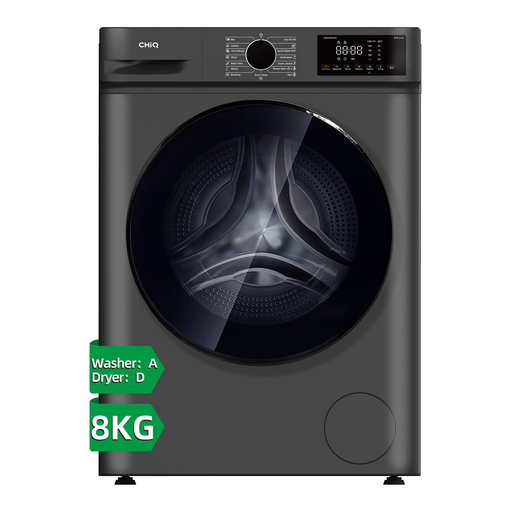 No image available
An option to consider if you want to compare programmes for cotton and delicates.
8 kg washing capacity and 5 kg drying capacity; the product information also lists a steam function and a quick wash programme.
The drying capacity is the relevant limit for a continuous drying cycle.
No. Check the washing and drying symbols first. They show, among other things, the maximum permitted washing temperature and treatment. Only use a continuous drying programme if the label allows it and the load is within the drying capacity.
Check the dimensions and make sure there’s a water supply, a drain and an earthed socket. The Consumentenbond also advises levelling the appliance and following the installation instructions for your chosen model.
No. When you buy as a consumer, you’re entitled to a product that’s fit for purpose, but the Dutch government says there’s no fixed statutory guarantee period in the Netherlands. If there’s a fault, contact the retailer; this explanation applies to consumer purchases.
The EU label for washer-dryers includes information such as energy use per 100 cycles, water use, programme duration and noise. The European Commission describes these label figures; if you’re machine-drying your laundry, compare the information for the full wash-and-dry cycle, not just washing.