A washer-dryer can be a good fit if you have limited space, provided the school clothes that need to be ready on time fit within the drying capacity of the programme you choose. Compare the washing and drying capacities separately, and check the total programme duration: a full wash load cannot automatically be dried in one go. If you have room for two appliances and often dry large loads, compare a separate washing machine and heat pump tumble dryer too, bearing in mind the extra space they take up and the need to transfer the laundry.
Who is a washer-dryer suitable for?
Families with space for just one appliance
If you have limited space for appliances or a drying rack, a washer-dryer lets you wash and dry your clothes in the same spot. Compare the drying capacity in particular, not just the maximum wash load. The Consumers' Association discusses this trade-off when choosing a washer-dryer.
Families with a clothing deadline
If school or sports clothes are needed again the next day, check whether the load you need to dry is within the drying capacity and look at the total programme duration. The Consumers' Association explains that both how dry the laundry is and the length of the combined programme need consideration.
Households that use a tumble dryer often
If you regularly use a tumble dryer despite limited space, factor in the energy and water used by the full wash-and-dry programme. Milieu Centraal discusses alternatives to a tumble dryer, while the European Commission explains what energy-use information appears on the EU energy label.
What should you look for when buying?
Start with the amount of school clothing that needs to be dry by a particular time. Then check whether the appliance will fit, how long a full cycle takes and how much energy and water it uses if you dry clothes frequently.
| What to consider |
What should you check? |
Who is this important for? |
| Will the appliance fit? |
Measure the space and delivery route, and check the dimensions of the exact model. |
If I want to wash and dry in one place, the machine needs to fit in my home. Space is the top priority for around 36% of consumers. |
| Will the laundry be dry in time? |
Compare the programme duration for the load and fabric type you have in mind with when you need the clothes again. |
If school clothes need to be ready by a set deadline, both the drying load and the total cycle time matter. Time comes first for around 29% of consumers. |
| What are the implications of frequent drying? |
Check the EU energy label for the full wash-and-dry programme, including energy and water consumption, and consider how often you use it. |
If I dry clothes often, I want to factor in the electricity and water used by the full cycle. Running costs are the top priority for around 21% of consumers. |
| Is the programme suitable for the fabric? |
Check the washing and drying symbols, and read the programme instructions and drying capacity for the fabric in question. |
If you dry school clothes made from different fabrics, you’ll want to choose a programme that’s suitable for them. Fabric care is the main priority for around 14% of consumers. |
Common buying mistakes
-
Looking only at the maximum wash load
For the models described here, which have a 9 kg wash capacity and a 6 kg drying capacity, the drying limit is lower than the maximum wash load.
Work out how much school clothing needs to be dried at once, then compare that load with the drying capacity of the programme you choose.
Some of the laundry may need another drying cycle or have to be hung out to dry.
-
Confusing a short wash programme with a short wash-and-dry cycle
The Consumers' Association describes combined cotton programmes as lengthy, so the wash-only time won’t tell you how long the full cycle takes.
Check the total programme duration for the load and fabric type you actually want to wash and dry.
-
Comparing only the washing energy rating
A full wash-and-dry cycle is different from washing alone. The Consumers' Association also notes that water use during drying differs between standard and heat pump washer-dryers.
Compare label figures for the same cycle and consider how often you use a tumble dryer.
-
Ruling out a drying rack or separate appliances too soon
A drying rack may work for clothes you don’t need straight away, but it won’t solve a lack of drying space. For drying clothes indoors, Milieu Centraal recommends extra ventilation. Separate appliances need space and mean you’ll have to transfer the laundry.
Separate clothes with a deadline from laundry that can dry at its own pace, then decide which set-up works best in your home.
Brands to consider
LG
The F4DR3096N3W has a 9 kg wash capacity and a 6 kg drying capacity.
- LG lists AI DD, Steam and a direct-drive motor as features of this model.
- The drying capacity is lower than the wash capacity; claims about fabric protection or quiet operation have not been independently verified.
Bosch
According to Bosch, the Serie 6 WNA14420NL has a 9 kg wash capacity and a 6 kg drying capacity.
- Bosch states that it has a spin speed of 1400 rpm.
- That figure alone doesn’t tell you how quickly school clothes will be dry after a full wash-and-dry cycle.
Samsung
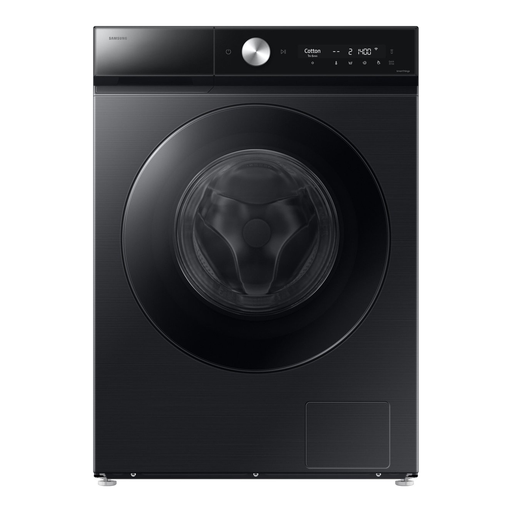
The WD90DG5B15BHEN is an AI Ecobubble 5000-series washer-dryer with a 9 kg wash capacity and a 6 kg drying capacity.
- Samsung lists dimensions of 600 × 850 × 600 mm for this model, which can help you check the fit initially.
- Check the full model code: features of this version don’t necessarily apply to other Samsung series.
AEG
The LWR9506BN4 from the 9000 AbsoluteCare range is a heat pump washer-dryer with a 10 kg wash capacity and a 6 kg drying capacity.
- AEG lists heat pump technology for this model.
- AEG’s claims about fabric care are manufacturer claims, not the result of an independent comparison; the drying capacity is still lower than the wash capacity.
Miele
The Dutch WT1 WTR870WPM PWash&TDos has an 8 kg wash capacity and a 5 kg drying capacity.
- The model name includes TwinDos and SteamCare.
- Its 5 kg drying capacity is lower than the 6 kg capacity of the models mentioned above; features in a product name don’t prove that it will dry clothes better.
Washer-dryers at Joybuy
These models combine washing and drying in one appliance. For each model, compare the separate wash and drying capacities with the load of school clothes you need ready on time.
 No image available
Candy BWR 495BL8-S – 9 kg washing, 5 kg drying
A freestanding washer-dryer for anyone who wants to wash and dry clothes in one place.
The title lists a 9 kg wash capacity and a 5 kg drying capacity. The product description mentions condenser drying and two drying programmes.
View at Joybuy
 No image available
Hisense WD5I8043BWF – 8 kg washing, 6 kg drying
A freestanding washer-dryer to consider if you want to match the drying load for school clothes to the space available.
The product title lists an 8 kg wash capacity and a 6 kg drying capacity. The product description gives a depth of 47 cm.
View at Joybuy
 No image available
Hisense WD3S9043BW3 – 9 kg washing, 6 kg drying
A freestanding washer-dryer to consider if you need a load dry on time; check that the programme duration fits your schedule.
The product title lists a 9 kg wash capacity and a 6 kg drying capacity. The description mentions a 60-minute wash-and-dry programme for up to 1 kg.
View at Joybuy
 No image available
Samsung WD18DB8995BZ/T2 – 18 kg washing, 11 kg drying
A heat pump washer-dryer to consider if you want to use a single appliance and are looking at drying larger loads.
The product title lists an 18 kg wash capacity and an 11 kg drying capacity. The product description mentions heat pump drying.
View at Joybuy
 No image available
Samsung WD11DB8B85GB – 11 kg washing, 6 kg drying
A heat pump washer-dryer to consider if you want to combine washing and drying in one appliance.
The product title lists an 11 kg wash capacity and a 6 kg drying capacity. The product description mentions heat pump drying.
View at Joybuy
Frequently asked questions
Can I wash and dry a full load without stopping?
Only if the load is also within the drying capacity of the programme you choose. For the models described here, with a 9 kg wash capacity and a 6 kg drying capacity, a 9 kg wash load doesn’t mean you can dry 9 kg in one go.
What should I consider when installing and maintaining it?
Follow the installation and maintenance instructions for the exact model, and check the required connection and drainage. The Fire Service recommends connecting high-power appliances directly to a socket where possible, and following the cleaning and maintenance instructions. This is safety advice, not a specific legal requirement to connect every washer-dryer in a particular way.
Which energy information should I compare for washing and drying?
Compare the figures for washing alone and for the full wash-and-dry programme on a like-for-like basis. The European Commission says the EU energy label includes information such as energy use per 100 cycles, water use per cycle and programme duration.
Who should I contact if it develops a fault, and do I need an extended warranty?
In the Netherlands, the seller must provide a solution if there’s a problem with a product, according to the Dutch Government. Before deciding whether an extended warranty is worthwhile, compare its terms with your statutory rights.


