
Housemates with space for one appliance
You want to be able to dry aprons and everyday laundry without making room for a second appliance. The lower drying capacity determines whether you’ll need to remove some laundry from the drum before drying.


A washer-dryer is best suited to a shared house with room for just one appliance, provided the care labels allow the aprons to be machine-dried and the load fits the drying capacity. The Dutch Consumers' Association points out that, on a combined cycle, you can’t wash more than the programme can dry. If the laundry schedule is busy, separate appliances may be more practical if you have the space.
You want to be able to dry aprons and everyday laundry without making room for a second appliance. The lower drying capacity determines whether you’ll need to remove some laundry from the drum before drying.
You need to fit apron laundry around everyone’s personal washes. In that case, the programme duration and the option to use two appliances at once may matter more than avoiding the need to transfer laundry between machines.
You may have aprons made from different fabrics, or with different care labels. You’ll want to choose the right wash and drying settings for each load.
First, compare the aprons’ care requirements with the drying limit and programme duration. Then check whether the cycle fits into your shared laundry schedule.
| Concern | What to look for when buying | Who should give this more thought? |
|---|---|---|
| Drying capacity for a shared load | Compare your usual apron load with the drying limit of the programme you plan to use, and check whether the aprons can be tumble-dried. | I want to wash and dry a load of aprons in one go without transferring them; around 30% of consumers say drying capacity is their main buying concern. |
| Appliance availability | Compare the duration of a suitable wash-and-dry programme with the times when your housemates need the drum. | If housemates want to do their laundry one after another, I want to know how long the only drum will be in use; around 30% of consumers prioritise appliance availability. |
| Washing and drying according to the apron care label | Check the washing and drying symbols on each apron and choose a suitable programme; wash aprons separately if necessary when their care instructions differ. | I want to care for different aprons according to their individual instructions; around 20% of consumers say care requirements are their main buying concern. |
| Ongoing energy and water use | For specific models, compare the figures for washing only with those for a complete wash-and-dry cycle, and consider how often you’ll use the electric dryer. | If you often use an electric dryer, you’ll want to factor in the consumption of the complete cycle; around 20% of consumers say energy use is their main consideration. |
A good fit when: there’s room for just one appliance and you want to wash and dry a suitable load without transferring it.
Bear in mind: the same drum is in use throughout the combined programme, and the drying limit may be lower than the washing limit.
A good fit when: housemates often do their laundry one after another and there’s room for two appliances.
Bear in mind: you’ll need space for both the washing machine and the tumble dryer.
A good fit when: the care label allows line drying and you have a suitable place to hang the aprons.
Bear in mind: the aprons won’t be dry as soon as the wash programme ends.
The washing capacity doesn’t automatically tell you how much laundry can be dried straight after washing. For the models listed, the drying capacity is lower than the washing capacity.
Compare both capacities and check the limit for the programme that suits the apron fabric.
The word ‘washable’ doesn’t tell you which temperature or drying method is suitable for a particular apron.
Check the care labels and choose the right treatment for each load; separate aprons if their care instructions differ.
Washing and a complete wash-and-dry cycle are different uses, with separate consumption figures.
Compare complete cycles on a like-for-like basis and consider how often you’ll actually use the electric dryer.
With one appliance, the drum is in use throughout the combined wash-and-dry programme.
Before choosing between one or two appliances, compare the space available and the number of consecutive washes you expect with the programme durations.
Hisense Netherlands lists a washing capacity of 9 kg and a drying capacity of 6 kg for the WD3S9043BW3.
Beko Netherlands lists a capacity of 8 kg for washing and 5 kg for drying for the BM5DFT4841A, and 9 kg for washing and 6 kg for drying for the BM5DFT4941B.
Bosch Netherlands lists a maximum capacity of 8 kg for washing only and 5 kg for washing and drying for the WNA13400NL.
LG Netherlands lists a washing capacity of 9 kg and a drying capacity of 6 kg for the F4DR3096N3W.
AEG Netherlands lists a washing capacity of 10 kg, a drying capacity of 6 kg and a heat pump for the LWR9706C8.
This selection includes sets with a separate washing machine and tumble dryer, as well as washer-dryers. Compare the space needed, the individual washing and drying capacities, and programme durations with the aprons and your housemates’ laundry schedule.
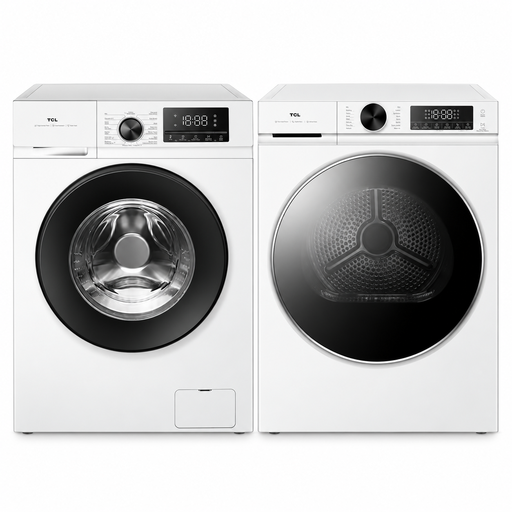 Image unavailable
Separate appliances suit housemates who want to wash one load while another is drying; you’ll need space for both appliances.
The product name lists 8 kg + 8 kg, a spin speed of 1400 rpm and a steam function.
 Image unavailable
This model could be a good fit if you have room for one appliance; keep the combined load within the lower drying capacity.
The product name lists 9 kg for washing, 5 kg for drying and a spin speed of 1400 rpm.
 Image unavailable
A washer-dryer could be a good fit if you have space for one appliance; plan your load around the drying limit and the programme that suits the aprons.
The product name lists 9 kg for washing, 5 kg for drying and a spin speed of 1400 rpm.
 Image unavailable
This model is worth comparing if you prefer one appliance; check whether its drying limit suits your usual apron load.
The product name lists 8 kg for washing, 6 kg for drying, 1400 rpm, Wi-Fi and a steam function.
 Image unavailable
A washer-dryer could suit a home with space for one appliance; for a combined cycle, bear in mind the 5 kg drying capacity.
The product name lists 8 kg for washing and 5 kg for drying.
No. Don’t assume that from the word ‘washable’. Clevercare advises following the washing and drying symbols on the specific apron and choosing the appropriate care accordingly.
Only if the load is within the drying capacity of the programme you choose. For example, Bosch lists a maximum of 8 kg for washing only and 5 kg for washing and drying for the WNA13400NL. That specification applies to this model and isn’t a general limit for other machines.
The Dutch Consumers' Association advises placing the machine on a flat, solid surface, removing the transit bolts, connecting the water inlet and drain, levelling the machine and using an earthed socket. Also follow the installation and maintenance instructions for your chosen model.
No. According to the Dutch government, statutory guarantees don’t have a fixed term; what you can expect in terms of a product’s lifespan depends on factors including the product and normal use. If a product is faulty, the retailer is your point of contact, and an additional warranty doesn’t replace your statutory rights.
Compare the figures for washing only with those for a complete wash-and-dry cycle, as these are different uses. EU rules, including Regulation (EU) 2019/2014, provide for labelling and additional product information for household washer-dryers; they don’t require housemates to use the electric dryer.