A washer-dryer could suit you if you only have space for one appliance, can’t easily hang pillowcases up to dry, and the care label says they can be tumble dried. If you can hang them up, a separate washing machine and airer may be enough. With a washer-dryer, check the available space first, then compare its separate washing and drying capacities.
Which option is right for you?
Living somewhere with room for one appliance
If you want to wash and dry pillowcases but don’t have room for two machines, check that the washer-dryer will fit in the space available and can be brought along the access route. The Dutch Consumers’ Association also highlights the need to check the required connections and clearance around the appliance when planning its installation.
Often without space to air-dry laundry
If it’s difficult to hang laundry up, pay particular attention to the drying capacity: this determines how much washing can go through a full wash-and-dry cycle. The Dutch Consumers’ Association advises matching the amount you wash to the amount you want to dry afterwards.
Usually air-drying, but sometimes using a tumble dryer
If you can usually use an airer, weigh the space-saving benefit of a washer-dryer against how often you’ll actually need its drying function. Milieu Centraal notes that a washer-dryer can use more energy than washing and drying separately.
What should you look for when choosing?
Washer-dryer
Choose this if: you have space for one appliance and it’s difficult to hang laundry up.
Bear in mind: the drying capacity is often lower than the washing capacity. For a cotton programme, the Dutch Consumers’ Association gives an average of almost 7 hours for a combined cycle. This is not a prediction for a particular model or a small load.
Washing machine with an airer
Choose this if: you have a suitable place to hang pillowcases and don’t need to tumble dry them.
Bear in mind: hanging laundry up takes time and space, but you won’t need to run a drying cycle for that load.
Separate washing machine and heat pump tumble dryer
Choose this if: you have the space and suitable connections for two appliances, and regularly tumble dry your laundry.
Bear in mind: you’ll need space for two appliances. According to Milieu Centraal, washing and drying separately uses less energy than a washer-dryer.
| What to consider |
What to check before buying |
Who is this important for? |
| Will the appliance fit? |
Measure the space and access route. Check the connections and allow room for the door and hoses, too. |
If I only have space for one appliance, I want to make sure the machine will fit and can be connected. Around 33% of consumers put available space first. |
| Can one load go straight through? |
Compare the washing and drying capacities of the same model, and check the programme limit and care label. |
If I want to take my pillowcases out after one cycle, I’ll check how much laundry can actually go through the drying stage. Around 27% of consumers prioritise washing and drying in one continuous cycle. |
| What does drying involve? |
Compare the energy-label information for washing and for washing plus drying, and check the programme duration, too. |
If I can usually hang laundry up, I want to know what a drying cycle adds before choosing a washer-dryer. Around 20% of consumers put running costs first. |
| Is the programme suitable for the fabric? |
Check the care label and make sure the selected temperature and drying setting are suitable. |
If I don’t want to treat my pillowcases at too high a temperature or with an unsuitable programme, I’ll check the care label first. Thuisarts recommends washing pillowcases at 60 °C to help tackle dust mites; around 20% of consumers prioritise fabric care. |
Common pitfalls
-
Confusing washing capacity with the capacity for a full wash-and-dry cycle
The stated drying capacity may be lower than the washing capacity. This means a load that fits within the washing weight limit may be too large to dry all at once.
Check both capacity figures for the exact model, and don’t fill it for a continuous cycle based on the washing weight alone.
A load over the drying limit may mean you need to run an extra drying cycle or split the laundry by hand.
-
Looking only at the energy rating for washing
Information for washing doesn’t automatically show how much energy a full wash-and-dry cycle uses. This matters if you use the drying function regularly.
Compare the figures for a complete cycle and consider how often you expect to tumble dry. Milieu Centraal notes that a washer-dryer can use more energy than washing and drying separately.
Some standard washer-dryers may also use water during drying; check the specifications for the particular model.
-
Assuming a washer-dryer will automatically fit in a small space
Dimensions vary from model to model. The access route, connections and space for hoses and the door all affect installation, too.
Before ordering, measure the space and the route to it, and check the installation diagram for the exact model.
Brands to consider
Beko
Beko lists a washing capacity of 8 kg, a drying capacity of 5 kg and a depth of 57 cm for the BM5DFT4841A. These dimensions are worth considering if depth is limited.
- The manufacturer gives both the separate capacities and the depth for this model.
- The drying capacity is lower than the washing capacity, so bear the drying limit in mind for a continuous cycle.
LG
LG lists a washing capacity of 9 kg and a drying capacity of 6 kg for the F4DR3096N3W. This may be worth considering if you wash other items as well as pillowcases.
- The manufacturer lists AI DD and steam for this model.
- The protection claim cited is based on tests with other LG models and cycles; it doesn’t show how this model will treat your pillowcases. The drying capacity is also lower than the washing capacity.
Bosch
Bosch lists a washing capacity of 9 kg, a drying capacity of 6 kg and dimensions of 848 × 598 × 590 mm for the Serie 6 WNG24406NL.
- Bosch lists Auto Dry for this model. Its stated external dimensions can help you check whether it will fit.
- The drying capacity is lower than the washing capacity, so check the load limit for a combined cycle separately.
Hisense
Hisense lists a washing capacity of 9 kg, a drying capacity of 6 kg, a width of 595 mm and a height of 845 mm for the WD3S9043BW3.
- The manufacturer lists automatic programme adjustment and gives the energy ratings as A for washing and D for the combined wash-and-dry function.
- The two energy ratings relate to different uses. Compare both figures, and don’t treat claims about savings or steam as independent tests on pillowcases.
Samsung
Samsung lists a washing capacity of 9 kg, a drying capacity of 6 kg and dimensions of 600 × 850 × 600 mm for the Bespoke AI Wash 7000 WD90DB7B85GWU3.
- The stated dimensions and capacities give you specific details to compare with your space and laundry load.
- Samsung links its energy-saving claim to specific AI Energy Mode programmes and conditions of use, so consider the claim in light of those conditions.
Washer-dryers on Joybuy
These Joybuy products are washer-dryers for anyone who wants to wash and dry with one appliance. Compare the external dimensions and separate washing and drying capacities of each model.
 No image available
Haier HWD90-BP14929A-S washer-dryer, 9/5 kg
This washer-dryer combines washing and drying. For a continuous cycle, the stated drying capacity is the limit.
Washing: 9 kg. Drying: 5 kg. Spin speed: 1400 rpm.
Joybuy
 No image available
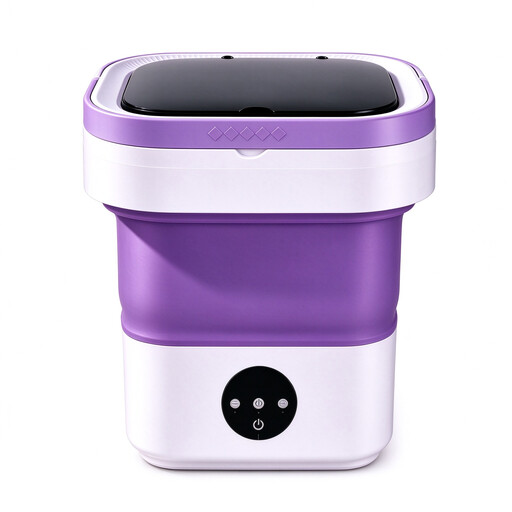
Foldable 3-in-1 mini washing machine with portable dryer
The description presents this appliance as suitable for small loads. Check that its capacity and programmes are right for your pillowcases.
The product name describes a foldable design and a 3-in-1 function.
Joybuy
 No image available
Midea MF205D80WB/W-NL washer-dryer, 8/6 kg
This washer-dryer combines washing and drying in one appliance, but bear the lower drying capacity in mind for a continuous cycle.
Washing: 8 kg. Drying: 6 kg. The product name lists 1400 rpm, Wi-Fi and a steam function.
Joybuy
 No image available
Bosch WNA13400EU washer-dryer, 8/5 kg
The stated depth can help you compare it with your available space. Remember to allow room for the connections and access route, too.
Washing: 8 kg. Drying: 5 kg. Stated depth: 59 cm.
Joybuy
 No image available
Hisense WD5I8043BWF washer-dryer, 8/6 kg
The stated depth of 47 cm is a useful comparison if space is limited, but it doesn’t tell you on its own whether the appliance will fit with the connections in place.
Washing: 8 kg. Drying: 6 kg. Stated depth: 47 cm.
Joybuy
Frequently asked questions
Can a full load of pillowcases go straight through to the drying stage?
Not always. Check the model’s drying capacity and the programme limit separately. For example, the Beko BM5DFT4841A lists a washing capacity of 8 kg and a drying capacity of 5 kg. Check the care label on your pillowcases, too.
Do pillowcases always need to be washed at 60 °C?
No, 60 °C isn’t a general washing rule for every pillowcase. Thuisarts recommends this temperature as a measure against dust mites; first check that the care label on your pillowcases allows it.
What should I check before installation?
Check that the appliance will fit and that you have a suitable water supply, drain, firm and level surface, and earthed socket. Remove the transit bolts before use and follow the instructions for the exact model.
Which energy figures should I compare?
Compare the figures for washing and washing plus drying separately. Household washer-dryers covered by the relevant EU rules must meet energy-labelling requirements; the European Commission explains the information shown on the label. Also check the capacity and programme duration for the cycle you plan to use.


