
Vandaag of morgen in huis

Kwaliteit gegarandeerd

Welkomstaanbiedingen ontgrendelen: GRATIS bezorging | Tot 80% korting | Gratis 30 dagen JoyPlus-proefperiode
Download de app
A wall-mounted extractor hood can complete the look of a kitchen, but its appearance tells you little about how it will perform day to day. There are a few things buyers can easily overlook, particularly when choosing a black extractor hood measuring 60, 80 or 90 cm. A glossy glass front, for example, can quickly show fingerprints, while a high extraction rate on the highest setting doesn’t automatically mean the appliance will perform well on its normal setting.
This buying guide helps homeowners, kitchen renovators and keen home cooks compare specifications fairly. We look at extraction rate, noise, energy use, installation and maintenance.
Manufacturers and retailers often quote the extraction rate on the intensive setting. This is useful when you’re stir-frying or frying food, but you won’t use it all the time. So check the extraction rate on the normal settings too. A model with a high boost rate may offer considerably less on its everyday setting.
Pay attention to the unit as well. Product information usually gives the rate in m³/h. A higher figure indicates greater airflow, but the actual results also depend on the duct, bends, length of the ducting and the hood’s position above the hob.
A quiet extractor hood may be pleasantly unobtrusive on its lowest setting, but noticeably louder at full power. Compare both the minimum and maximum noise levels. A difference between, for example, 39 dB and 70 dB is easy to notice when you’re cooking or chatting at the kitchen table.
Noise levels can also change in recirculation mode because of the extra filters and air resistance. So don’t rely on a marketing description such as ‘quiet’ alone: check the stated dB levels for each setting.
Not every kitchen has a suitable duct leading outside. An extractor hood with recirculation can be a good solution, but a charcoal filter isn’t always included. Several models in this selection are sold with the recirculation kit separately. Also check how often the grease and charcoal filters need to be cleaned or replaced.
Your hob and extractor hood should be a good match. An 60 cm extractor hood is often suitable for a standard hob. For a wider cooking area or a medium to large kitchen, an 80 cm extractor hood or 90 cm extractor hood can provide more coverage. Always measure the available wall space and check the height of the chimney section.
A sloping extractor hood gives you more headroom because its front slopes forwards. This is practical for taller users and kitchens where the hood is installed relatively low above the hob. Follow the minimum distance in the manual and local installation regulations. Some models, for example, specify a minimum distance of 65 cm above gas hobs and 55 cm above electric hobs; always check the requirements for the model you choose.
Several settings are useful for everyday cooking. A household that mainly boils and simmers has different needs from someone who regularly stir-fries, deep-fries or uses large pans. Look for:
A high-capacity extractor hood won’t necessarily be suitable if the duct is too narrow or too long. If in doubt, have it installed in line with the manufacturer’s instructions.
An energy-efficient extractor hood with an A or A+ energy label can help reduce electricity use compared with models with a lower rating. Lighting also contributes to energy use. An extractor hood with LED lighting directs light onto the cooking surface and, according to product specifications, usually uses little power.
An extractor hood with touch controls is easy to wipe clean, but a control panel with lots of functions may take a little getting used to. A dishwasher-safe grease filter makes maintenance easier. A filter saturation indicator is especially useful if you don’t want to keep track of when the filter needs cleaning.
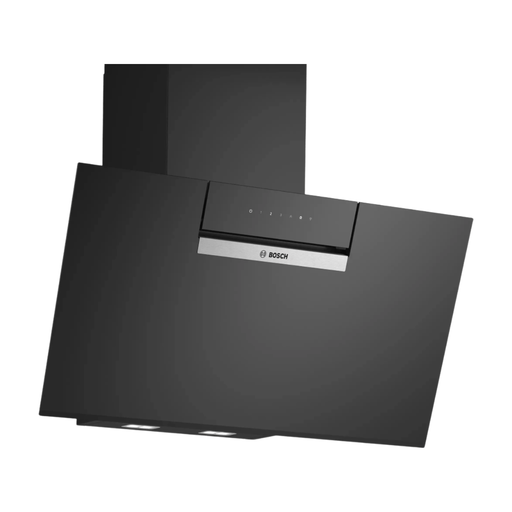
Why it suits this profile: This 80 cm black wall-mounted extractor hood combines a normal extraction rate of 431 m³/h with an intensive setting of 768 m³/h. That gives you flexibility for everyday cooking and occasional intensive use.
The product specifications give both normal and intensive extraction rates, as well as noise levels of 56 dB on normal and 68 dB on intensive. This lets you compare more than just the highest figure in the marketing copy.
A+ energy label, dishwasher-safe aluminium filter, LED lighting and suitable for ducted extraction or recirculation.
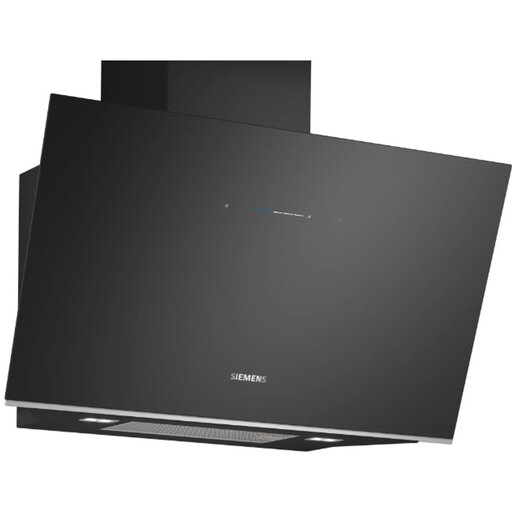
Why it suits this profile: This 90 cm model is designed for users looking to combine a spacious black wall-mounted chimney extractor hood with smart controls and a high stated extraction rate.
The specifications state a maximum extraction rate of 1007 m³/h, an A+ energy label and a maximum noise level of 70 dB. The intensive setting is powerful, but it isn’t completely quiet.
Home Connect controls, LED lighting, dishwasher-safe filters and support for ducted extraction or recirculation.
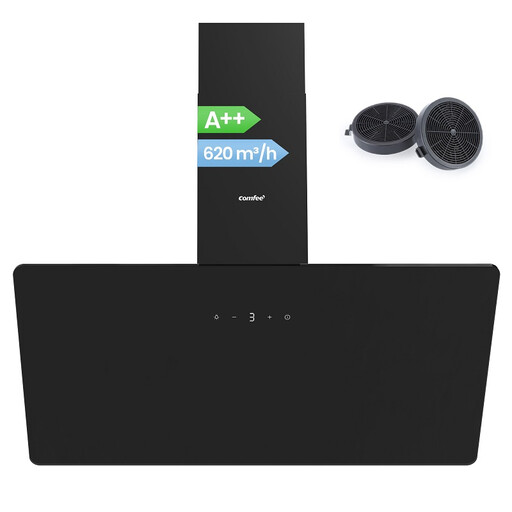
Why it suits this profile: This 90 cm angled extractor hood is a good option for households that cook frequently and want four speed settings without necessarily needing a duct leading outside.
The product description lists both ducted extraction and recirculation, and gives a noise level of 59 dB. Check in advance whether the required filters and fitting materials are included.
Stated extraction rate of 620 m³/h, A++ energy label, four settings and support for two installation methods.
We’ve put together a complete, up-to-date list of products that meet these strict selection criteria and the applicable European safety regulations.
Before buying, check the position of the power socket, the length of the cable supplied and the duct diameter. A 150 mm connection may require different preparation from a 120 mm connection. In recirculation mode, air needs to flow back into the kitchen, and suitable odour filters must be fitted.
Have the electrical connection and installation carried out in line with the manual and applicable local regulations. Don’t use the hood without a grease filter, and clean metal filters regularly. Switch off the power before carrying out maintenance. Naked flames beneath an extractor hood pose an additional risk, so never leave pans unattended.
Ideally, choose a hood that is at least as wide as your hob. A model measuring 80 or 90 cm can provide more coverage over a wide cooking area. Also measure the available wall space and check the installation height in the manual.
Recirculation is practical when there’s no duct leading outside. The air passes through grease and charcoal filters before being blown back into the room. Check that the model supports recirculation and whether you need to buy a charcoal filter separately.
It depends on the setting you choose and the installation method. Compare the dB levels on the lowest, normal and intensive settings. A model that’s quiet at low speed may be considerably louder at maximum capacity.
