
Vandaag of morgen in huis

Kwaliteit gegarandeerd

Welkomstaanbiedingen ontgrendelen: GRATIS bezorging | Tot 80% korting | Gratis 30 dagen JoyPlus-proefperiode
Download de app
A cluttered desk, stacks of mail on the kitchen table, or papers scattered in the hallway. It's a familiar problem in many households and (home) offices. A wall-mounted document holder seems like the perfect, space-saving solution. Yet, an impulse buy often leads to disappointment. Many models look great online but prove to be impractical in reality.
As a Joybuy Product Recommendation Officer, I see where things often go wrong. Before you invest in an organized workspace, it's crucial to understand the common pitfalls.
wall-mounted letter tray that creases your mail defeats its purpose.A bad purchase is not only a waste of money but also a source of ongoing frustration. Fortunately, these problems are easy to avoid by paying attention to a few key points.
To make a durable and functional choice, focus on the following three specifications. These are the factors that distinguish a useful wall organizer from a source of frustration.
The lifespan of your document holder depends on its material. A metal document holder is often a solid choice, but pay attention to the details. Look for models made of sturdy steel with a powder coating. This finish not only protects against rust and scratches but also provides a sleek, professional look that stays beautiful for a long time. Avoid thin sheet metal that you can bend by hand.
Think carefully about what you want to store. Do you need a simple office file holder for a few active projects, or a complete wall-mounted A4 storage system for the whole family?
wall-mounted mail slots, where each family member has their own slot.hanging document holder offers enough room without paper getting stuck.A secure and stable installation is crucial. A good document holder comes with the necessary screws and wall plugs. However, check if they are suitable for your wall type (e.g., drywall, concrete, or wood). If necessary, invest in better wall plugs. Also, look at the design of the mounting points; multiple attachment points along the length of the holder ensure better weight distribution and more stability.
Not all document holders are created equal. To help you find the right match, we've highlighted a few options that suit different user profiles.
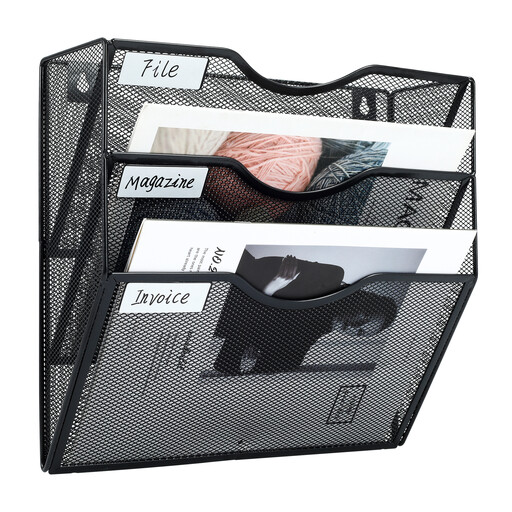
Why This Fits Their Persona: Ideal for a compact home office. With three pockets, you can create a simple yet effective system to separate active documents, mail, and notes without sacrificing precious desk space.
The powder-coated metal construction prevents sagging. The included label plates make it a practical and organized system, unlike awkwardly designed holders.
Compact size (30 cm high) that fits on almost any wall. Includes label plates for immediate organization.
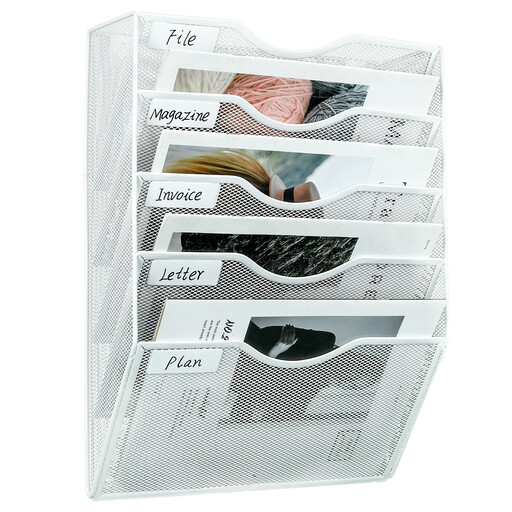
Why This Fits Their Persona: This model functions as a central command center in the hallway or kitchen. With five pockets, there's room for incoming mail, school papers, bills, and important documents for each family member.
The label plates on each of the five pockets prevent the chaos of an impractical design. The sturdy metal construction is built to handle the weight of the daily influx of mail and papers.
Five separate pockets for clear categorization. The white finish fits well in most interiors.
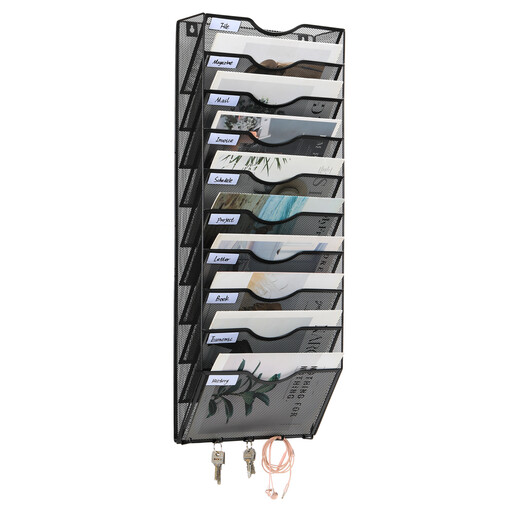
Why This Fits Their Persona: For the professional who manages multiple projects, clients, or a large paper flow. This system with ten pockets and extra hooks transforms an empty wall into a highly efficient organization station.
The high capacity solves the problem of a holder being too small. The robust metal construction is designed for a heavier load, avoiding the pitfall of weak, sagging material.
Extremely high capacity with 10 A4 pockets. Added functionality with 5 hooks at the bottom for keys or other essentials.
We have compiled a complete, up-to-date list of products that meet these strict selection criteria and current regulations.
Always check the wall type first. For a hollow wall (like drywall), you'll need special anchors for a secure hold. Use a spirit level to ensure the holder is straight before drilling the holes. Tighten the screws firmly, but not so tight that you damage the holder. Check its stability by gently pulling on it before you fill it.
This varies by model and is often stated in the product specifications. As a general rule, distribute the weight evenly across the different pockets. Avoid overloading a single pocket with a heavy stack of paper. Exceeding the recommended capacity can lead to sagging or, in the worst case, the holder detaching from the wall.
Most models are designed with the A4 size as a standard. However, the pockets are often spacious enough for more than just loose sheets. Think of it as a wall-mounted magazine rack, for thin folders, notepads, or catalogs. If you want to store thicker items, check the specifications for the depth and width of the pockets to make sure they will fit.
